
Questions
Question 1
A flywheel drives a punching press. The angular speed increases smoothly between punches and decreases rapidly during each punch.
Data: moment of inertia ; immediately before a punch ; immediately after a punch ; time between punches .
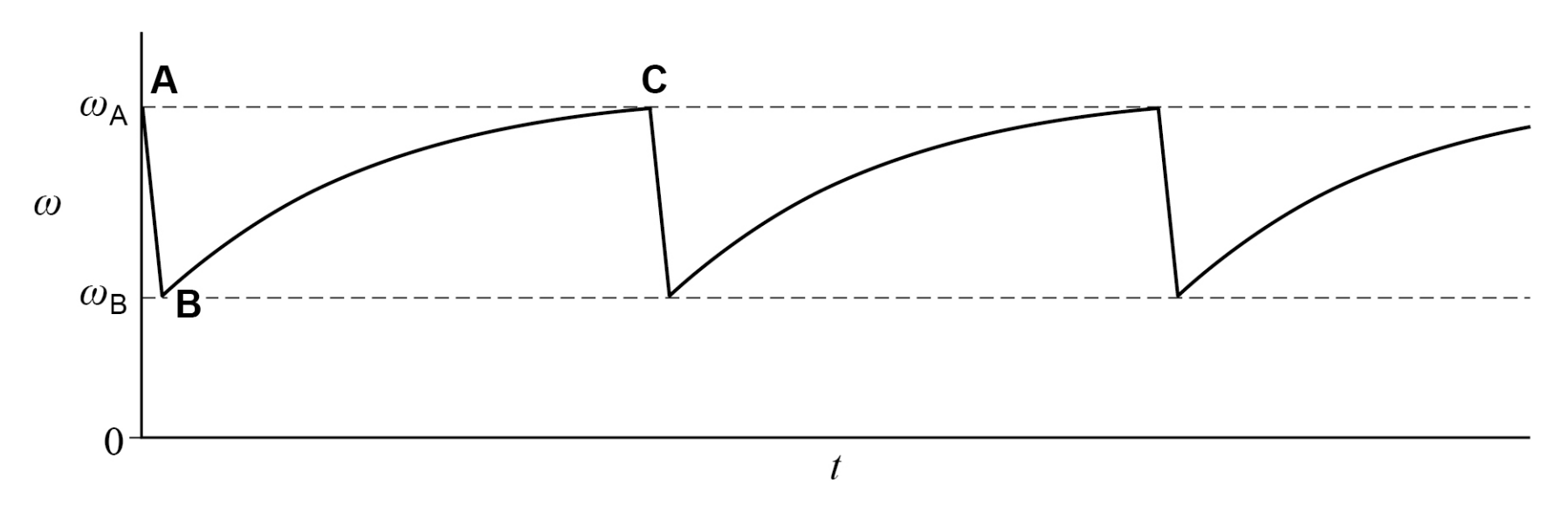
Using the graph, identify the time intervals during which the motor does net positive work on the flywheel.
Calculate the energy transferred from the flywheel to the press during one punch.
Determine (i) the average motor power between punches and (ii) the motor torque if the average angular speed between punches is .
Explain, with reference to rotational dynamics, why increasing reduces the variation in angular speed and the peak motor power required.
Question 2
A rectangular coil rotates clockwise between the poles of a magnet. At the orientation is as shown. The coil has turns, magnetic flux density , area and angular speed .
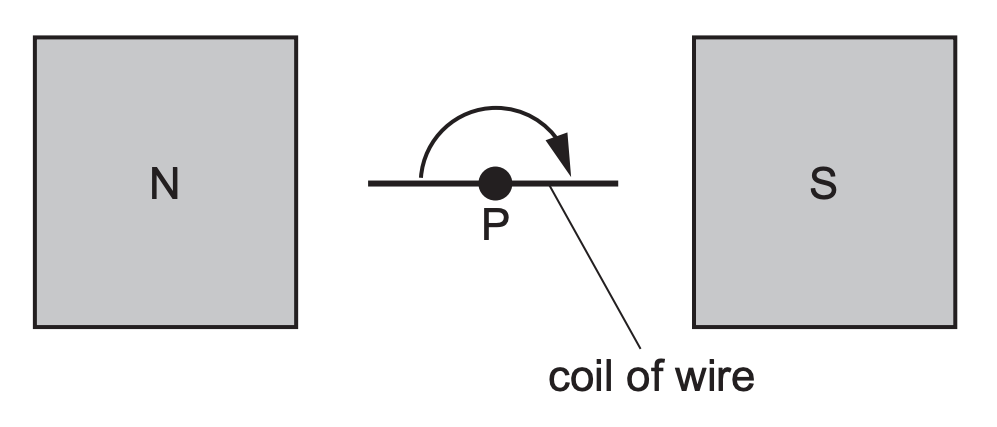
Determine the instantaneous direction of the induced current in the side of the coil nearest the S pole at . State the rule used.
Sketch the variation of the induced emf with time for one complete rotation starting at . Label axes and indicate zero crossings.
Calculate the amplitude of the induced emf.
Suggest two design changes that would increase without changing . Justify briefly.
At the instant shown, identify which side of the coil experiences an upward magnetic force due to the induced current. Justify using Fleming’s left-hand rule.