
Questions
Question 1
A car horn produces a steady tone. A car approaches a stationary microphone connected to a frequency meter. The meter display is shown.
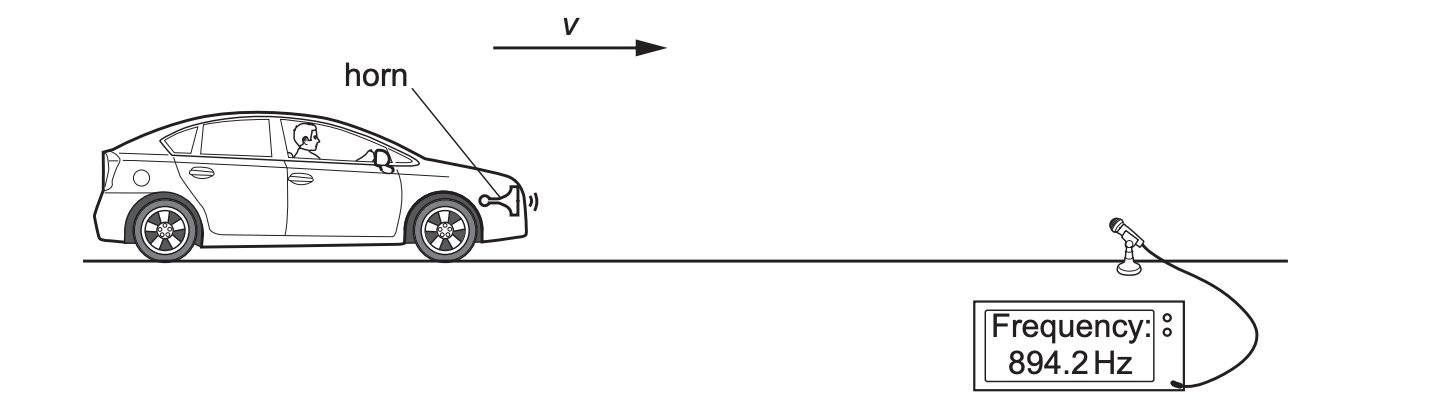
Using the image, state the observed frequency shown on the meter.
The horn has a rest frequency of 800 Hz. Take the speed of sound as . Calculate the speed of the car as it approaches the microphone. Use the moving-source Doppler relation for sound.
Using a wavefront argument, explain why the observed wavelength is shorter for an approaching source.
After the car passes and is receding, the meter reads 720 Hz.
Calculate the car’s speed from this measurement.
Comment on whether the two speed values are consistent, giving a reason.
Question 2
A constant-volume gas thermometer consists of a sealed bulb connected to a pressure sensor. The bulb is immersed in water baths at different temperatures and the pressure is recorded.
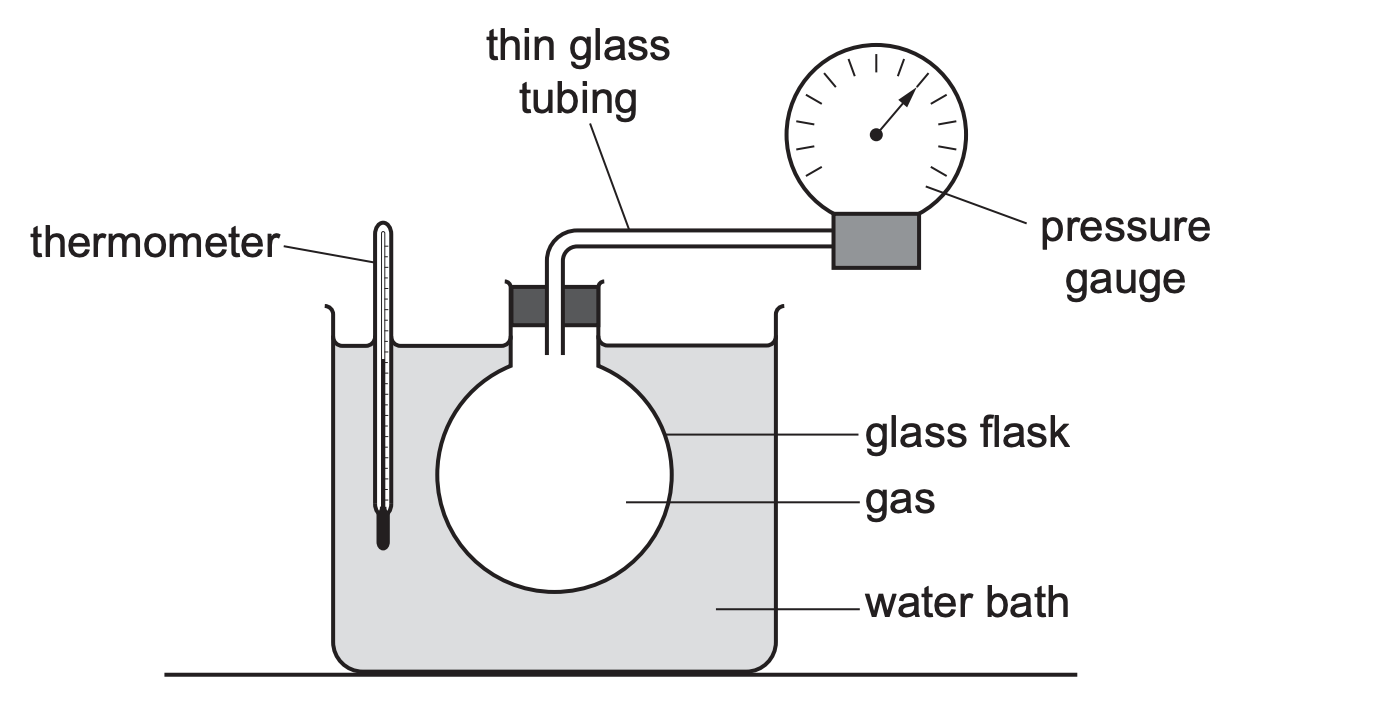
The following data were obtained:
/ : 0, 20, 50, 80
/ : 100.0, 107.3, 118.3, 129.3
From the apparatus, identify the state variable kept constant in these measurements.
State the relationship between pressure and temperature for an ideal gas at constant volume.
Assuming varies linearly with in at constant volume, estimate absolute zero by straight-line extrapolation using the data.
Suggest one reason why a school experiment using this setup could give a value different from .
Using your linear model, predict (i) the pressure at and (ii) whether the linear model is expected to remain valid far above this temperature.