
The nucleus and nucleons
An atom contains a dense, positively charged nucleus, with negatively charged electrons occupying the space outside it.
The nucleus contains protons and neutrons, collectively called nucleons.
Protons carry positive charge, while neutrons have no charge.
Almost all atomic mass is concentrated in the nucleus because the electron mass is negligible.
The number of protons is the atomic number .
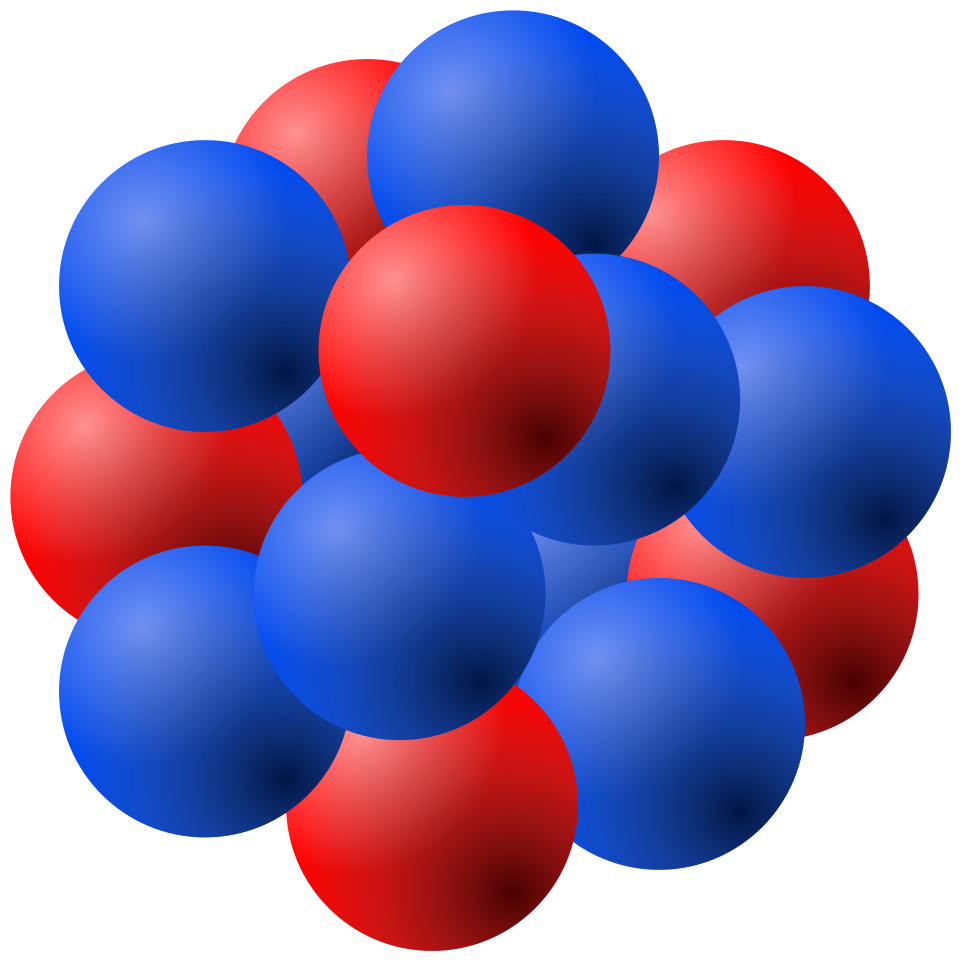
The diagram represents the nucleus as an assembly of protons and neutrons. Together, these particles are called nucleons and account for almost all the atom's mass. Source
Using the nuclear symbol
The nuclear symbol is written as , where is the element symbol.
is the atomic number and equals the number of protons.
is the mass number and equals the total number of nucleons: .
Number of protons .
Number of neutrons .
For a neutral atom, number of electrons .
Isotopes
Isotopes are atoms of the same element containing different numbers of neutrons.
Isotopes therefore have the same atomic number but different mass numbers .
The proton number remains constant because changing the proton number would produce a different element.
Different neutron numbers give isotopes different masses.
Their physical properties can differ where those properties depend on particle mass.
Specific isotope examples do not need to be memorized for this syllabus statement.
Finding isotopic abundance
For two isotopes, if one abundance is , the other abundance is .
Insert these expressions into the weighted-mean equation for .
For isotope masses and : .
Rearrange the equation to calculate the unknown value of .
Check that every abundance lies between and .
All percentage abundances must total .
HL Only: Relative atomic mass from a mass spectrum
Read the relevant peak positions as the isotope mass values and the peak intensities as relative abundances.
Calculate using .
If intensities are already percentages, the denominator is .
Relative intensities do not need to be converted to percentages before using the general weighted-mean equation.
The calculated must lie between the smallest and largest isotopic masses.
should lie closer to the mass of the most abundant isotope.Subatomic particles
Subatomic particles
Particle | Location | Relative charge | Relative mass |
|---|---|---|---|
Proton | Nucleus | ||
Neutron | Nucleus | ||
Electron | Outside nucleus | , approximately negligible |
Deducing electrons in ions
Forming an ion changes the number of electrons, not the numbers of protons or neutrons.
For a positive ion of charge magnitude , electrons .
For a negative ion of charge magnitude , electrons .
For : protons , neutrons , electrons .
For : protons , neutrons , electrons .
Exam check: never change the proton number to account for ionic charge.
Calculating relative atomic mass
Relative atomic mass is calculated as an abundance-weighted mean of the isotopic masses.
For percentage abundances: .
More generally: .
A non-integer results when an element occurs naturally as isotopes with different masses and abundances.
Example: isotopic masses and at and give .
Always multiply each isotopic mass by its corresponding relative abundance.
HL Only: Interpreting mass spectra
Mass spectra are used to determine relative atomic masses from an element's isotopic composition.
Each isotope produces a signal at a characteristic mass-to-charge ratio .
The peak position is used to identify the isotope represented.
The relative peak height or intensity indicates the isotope's relative abundance.
Compare all peak positions and relative intensities when interpreting an isotopic composition.
The operational details of the mass spectrometer are not assessed.
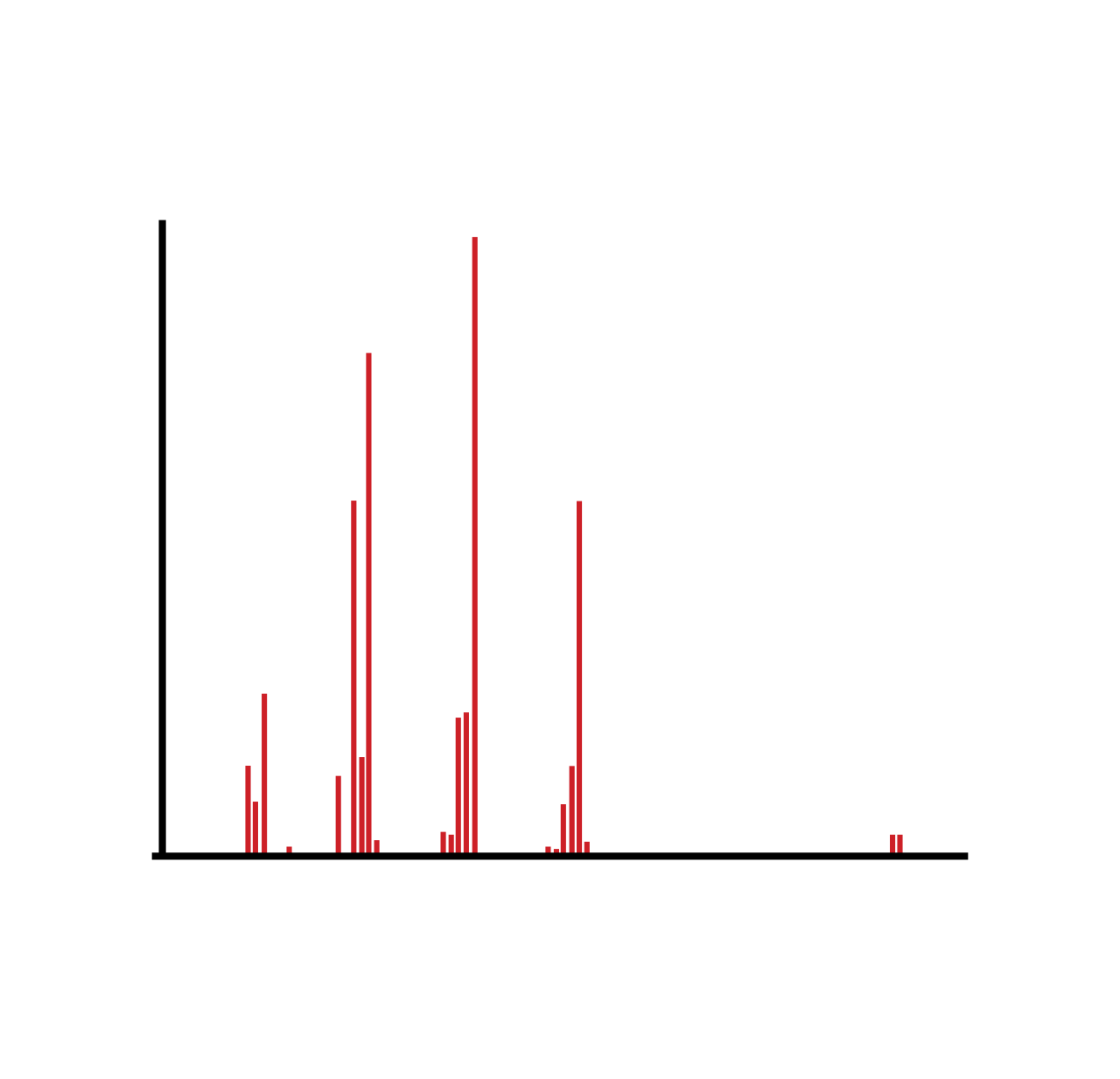
Each peak represents detected ions at a particular . For isotope questions, peak position identifies isotopic mass information while relative peak intensity represents relative abundance. Source
Checklist: can you do this?
Can you state the relative masses and charges of protons, neutrons and electrons?
Can you deduce numbers of protons, neutrons and electrons from for atoms and ions?
Can you distinguish isotopes using proton and neutron numbers?
Can you explain why isotopes can have different physical properties?
Can you calculate from isotopic masses and abundances?
Can you calculate an unknown isotopic abundance from a given ?
Can you interpret isotope identity and relative abundance from a mass spectrum and calculate ? HL only