
Sustainability and long-term viability
Sustainability measures whether practices allow the long-term viability of a system.
It means responsibly maintaining socio-ecological systems without diminishing conditions available to future generations.
All activity is embedded within systems; increasing system resilience generally increases sustainability.
Sustainable development and economic indicators
Sustainable development meets present needs without compromising future generations' ability to meet theirs.
It applies sustainability to social and economic development while maintaining economic stability, social equity and ecological integrity.
The Brundtland Report (1987) introduced social and economic aspects of sustainability to sustainable development.
Unsustainable resource use can cause ecosystem collapse; the syllabus example is overfishing of the Newfoundland cod fisheries.
GDP measures the monetary value of final goods and services produced and sold by a country during a given period.
Focusing on GDP may encourage unsustainable development; Green GDP subtracts environmental costs from GDP.
Measuring sustainability
Sustainability indicators quantify biodiversity, pollution, human population, climate change, material footprints, carbon footprints and other variables from local to global scales.
An ecological footprint is the land and water area needed to supply resources sustainably and absorb waste for a population.
If an ecological footprint exceeds available resources or biocapacity, the situation is unsustainable.
A carbon footprint measures greenhouse-gas emissions in tonnes of carbon dioxide equivalents; a water footprint measures water use in .
Biocapacity is an area's ability to generate renewable resources and absorb resulting wastes.
Use footprint calculators and graph comparative ecological, carbon or water footprint data; detailed calculation methods are not required.
Citizen science provides locally relevant data that can contribute to wider research on Earth systems and sustainability.
Planetary boundaries model
The planetary boundaries model describes nine processes and systems that regulated Earth-system stability and resilience in the Holocene.
It identifies limits to human disturbance; crossing them increases the risk of abrupt and irreversible changes to Earth systems.
Students should identify which boundaries appear to have been crossed and the factors that contributed.
Use: provides science-based limits, broadens attention beyond climate change and alerts the public and policymakers to urgent action.
Limitation: it focuses on ecological systems and does not fully include the human dimension needed for environmental justice.
Other limitations are changing assessments as new data appear and limited usefulness of global boundaries for local or country-level action.
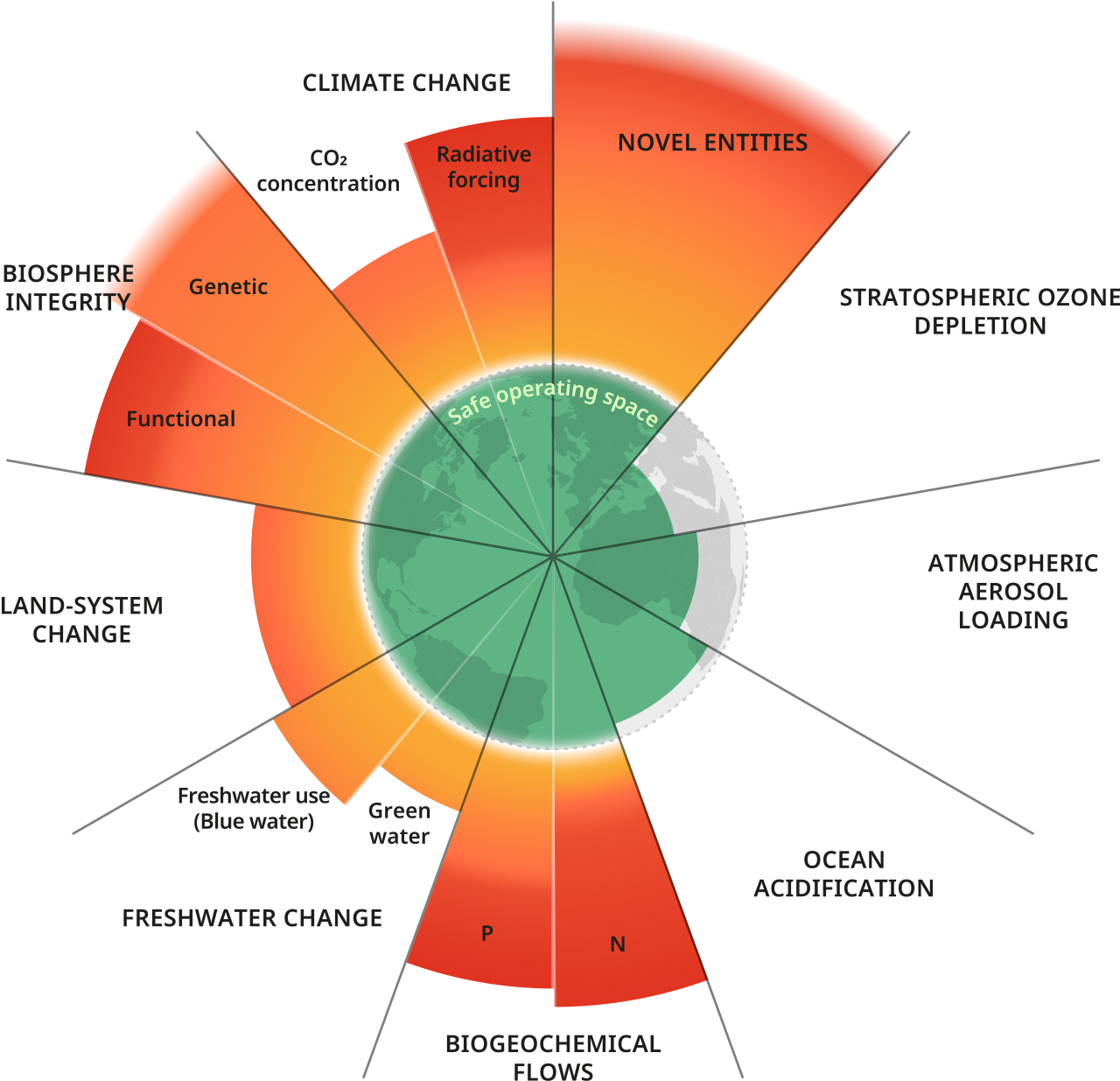
The diagram visualizes the status of the planetary boundaries. Use it to identify boundaries that appear crossed and relate this to the model's limits on human disturbance. Source
Circular economy
The circular economy aims to decouple economic activity from consumption of finite resources.
Its three principles are eliminating waste and pollution, circulating products and materials, and regenerating nature.
It contrasts with the linear take–make–waste model; the syllabus identifies the butterfly diagram as a useful illustration.
Uses include regenerating natural systems, reducing greenhouse-gas emissions, strengthening local food networks, extending product life and changing consumer habits.
Limitations include weak environmental awareness, limited recycling regulation, technical limits to recyclability and lack of finance.
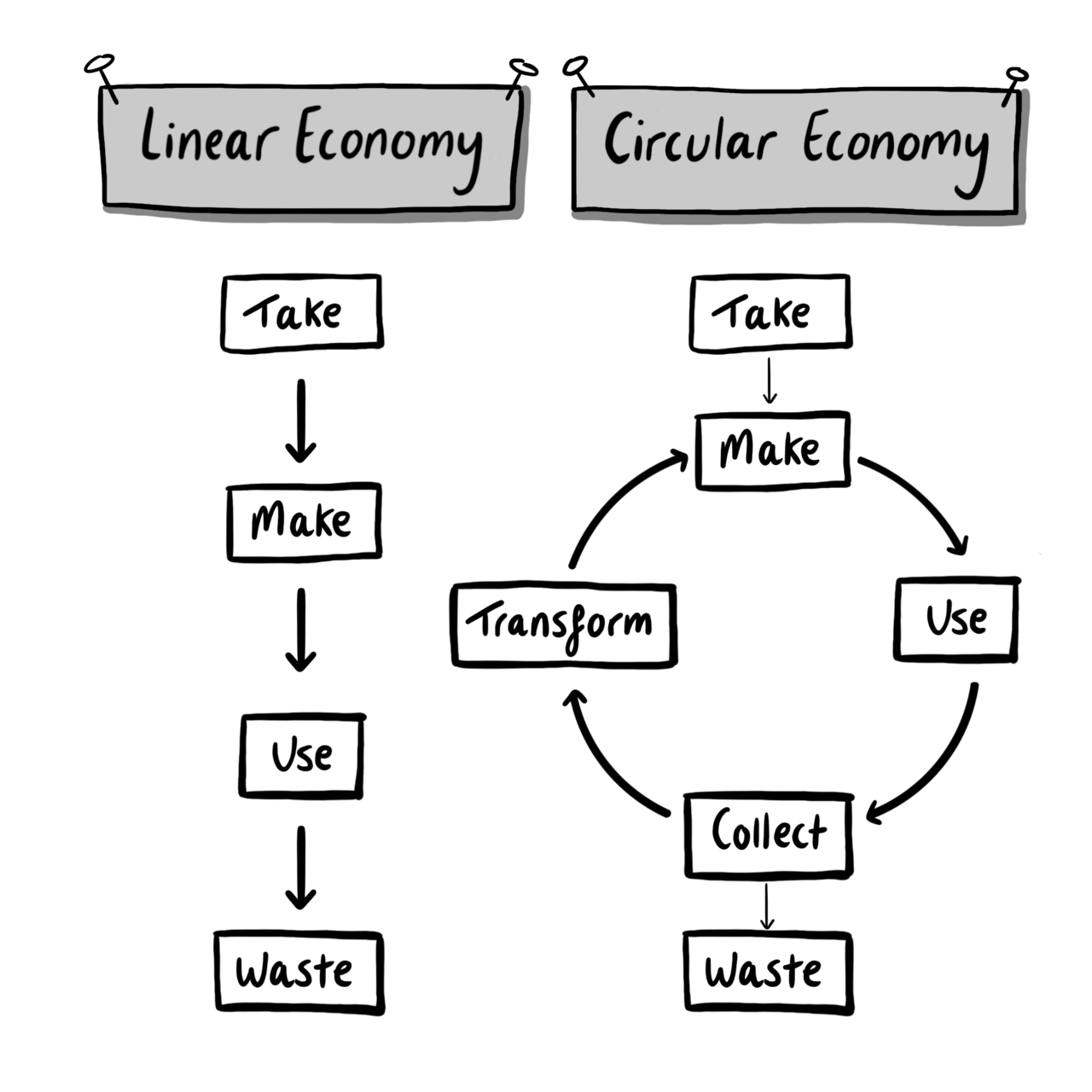
The comparison shows how a circular economy differs from take–make–waste. Link the circular side to eliminating waste, circulating products and materials, and regenerating nature. Source
The three pillars and sustainability models
Environmental sustainability manages natural resources so resources can be replaced and ecosystems can recover and regenerate.
It focuses on resource depletion, pollution, biodiversity conservation and active ecosystem regeneration across different replacement timescales.
Social sustainability builds structures such as health, education, equity and community that support well-being and cultural continuity.
Economic sustainability supports future production and consumption that meet human needs; it depends on environmental sustainability.
A strong sustainability model nests the economy within society, and both within the natural environment.
A weak sustainability model shows the environmental, social and economic pillars as overlapping rather than nested.
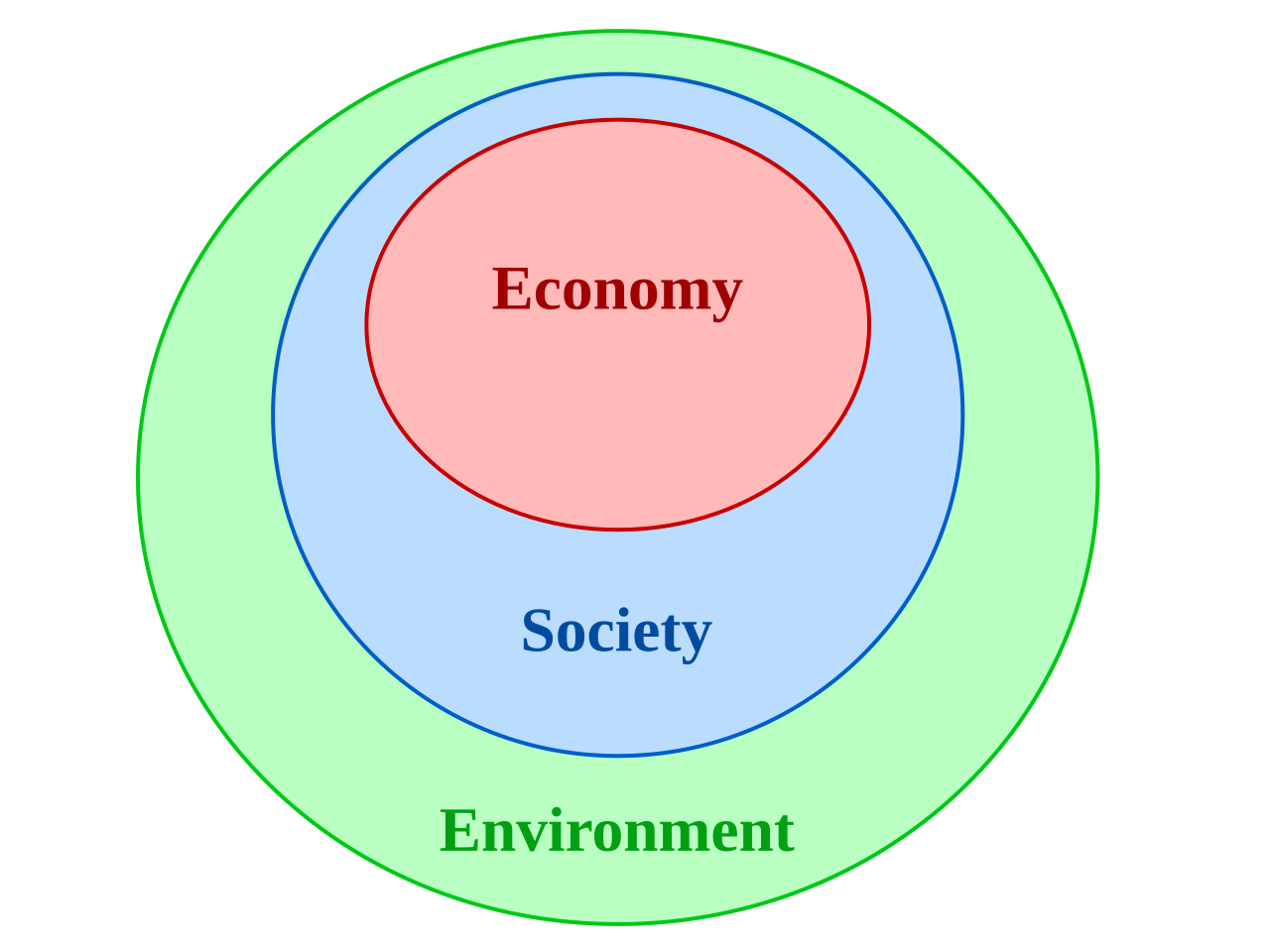
The nested structure illustrates strong sustainability: the economy depends on society, and both depend on the environment. Contrast this with weak sustainability, where the three pillars overlap. Source
Environmental justice, inequality and scale
Environmental justice is the right to a pollution-free environment and equitable access to natural resources regardless of race, gender, socioeconomic status or nationality.
A local-scale example can be landfills located in low-income areas.
A global example is the Union Carbide gas release in Bhopal, India (1984) or waste disposal from developed to developing countries.
Inequalities in income, race, gender and cultural identity create unequal access to water, food and energy.
Examples include inability to afford electricity and privatization of water sources.
Sustainability and environmental justice operate from individual, business, community and city scales to country and global scales such as the UN SDGs.
Sustainability models and the SDGs
Sustainability models simplify reality, so every model has both uses and limitations.
The UN Sustainable Development Goals (SDGs) set social and environmental goals and targets for sustainability and environmental justice.
Uses include creating common ground for policymaking, applying to developed and developing countries, and mobilizing action on economic and social inequality.
Limitations include goals that may not go far enough, top-down bureaucracy, weak attention to local contexts and insufficient supporting data.
HL Only: Quantitative planetary boundaries
HL only: use quantitative data to investigate planetary-boundary status where appropriate in the course.
Use data to determine when a planetary boundary appears to have been crossed.
Use updated evidence to judge whether it has been crossed, recognizing that assessments can change as new data become available.
Doughnut economics model
The doughnut economics model aims for a regenerative and distributive economy that meets human needs within planetary means.
The inner social foundation is based on social SDGs; the outer ecological ceiling is based on planetary boundaries science.
The space between them is the safe and just space for humanity.
A regenerative economy works within living-world cycles and limits; a distributive economy shares value and opportunity more equitably.
Uses: combines ecological and social elements, supports environmental justice and can guide action at country, city, neighbourhood and business scales.
Limitations: it remains a work in progress and promotes broad principles without specifying particular policies.
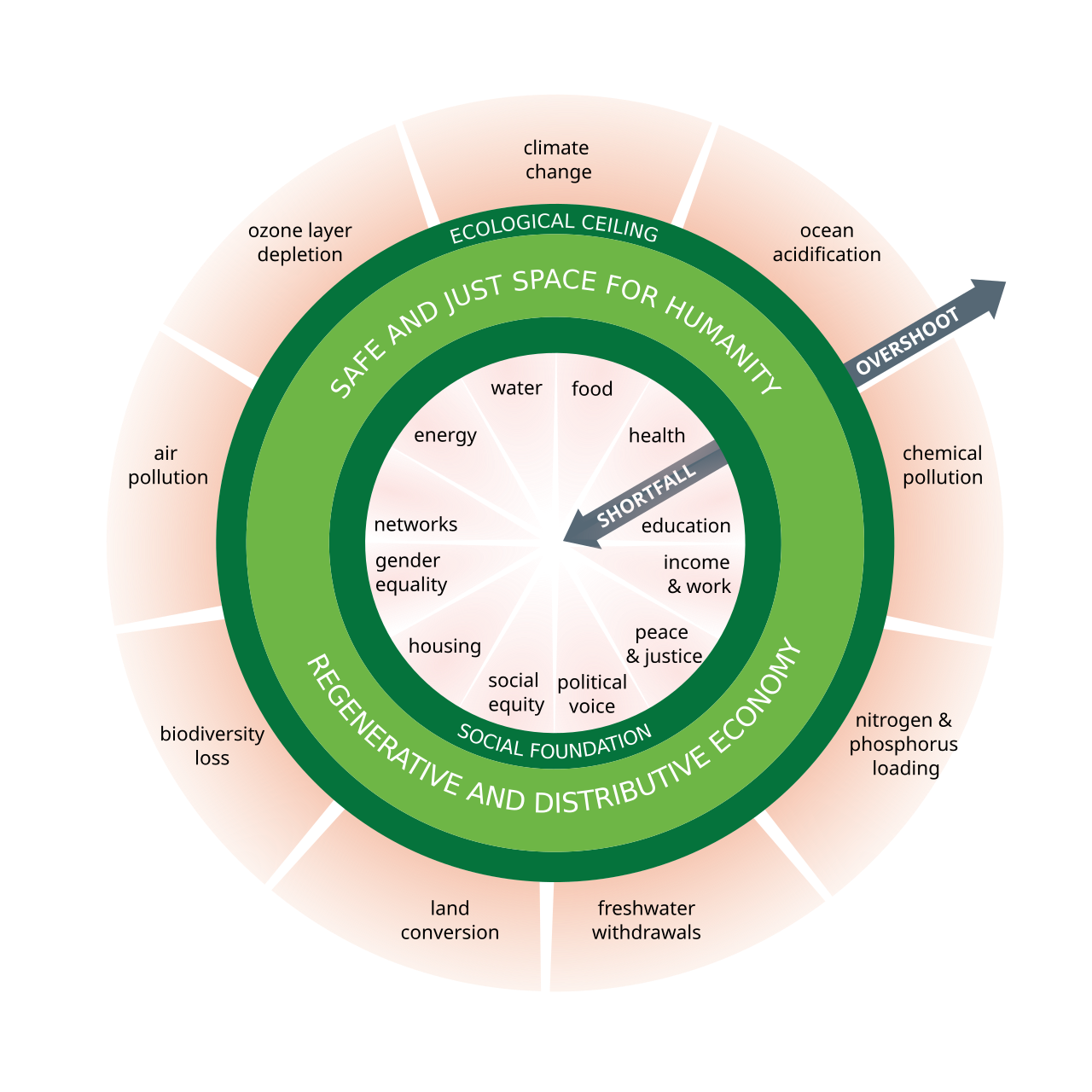
The doughnut places a social foundation inside an ecological ceiling. The space between them represents conditions in which human needs can be met within planetary limits. Source
Checklist: can you do this?
Can you explain sustainability and its relationship with system resilience?
Can you distinguish environmental, social and economic sustainability and strong versus weak sustainability?
Can you explain sustainable development and evaluate GDP and Green GDP as measures of progress?
Can you explain environmental justice, resource inequalities and how these issues operate at different scales?
Can you interpret ecological, carbon and water footprints and explain biocapacity?
Can you evaluate the SDGs and other sustainability models using their uses and limitations?
Can you interpret the planetary boundaries model and, at HL, use quantitative data to assess boundary status?
Can you compare doughnut economics and the circular economy, including their uses and limitations?