

OCR Specification focus:
‘Translocation is an energy-requiring movement of assimilates, especially sucrose, from sources to sinks; describe active loading at sources and removal at sinks.’
Plants transport organic nutrients through the phloem in a process known as translocation. This movement sustains growth, respiration, and storage by distributing assimilates such as sucrose between sources and sinks in a controlled, energy-dependent system.
The Phloem and Its Structure
Phloem is a living vascular tissue specialised for the transport of dissolved organic substances. It complements the xylem, which moves water and minerals, forming an integrated transport network.
Components of the Phloem
Sieve tube elements – elongated, living cells joined end-to-end to form tubes; they lack nuclei and have reduced organelles, ensuring minimal resistance to flow.
Sieve plates – perforated cross-walls between sieve tube elements that allow cytoplasmic continuity for sap flow.
Companion cells – metabolically active cells connected to sieve tube elements via plasmodesmata, providing ATP and metabolic support necessary for translocation.
Phloem parenchyma and fibres – offer storage and structural support, respectively.
The close association between sieve tube elements and companion cells enables efficient active loading and maintenance of pressure flow.
Translocation Overview
Translocation is the transport of assimilates (mainly sucrose and amino acids) within the phloem from source regions (where substances are produced) to sink regions (where they are used or stored).
Translocation: The movement of assimilates, primarily sucrose, through the phloem from sources to sinks in plants.
Source and Sink Relationship
Sources include photosynthetic leaves, storage organs mobilising resources (e.g. germinating seeds, tubers), and tissues exporting assimilates.
Sinks include roots, developing leaves, flowers, fruits, and storage organs accumulating materials.
The direction of flow is bidirectional within a plant system — sucrose can be transported up or down depending on the relative positions of sources and sinks.
Mechanism of Translocation: The Pressure Flow Hypothesis
The mass flow hypothesis (or pressure flow model) describes how assimilates move through the phloem:
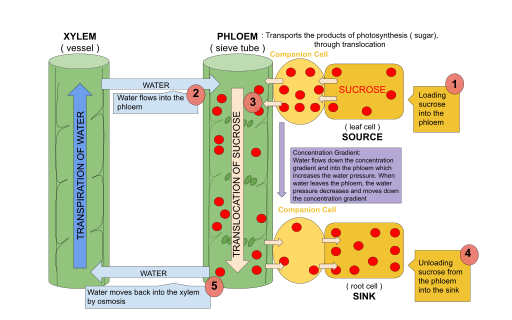
Annotated diagram of phloem translocation from source to sink. It shows sucrose loading lowering water potential, water entry increasing hydrostatic pressure, and bulk flow towards sinks, followed by unloading and water return to xylem. This visual aligns precisely with the pressure-flow steps described in the notes. Source.
Active loading of sucrose into sieve tubes at the source lowers the water potential of the sieve tube element.
Water enters from the adjacent xylem by osmosis, raising hydrostatic pressure.
Phloem sap moves from regions of high to low hydrostatic pressure along the sieve tubes.
At the sink, sucrose is removed, increasing water potential, and water exits to the xylem.
This continuous process maintains a pressure gradient driving bulk flow.
EQUATION
—-----------------------------------------------------------------
Pressure Flow (Rate) ∝ ΔPressure / Resistance
ΔPressure = Difference in hydrostatic pressure between source and sink
Resistance = Frictional or physical resistance within the sieve tubes
—-----------------------------------------------------------------
This model emphasises that phloem transport is active, relying on metabolic energy, unlike the passive movement of water in xylem.
Active Loading at the Source
Active loading is the process by which sucrose is transported from mesophyll cells into sieve tube elements via companion cells using ATP.
Step-by-Step Process
1. Proton pumping: Hydrogen ions (H⁺) are actively transported out of companion cells using ATP-powered proton pumps, creating an electrochemical gradient.
2. Co-transport of sucrose: As H⁺ ions diffuse back into the companion cell through co-transporter proteins, sucrose molecules are simultaneously carried in against their concentration gradient.
3. Transfer to sieve tube elements: Sucrose moves from companion cells to sieve tube elements through plasmodesmata, establishing a high sucrose concentration in the phloem sap.
Key Features
The process requires ATP, highlighting its energy-dependent nature.
Active loading allows the plant to control distribution and maintain high concentrations of sucrose in phloem sap, facilitating mass flow.
This method is described as apoplastic loading, as sucrose initially travels through cell walls and intercellular spaces before entering the phloem via membranes.
Apoplastic loading: Active loading of sucrose into phloem sieve tubes via the cell wall and membrane pathway, requiring ATP for proton pumping and co-transport.
Some plants use symplastic loading, involving diffusion of sucrose through plasmodesmata without membrane transporters, often with sucrose converted into larger oligosaccharides to maintain a diffusion gradient.
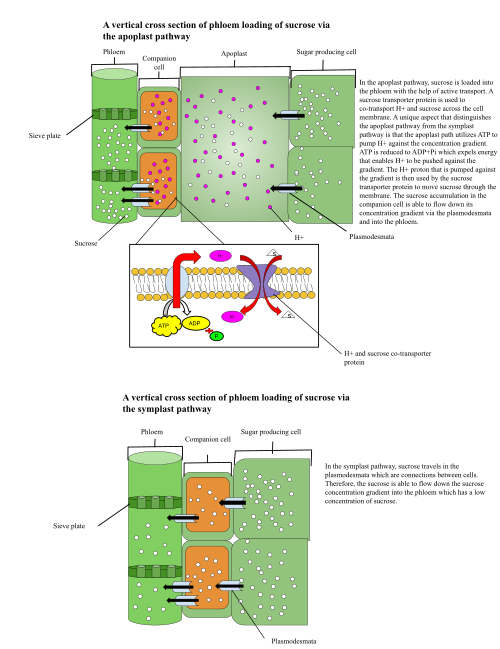
Vertical cross-sections compare apoplastic (ATP-driven H⁺ pumping with sucrose co-transport) and symplastic loading into sieve tubes. Labels highlight proton pumps, co-transporters, companion cells, plasmodesmata, and sieve tube elements. This directly supports the OCR focus on active loading at sources. Source.
The Role of Companion Cells
Companion cells are critical for maintaining the activity and function of sieve tube elements.
They contain numerous mitochondria to generate ATP for active loading.
Their dense cytoplasm supports metabolic exchange with sieve tube elements.
The plasmodesmata ensure coordinated cytoplasmic continuity for solute transfer.
These cells effectively act as the metabolic engine of the phloem, sustaining both loading and maintenance of phloem pressure.
Transport Pathway and Regulation
Once loaded, sucrose moves through the sieve tubes as part of the phloem sap, which may also contain amino acids, hormones, and ions. Flow is directed by differences in hydrostatic pressure, with local metabolic activity adjusting source-sink dynamics.
Factors influencing translocation include:
Rate of photosynthesis – determines sucrose availability.
Temperature – affects enzyme activity and membrane transport efficiency.
Water availability – influences turgor pressure and sap flow.
Plant demands – growing tissues or reproductive organs alter sink strength dynamically.
Unloading at the Sink
Phloem unloading occurs at sinks where sucrose is actively or passively removed from sieve tubes.
Mechanism
At the sink, sucrose concentration in sieve elements decreases as it is either metabolised for energy or converted to storage forms such as starch.
The increase in water potential causes water to move out into the xylem by osmosis, reducing local pressure and maintaining the gradient required for flow.
Sink: A region of a plant where assimilates, such as sucrose, are actively removed from the phloem for use or storage.
Phloem unloading can be active, using ATP to move substances into sink cells, or passive, where sucrose diffuses down its concentration gradient.
Energy and Efficiency of Translocation
Translocation is an energy-requiring process, relying on respiration within companion cells to supply ATP. This energy maintains:
Proton gradients for active loading
Pressure gradients for bulk flow
Regulatory transport ensuring priority to active sinks
Despite its metabolic cost, phloem translocation is highly efficient, enabling rapid redistribution of organic nutrients throughout the plant, vital for growth, reproduction, and survival in varying environmental conditions.
Practice Questions
Question 1 (2 marks)
Explain why the process of phloem translocation is described as an energy-requiring process.
Mark scheme:
1 mark for identifying that ATP is required for active loading of sucrose into the phloem.
1 mark for stating that ATP is used to pump hydrogen ions (H⁺) out of companion cells to create an electrochemical gradient for co-transport of sucrose back in.
Question 2 (5 marks)
Describe how the structure of the phloem and the process of active loading enable the transport of sucrose from sources to sinks in plants.
Mark scheme:
1 mark for stating that sieve tube elements are connected end-to-end with sieve plates allowing sap to flow.
1 mark for describing that companion cells are metabolically active and provide ATP for transport.
1 mark for explaining that hydrogen ions are pumped out of companion cells using ATP, creating a proton gradient.
1 mark for describing that sucrose is co-transported with hydrogen ions back into the companion cells via co-transporter proteins.
1 mark for explaining that sucrose then moves into sieve tube elements, lowering water potential, causing water to enter from the xylem and generating hydrostatic pressure for translocation towards sinks.
FAQ
Sucrose is non-reducing, so it does not react easily with other molecules during transport, preventing interference with cellular metabolism.
It is also more soluble and osmotically less active than glucose, allowing large quantities to move without causing excessive water movement into the sieve tubes.
Unlike starch, which is insoluble, sucrose can be loaded, transported, and unloaded efficiently in solution between cells.
Higher temperatures generally increase the rate of translocation because enzyme-controlled processes, such as ATP generation and sucrose loading, proceed faster.
However, extreme temperatures can denature transport proteins or disrupt membranes, reducing efficiency.
At lower temperatures, metabolic activity and ATP availability fall, slowing active loading and consequently reducing translocation rate.
Aphid stylet experiments show that sap exudes under pressure, confirming a pressure gradient in the phloem.
Radioactively labelled carbon (e.g., ¹⁴C in sucrose) moves from sources to sinks, demonstrating directional flow.
Cutting the phloem causes sap to leak out, unlike xylem where tension prevents outward flow.
These findings collectively support the idea of mass flow driven by hydrostatic pressure differences.
Companion cells use ATP from their abundant mitochondria to actively pump hydrogen ions out of the cytoplasm.
The resulting proton gradient powers co-transport of sucrose back into the cell through membrane proteins.
Sucrose then diffuses through plasmodesmata into sieve tube elements, maintaining a steep concentration gradient essential for continuous loading.
Oxygen is required for aerobic respiration in companion cells to produce ATP.
Without ATP, proton pumps cannot maintain the hydrogen ion gradient, and active loading of sucrose into the phloem ceases.
As a result, the hydrostatic pressure gradient cannot be sustained, halting the mass flow of assimilates through the sieve tubes.


