

OCR Specification focus:
‘Plants respond to abiotic stress and herbivory; include chemical defences (alkaloids, pheromones) and folding on touch, and describe phototropism and geotropism.’
Plants detect and respond to environmental and biological changes through coordinated physiological and behavioural mechanisms, ensuring survival, growth, and reproduction without the mobility or nervous systems seen in animals.
Plant Responses to the Environment
The Importance of Plant Responses
Plants must adjust to biotic (living) and abiotic (non-living) factors. Abiotic factors include light, gravity, temperature, and water availability, while biotic factors include predators (herbivores), pathogens, and competition. Through cell signalling and hormonal regulation, plants coordinate growth, development, and defence mechanisms to optimise survival and reproduction.
Abiotic Stress Responses
Abiotic stress refers to environmental conditions that reduce plant growth or function. Plants detect these changes using receptors that trigger chemical responses.
Drought: Some plants produce abscisic acid (ABA), which closes stomata to reduce water loss.
Cold: Certain species accumulate antifreeze proteins to prevent ice crystal formation within cells.
Excess light or heat: Chloroplasts may reposition within cells, and heat-shock proteins stabilise enzymes.
Waterlogging: Production of ethylene promotes formation of air spaces (aerenchyma) to facilitate oxygen diffusion to submerged tissues.
These adaptations are essential for maintaining homeostasis and metabolic efficiency under fluctuating environmental conditions.
Defence Against Herbivory
Chemical Defences
Plants produce a wide range of secondary metabolites that deter herbivores or inhibit pathogens.
Alkaloids: Nitrogen-containing compounds such as nicotine, morphine, and quinine that taste bitter or are toxic to herbivores.
Tannins: Polyphenolic compounds found in leaves and bark that bind to digestive enzymes, reducing palatability and nutrient absorption in herbivores.
Terpenoids: Volatile hydrocarbons that can act as toxins or repellents; for example, pyrethrin from chrysanthemums repels insects.
These substances often accumulate after herbivory through induced responses, demonstrating plants’ ability to sense attack and mobilise defences.
Pheromones and Inter-Plant Communication
Plants use pheromones—chemicals that influence the behaviour or physiology of other organisms. For instance:
Damaged maize plants release volatile organic compounds (VOCs) that attract parasitoid wasps to attack caterpillars feeding on the plant.
Acacia trees emit ethene gas when grazed, prompting neighbouring trees to produce tannins and deter further grazing.
This chemical communication represents a form of plant signalling, allowing populations to coordinate defences against herbivory.
Behavioural (Rapid) Responses
Some plants display immediate, visible reactions to physical stimuli.
Mimosa pudica (the sensitive plant): When touched, leaflets fold due to changes in turgor pressure within specialised cells at the leaf base called pulvini.
This response minimises damage from herbivores and environmental stress.
The movement results from an electrical impulse (action potential) spreading through the plant, analogous to a nervous response but slower.
Plant Tropisms
Definition and Overview
Tropism: A directional growth response of a plant organ to an external stimulus, where the direction of growth is determined by the stimulus.
Tropisms allow plants to orient themselves advantageously towards or away from environmental factors. Two key tropisms covered in this subtopic are phototropism and geotropism (gravitropism).
Phototropism: Response to Light
Phototropism ensures that leaves receive optimal light for photosynthesis.
Positive phototropism: Shoots grow towards light to maximise photosynthetic surface area.
Negative phototropism: Roots may grow away from light, remaining underground for water and mineral absorption.
Mechanism of Phototropism
Photoreceptors in shoot tips detect unilateral (one-sided) light.
The hormone auxin (indole-3-acetic acid, IAA) redistributes from the illuminated side to the shaded side.
Increased auxin concentration on the shaded side promotes cell elongation, causing the shoot to bend towards the light.
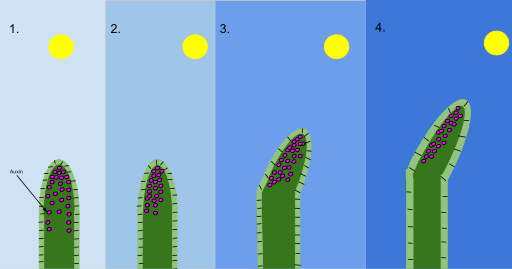
Schematic of phototropism showing auxin redistribution from the illuminated to the shaded side of the stem. Higher auxin on the shaded side stimulates cell elongation, so the shoot curves towards the light. Labels are clear and limited to the process steps required by the syllabus. Source.
Auxin: A plant growth hormone that regulates cell elongation, apical dominance, and tropic responses by influencing proton pump activity in cell membranes.
This redistribution allows plants to optimise light capture and increase photosynthetic efficiency, crucial for growth and energy production.
Geotropism (Gravitropism): Response to Gravity
Roots and shoots exhibit opposite growth responses to gravity.
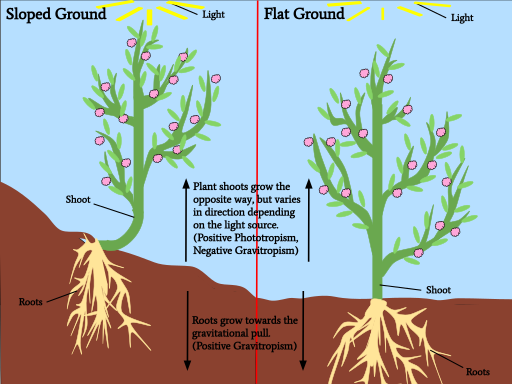
Simple diagram contrasting root and shoot orientations on flat and sloped ground to demonstrate gravitropic growth. Roots curve with gravity (positive geotropism) while shoots curve against gravity (negative geotropism). The visual is uncluttered and limited to syllabus-relevant labels. Source.
Positive geotropism: Roots grow in the direction of gravity, anchoring the plant and aiding water absorption.
Negative geotropism: Shoots grow upward against gravity, ensuring exposure to light and air.
Mechanism of Geotropism
In root cap cells, statoliths (dense starch granules) settle under gravity.
Their redistribution signals differential auxin transport.
In roots, high auxin levels inhibit elongation, so the lower side grows less, bending the root downwards.
In shoots, auxin stimulates elongation, so the lower side grows faster, bending the shoot upwards.
This coordination allows roots and shoots to grow in the optimal direction for resource acquisition and stability.
Integration of Tropisms and Environmental Responses
Interaction of Multiple Stimuli
Plants rarely experience a single stimulus. Growth direction often results from integration of several cues such as light, gravity, and water. For example:
A germinating seedling may exhibit positive phototropism and negative geotropism simultaneously.
Roots may show positive geotropism and positive hydrotropism (growth towards moisture).
The dominant response depends on the plant’s developmental stage and environmental priorities.
Hormonal Regulation in Tropic Responses
Although auxins are key, other hormones modulate tropic responses:
Cytokinins promote cell division and can counteract auxin effects.
Gibberellins stimulate stem elongation and interact with auxins during growth.
Abscisic acid (ABA) inhibits growth during stress, ensuring energy is diverted to survival.
Ethene influences leaf abscission and can modulate tropic sensitivity by altering cell wall elasticity.
These hormones form a complex signalling network, allowing plants to integrate multiple environmental and developmental signals effectively.
Practical Examples of Tropisms
Sunflower heads track the sun (heliotropism) for optimal photosynthesis.
Roots of bean seedlings bend towards gravity and water sources when grown on a rotating clinostat.
Shoots placed horizontally curve upward due to auxin redistribution, showing negative geotropism.
Through such coordinated responses, plants maximise access to essential resources—light, water, and minerals—while protecting themselves from predation and stress.
Practice Questions
Question 1 (2 marks)
Explain how auxin causes a shoot to bend towards light during phototropism.
Mark scheme:
1 mark: Auxin moves to the shaded side of the shoot.
1 mark: Cells on the shaded side elongate more than those on the illuminated side, causing the shoot to bend towards the light.
Question 2 (5 marks)
Describe and explain the roles of tropisms and rapid responses in helping plants survive in their environment.
Mark scheme:
1 mark: States that tropisms are directional growth responses to stimuli such as light (phototropism) and gravity (geotropism).
1 mark: Describes positive phototropism in shoots to maximise light absorption for photosynthesis.
1 mark: Describes positive geotropism in roots for anchorage and absorption of water and minerals.
1 mark: Explains that rapid responses (e.g. folding of Mimosa pudica leaves) protect plants from herbivory or physical damage.
1 mark: States that these responses enhance survival by allowing plants to adapt to environmental and biological challenges despite being immobile.
FAQ
Plants detect light direction using photoreceptor proteins called phototropins, located in the plasma membranes of cells in the shoot tip.
When light is stronger on one side, phototropins on that side become more active, triggering the redistribution of auxin to the shaded side. This uneven auxin distribution leads to differential cell elongation, bending the shoot towards the light source.
This process allows the plant to maximise light absorption for photosynthesis, particularly important for young seedlings competing for sunlight.
Tropisms are directional growth responses that depend on the direction of the external stimulus (e.g. light, gravity).
In contrast, nastic movements are non-directional responses to stimuli such as touch, temperature, or light intensity. For example, Mimosa pudica folds its leaves when touched, regardless of the direction of contact.
Nastic movements result from changes in cell turgor pressure, not growth, and are generally much faster than tropisms.
Shoots and roots respond differently to auxin concentration because of variations in cell sensitivity.
In shoots, high auxin concentrations stimulate cell elongation by increasing proton pump activity, loosening cell walls.
In roots, high auxin concentrations inhibit elongation, while low concentrations promote it.
This difference enables shoots to show negative geotropism and roots positive geotropism, ensuring optimal orientation for resource acquisition.
Statoliths are dense starch-filled organelles found in specialised statocyte cells of the root cap and shoot.
When the plant changes orientation, gravity causes statoliths to settle at the lowest point of the cell. This triggers a redistribution of auxin transport proteins (PIN proteins), leading to uneven auxin distribution across the organ.
The resulting differential growth produces bending — roots curve downwards and shoots curve upwards.
Ethene (ethylene) is a gaseous plant hormone that complements tropic responses by regulating growth and stress adaptation.
It promotes leaf abscission, fruit ripening, and senescence, helping plants manage energy and reproduction.
Ethene can also alter cell wall elasticity, modulating sensitivity to other hormones such as auxin. This allows plants to balance growth, repair, and survival under stress or developmental transitions.


