

AP Syllabus focus:
‘Use limits to redefine or define a function’s value at a point of removable discontinuity so that the new function becomes continuous at that point.’
In this section, you’ll learn how limits let us repair functions with holes by redefining a single point so the graph becomes continuous at c.
Understanding holes and removable discontinuities
A hole in the graph of a function is a point where the graph “should” have a value, based on nearby behavior, but does not actually have one.
Hole: A missing point in the graph of a function where the limit from nearby x-values exists but the function value is either missing or different.
A particularly important type of hole is a removable discontinuity, which is exactly the kind of discontinuity we can fix by redefining a single function value.
Removable discontinuity: A discontinuity at x = c where the limit of the function as x approaches c exists and is finite, but the function’s defined value at c does not match that limit (or is undefined).
When a function has a removable discontinuity, its graph looks like a smooth curve with a single point taken out or plotted incorrectly.
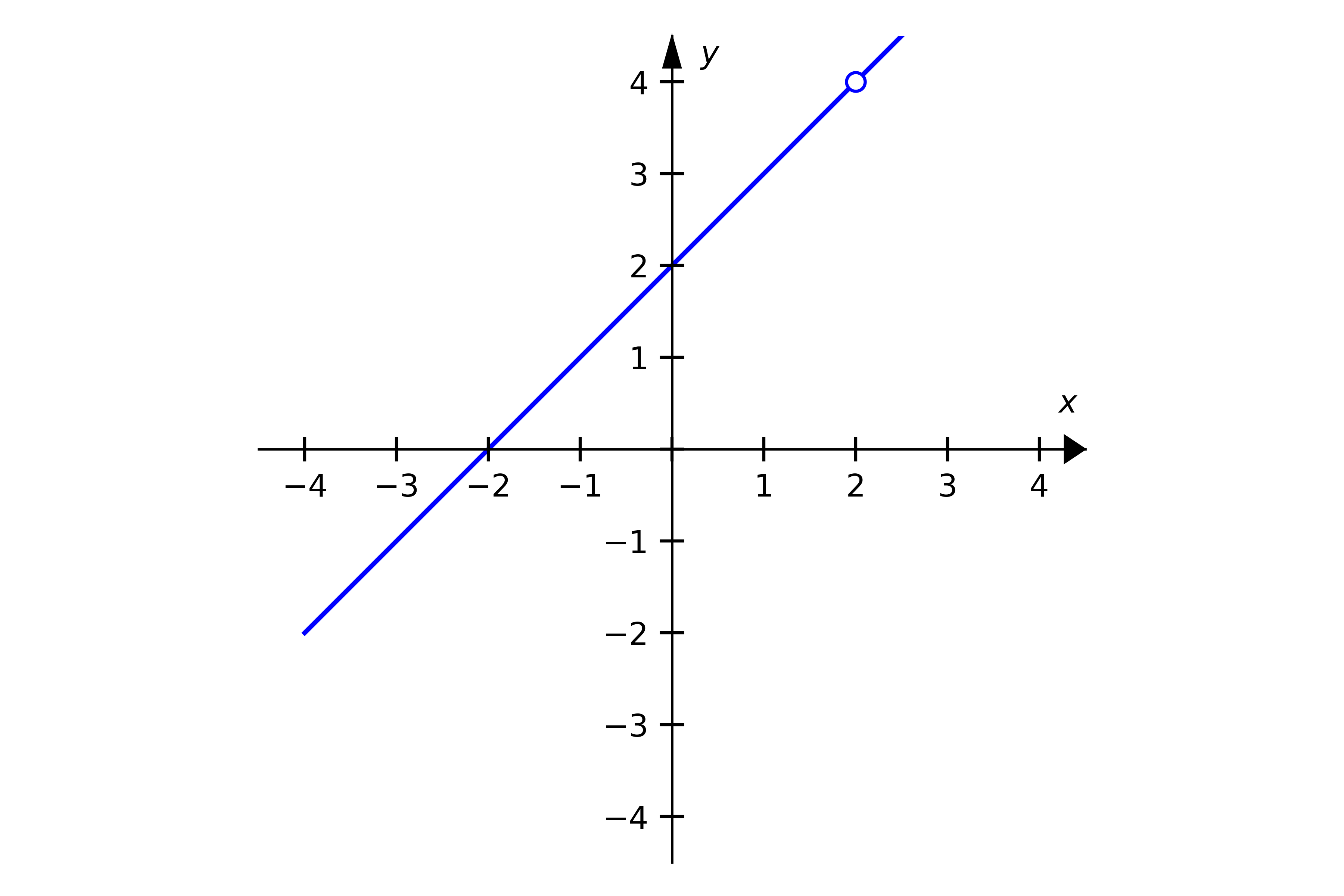
A straight-line graph with an open circle marks a removable discontinuity, showing that the surrounding values follow a clear trend while the point itself is missing. Source.
Limits as the tool for redefining function values
To use limits to fix a hole, we need the limit at a point.
Limit at a point: The value L that the function values f(x) approach as x gets arbitrarily close to x = c (from both sides), regardless of what happens exactly at x = c.
In the context of removable discontinuities, the limit tells us the “intended” value of the function at that x-value.
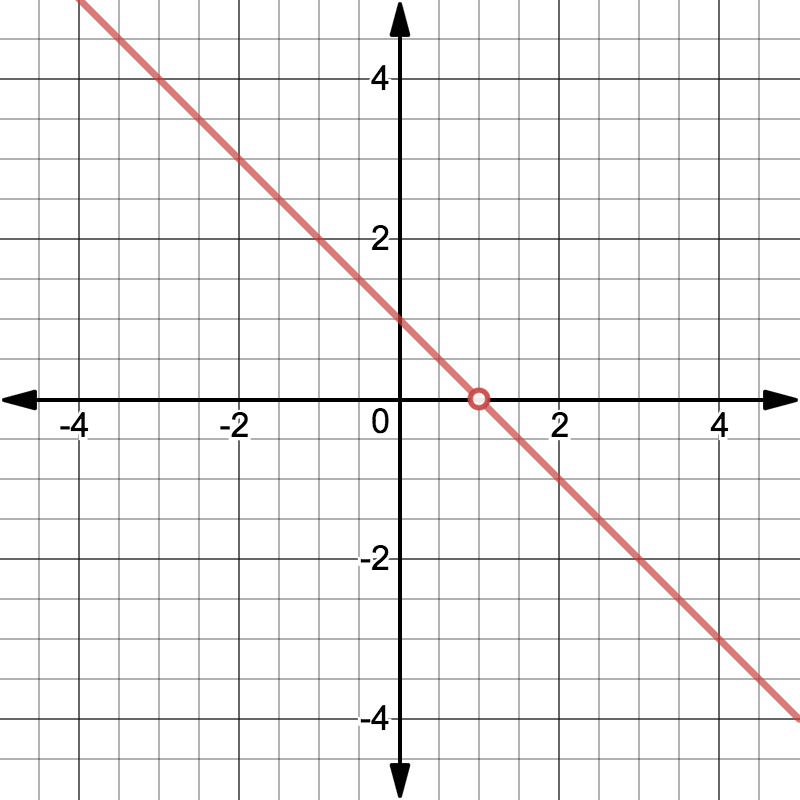
A parabola with an open circle at its lowest point illustrates that the function approaches a specific limiting value even though the actual function value is missing at that . Source.
The AP focus is on understanding that this limit supplies the correct value to plug into the function at the hole so that the graph becomes continuous at c.
Continuity and redefining the function
To see why redefining the function works, connect this idea to continuity at a point.
Continuity at a point: A function is continuous at x = c if three conditions hold: (1) the function value f(c) exists; (2) the limit of f(x) as x approaches c exists; and (3) the limit equals f(c).
At a removable discontinuity, condition (2) is satisfied, but condition (1) or (3) fails. Either f(c) is not defined at all, or it is defined but does not equal the limit. By redefining the value at c to match the limit, we can force all three conditions to hold and make the function continuous at that point.
This leads to the idea of constructing a redefined function that agrees with the original everywhere except at the hole.
Redefined function: A new function built from an original function by changing its value at one or more specific points so that it becomes continuous where it previously had removable discontinuities.
The redefined function preserves the original behavior while repairing the discontinuity at the hole.
Piecewise definition for removing a hole
A common way to formalize the repair is with a piecewise definition. Suppose f has a removable discontinuity at x = c, and the limit of f(x) as x approaches c is L. We then define a new function h by keeping the original formula everywhere except at c, and assigning h(c) the value L.
= New function with the hole removed
= Original function with a removable discontinuity
= x-value where the hole occurs
= Limit of f(x) as x approaches c
This piecewise definition explicitly shows how the new function agrees with the original but fills in the missing or incorrect value at the hole.
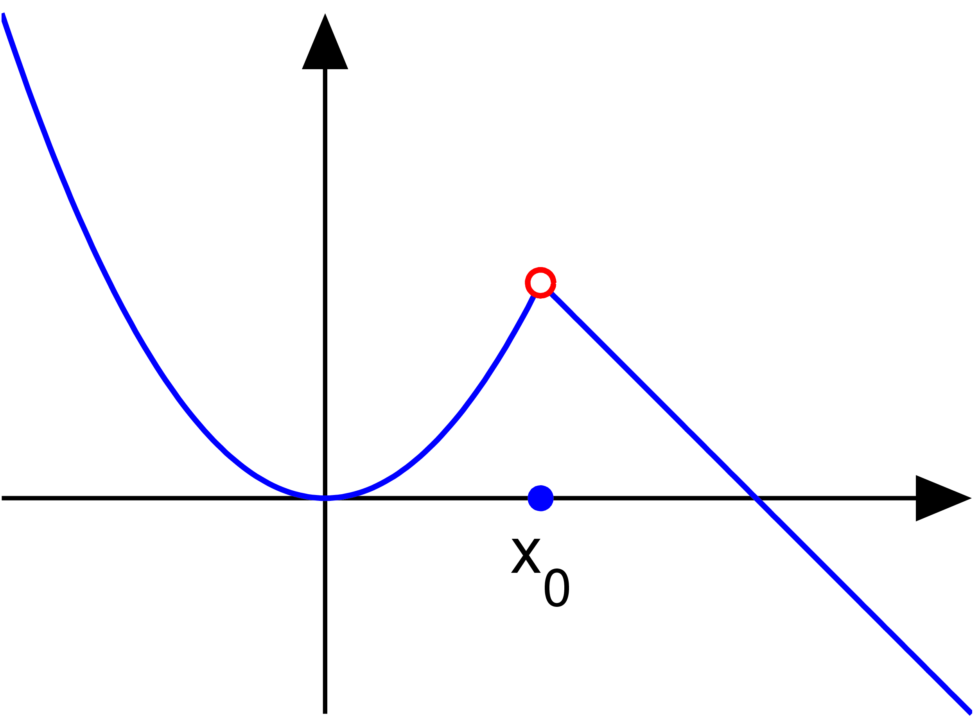
A curve with a hole and a misaligned filled point demonstrates that the limit exists along the curve, but has been assigned an incorrect value, creating a removable discontinuity. Source.
Step-by-step process for removing a hole
To apply the AP syllabus idea of using limits to redefine or define a function’s value at a point of removable discontinuity, follow this general procedure:
Identify the candidate point c.
Look for x-values where the function is undefined, where the formula suggests dividing by zero, or where the graph shows a missing point.
Check for a removable discontinuity at c.
Determine whether the limit of the function as x approaches c exists and is finite.
Confirm that the function is either not defined at c or has a value at c that does not equal this limit.
Compute or estimate the limit L.
Use algebraic simplification, cancellation, or an equivalent expression if possible.
If needed, use numerical tables or graphs to estimate the limit from both sides.
Redefine the function value.
If the function is undefined at c, define a new function value at c equal to L.
If the function has the wrong value at c, change the value at that single point to L in a new function.
Verify continuity in the new function.
Check that the new function’s value at c equals the limit as x approaches c.
Confirm that nearby values match the original function, ensuring that only the hole has been repaired.
Conceptual importance for modeling
In real-world modeling, a removable discontinuity often comes from how a function is originally written, not from the situation itself. A factor that cancels or a domain restriction can create a formal gap in the algebraic expression, even though the underlying phenomenon changes smoothly.
Redefining the function at the hole using the limit restores the continuity that the real-world context typically has. This idea allows you to treat the function as a reliable, continuous model while still recognizing that its original formula had a technical flaw at a single point.
Practice Questions
Question 1 (1–3 marks)
A function f is defined for all real x except x = 3. The limit of f(x) as x approaches 3 exists and is equal to 7.
(a) State the value that should be assigned to f(3) in order to remove the discontinuity at x = 3.
(b) Explain briefly why this redefinition makes the function continuous at x = 3.
Question 1
(a) 1 mark
• Correctly states f(3) = 7.
(b) 1–2 marks
• 1 mark for stating that continuity requires the function value to equal the limit at that point.
• 1 mark for stating that redefining f(3) to 7 ensures the limit and the function value match, so the discontinuity (a hole) is removed.
Question 2 (4–6 marks)
A function g is given by
g(x) = (x² − 4) / (x − 2), for x ≠ 2.
The function is undefined at x = 2.
(a) Show that the limit of g(x) as x approaches 2 exists.
(b) Hence find the value that should be defined as g(2) so that the function becomes continuous at x = 2.
(c) Write a complete piecewise definition for the redefined function.
(d) Explain why this new definition removes the discontinuity.
Question 2
(a) 2 marks
• 1 mark for factorising x² − 4 as (x − 2)(x + 2).
• 1 mark for showing that g(x) simplifies to x + 2 for x ≠ 2, and hence the limit at x = 2 is 4.
(b) 1 mark
• Correctly states that g(2) should be defined as 4.
(c) 1–2 marks
• 1 mark for giving the correct piecewise form: g(x) = x + 2 for x ≠ 2.
• 1 mark for defining g(2) = 4.
(d) 1 mark
• Explains that defining g(2) as the limit value makes the function continuous at x = 2 because the function value now matches the limit.
FAQ
Check whether the algebraic expression itself forces the function to be undefined at that point, such as division by zero or a cancelled factor.
If the graph is unclear, examine values close to the suspected point or rewrite the expression to reveal whether it simplifies to a continuous form. A true removable discontinuity will always correspond to an algebraic issue, not merely a graphical artefact.
A cancelled factor suggests the possibility of a removable discontinuity but does not guarantee one.
The discontinuity only occurs if the original function becomes undefined at the cancelled value. If the domain was never restricted at that point, or if no denominator becomes zero there, the apparent simplification does not create a removable discontinuity.
Redefinition preserves the behaviour of the function everywhere except at one isolated point.
This is acceptable because continuity concerns local behaviour. If the limit identifies a unique intended value, redefining the function simply restores the behaviour the formula implies without altering any surrounding values.
Yes, functions may have several distinct holes caused by different domain restrictions.
To fix them:
• Identify each x-value where the function is undefined.
• Compute the limit at each point separately.
• Redefine the function at every hole with its corresponding limit value.
Each redefinition is independent of the others.
Yes. Some functions disguise removable discontinuities within complicated expressions, piecewise definitions, or compositions.
In such cases, numerical or graphical investigations can reveal whether nearby values approach a single number. Once that limiting value is identified, the function can still be redefined at the hole, even if no simple algebraic simplification exists.
