
AP Syllabus focus:
‘Use the Intermediate Value Theorem in contextual situations, such as temperature or position, to argue that a continuous quantity must take on a specified intermediate value.’
The Intermediate Value Theorem helps explain why real-world quantities that change continuously must pass through all intermediate values, enabling justified conclusions about physical, biological, or economic behavior.
Applying the Intermediate Value Theorem in Context
Real-world modeling often relies on functions that vary smoothly over time or space. When such functions are continuous, the Intermediate Value Theorem (IVT) guarantees that they attain every value between two known output values. This principle allows us to assert the existence of important events—like reaching a temperature threshold or crossing a height level—without needing an explicit formula or step-by-step tracking of the entire path.
Understanding Continuous Change in Applied Settings
A quantity modeled by a continuous function changes with no sudden jumps. Continuous functions arise naturally in contexts such as temperature variation, water depth, position of an object, or concentration of a chemical.
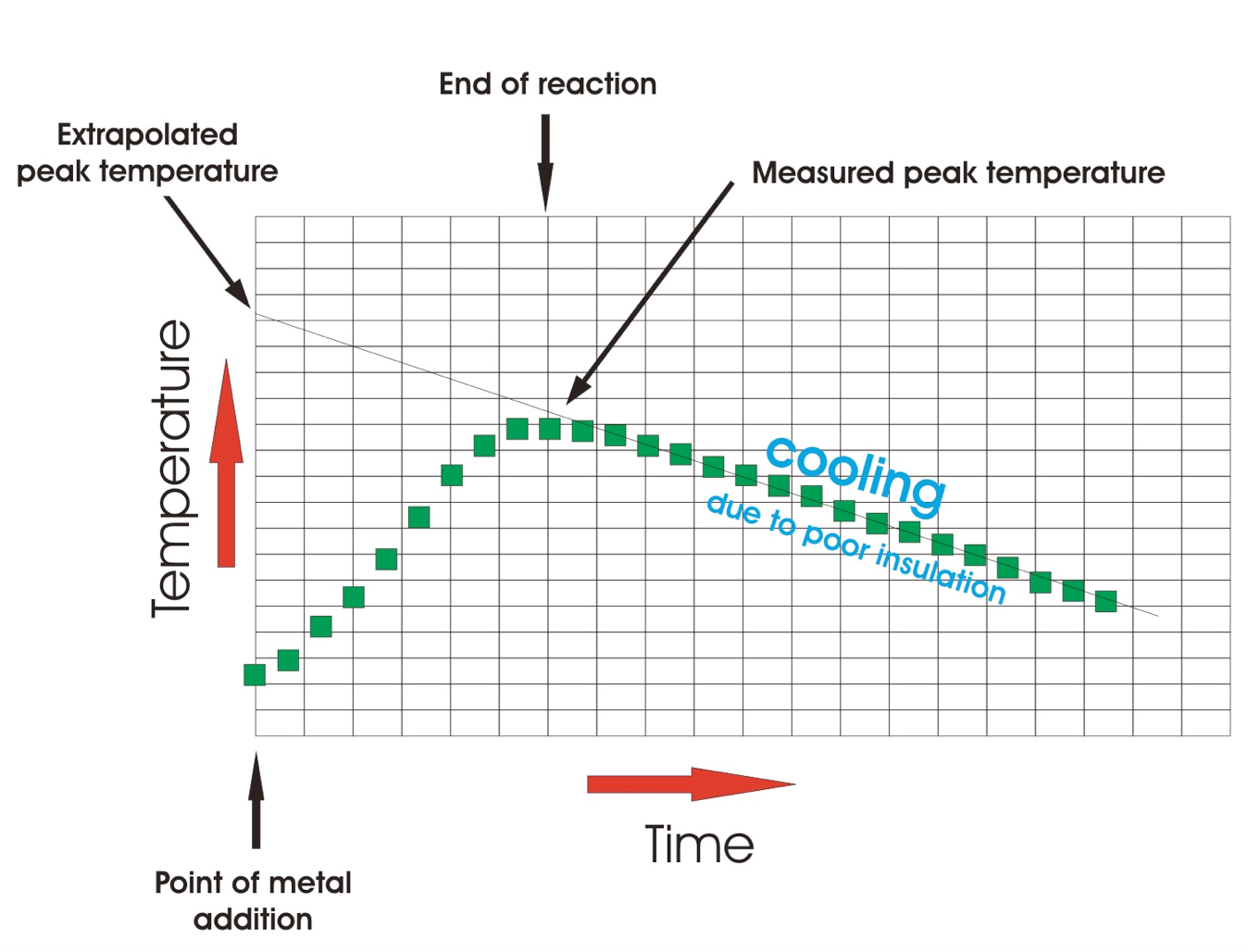
This graph plots temperature as a function of time during a chemical reaction, illustrating a continuous rise and subsequent cooling. Because the curve is continuous, any temperature between the initial and peak values must occur at some time during the experiment, which is precisely the situation where the Intermediate Value Theorem applies. The additional annotations about heat loss and extrapolated temperature are experimental details beyond what the AP Calculus AB syllabus requires, but they do not affect the basic continuity idea. Source.
Intermediate Value Theorem (IVT): If a function is continuous on a closed interval and takes values f(a)f(a)f(a) and f(b)f(b)f(b), then it must take every value between f(a)f(a)f(a) and f(b)f(b)f(b) at least once within that interval.
A continuous model ensures that if conditions differ at two times or two positions, then all intermediate conditions must occur somewhere between those points.
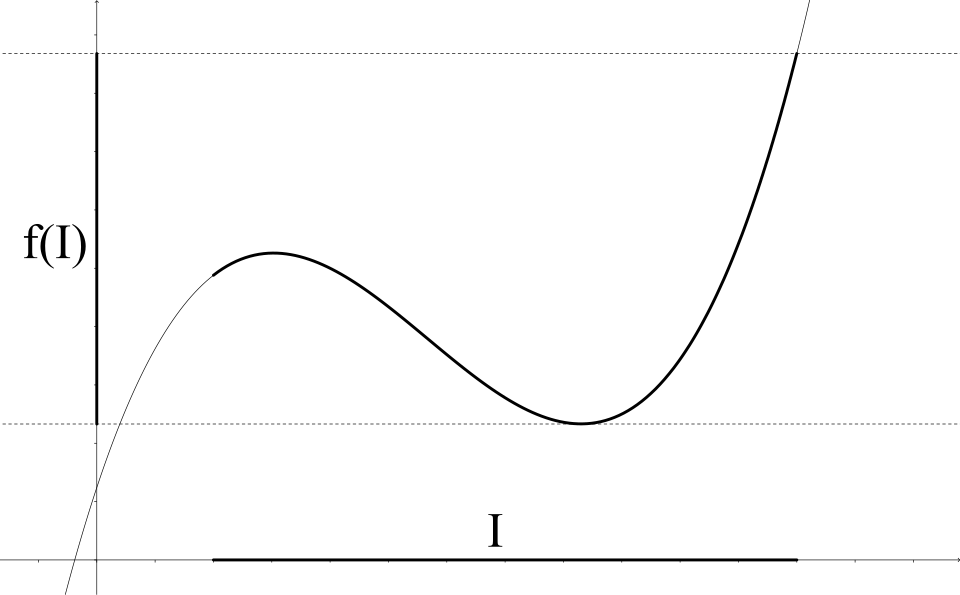
A continuous function on a closed interval takes every intermediate value between its endpoint values, as guaranteed by the Intermediate Value Theorem. The horizontal line represents a target value that the function must hit somewhere in the interval. This diagram focuses on existence, not on finding the exact value of the input where the crossing occurs. Source.
Why the IVT Justifies Real-World Conclusions
The power of the IVT in applications comes from linking observed or measured values at two points to the guaranteed existence of an unobserved moment where a certain threshold is crossed. This allows predictions or arguments even when the full functional form of the phenomenon is unknown.
Key reasons the theorem is valuable include:
Bridging limited data and complete behavior: Knowing only two values can justify the existence of critical intermediate values.
Avoiding reliance on explicit formulas: Many applied situations lack simple algebraic expressions, yet continuity assumptions remain reasonable.
Supporting scientific and engineering reasoning: Threshold crossings often matter more than exact times or positions.
Typical Real-World Scenarios Involving the IVT
Students should recognize common categories of problems where the IVT provides a legitimate basis for conclusions:
Temperature or climate change: A continuously varying temperature must pass through any intermediate temperature between observed readings.
Motion and navigation: A moving object’s continuous position function must cross any height, depth, or coordinate lying between two known positions.
Biology and chemistry: Concentrations, pH, or population levels modeled continuously must reach intermediate values when transitioning between states.
Economics: Cost, supply, or revenue curves modeled as continuous must take on intermediate levels between two measured points.
Requirements for Applying the IVT in Context
When applying the theorem to real-world change, students must verify three essential ideas:
Continuity: The quantity must be modeled by a continuous function—no jumps, breaks, or instantaneous leaps.
Closed interval: The starting and ending points must bound the interval of interest.
Intermediate value identification: A target value must lie between the two known outputs of the function.
These requirements align precisely with how the AP syllabus frames the need to justify that “a continuous quantity must take on a specified intermediate value.”
Logical Structure of IVT-Based Arguments
When constructing reasoning for real-world modeling, students should organize their explanations clearly and mathematically:
State the function being considered and the variable on which it depends (time, position, etc.).
Assert or justify that the function is continuous on the specified interval.
Identify the two functional values and show that the desired intermediate value lies between them.
Conclude that, by the Intermediate Value Theorem, the function must take the intermediate value at some point in the interval.
This structure mirrors the expectations of formal mathematical justification while remaining accessible in applied contexts.
Nuances of Modeling Continuous Quantities
Real phenomena can sometimes appear discontinuous due to measurement limitations. Nonetheless, many physical quantities—temperature, position, velocity, density—are inherently continuous. The IVT applies to the mathematical model rather than raw data points, so students must reflect on whether it is reasonable to treat the quantity continuously. Doing so often strengthens arguments about the inevitability of crossing thresholds.
Between measurement points, the IVT allows reasoning without interpolation. For example, if two observations differ meaningfully, continuity requires the existence of all intermediate observations, even if they were not directly recorded.
Using IVT to Support Claims in Applied Problems
The syllabus highlights modeling tasks in which students justify the existence of a moment or location where conditions match a given requirement. Typical claims the IVT can support include:
A temperature must have reached a freezing point at some time between two readings.
A rising water level must have crossed a specific safety threshold.
An object traveling upward must have passed through a designated height.
A chemical concentration must have reached an effective dosage level.
In each case, the strength of the argument is not numerical precision but the guarantee provided by continuity and the IVT.
Distinguishing IVT Arguments from Other Limit or Continuity Reasoning
While the IVT is grounded in continuity, its purpose differs from evaluating limits or checking for discontinuities. Its role is existence, not computation. Students should focus on whether a needed value must occur, not when or how often it occurs. This distinction is central to mastering the application of the syllabus statement.
Layered Reasoning for Complex Situations
Some modeling situations involve multiple stages of reasoning. A student may:
Model the phenomenon with an appropriate continuous function.
Identify inequalities or target levels relevant to the problem.
Use the IVT to argue that crossing points must exist.
This layered approach demonstrates a deep conceptual grasp of how continuity supports conclusions about real-world behavior.
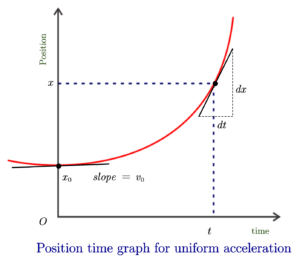
This diagram shows position plotted against time for an object undergoing uniform acceleration, with a smooth curve connecting points A and B. The continuity of the curve guarantees that the object’s position takes every intermediate value between its starting and ending positions, so it must pass through any specified height in between, as the Intermediate Value Theorem asserts. Extra labels such as , , and the chord between A and B relate to average velocity and are not required by the AP Calculus AB IVT syllabus, but they remain consistent with the underlying continuous model. Source.
Practice Questions
Question 1 (1–3 marks)
A lake’s water depth is modelled by a continuous function D(t), where t is the number of hours after midnight. At 6:00 a.m., the depth is 1.8 metres, and at 8:00 a.m., the depth is 2.4 metres.
Using the Intermediate Value Theorem, explain why there must be a time between 6:00 a.m. and 8:00 a.m. when the water depth is exactly 2.1 metres.
Question 1
• 1 mark: States or implies that D(t) is continuous on the interval between 6:00 a.m. and 8:00 a.m.
• 1 mark: Identifies that 2.1 metres lies between the values 1.8 metres and 2.4 metres.
• 1 mark: Concludes that, by the Intermediate Value Theorem, there must be a time in the interval when D(t) = 2.1 metres.
Question 2 (4–6 marks)
The height h(t) of a drone above the ground, measured in metres, is modelled by a continuous function for 0 ≤ t ≤ 12 seconds. The drone is recorded at 3 metres above the ground at t = 0 seconds and at 11 metres above the ground at t = 12 seconds.
A safety alarm is triggered whenever the drone’s height first reaches 8 metres.
(a) Use the Intermediate Value Theorem to show that the alarm must be triggered at some time t within the interval 0 ≤ t ≤ 12.
(3 marks)
(b) A second measurement shows that at t = 4 seconds the drone is at 5 metres. Without calculating the exact time, explain why the moment the alarm triggers must occur after t = 4 seconds.
(2 marks)
(c) State one assumption about the physical situation that justifies using the Intermediate Value Theorem in this context.
(1 mark)
Question 2
(a) (3 marks)
• 1 mark: States that the height function h(t) is continuous on the interval 0 ≤ t ≤ 12.
• 1 mark: Notes that 8 metres lies between the values 3 metres and 11 metres.
• 1 mark: Concludes that the Intermediate Value Theorem guarantees at least one time t in the interval when h(t) = 8.
(b) (2 marks)
• 1 mark: Recognises that at t = 4 seconds the drone is still below 8 metres.
• 1 mark: Explains that since the height increases from 5 metres at t = 4 to 11 metres at t = 12, continuity ensures the height must cross 8 metres after t = 4 seconds.
(c) (1 mark)
• 1 mark: States an appropriate assumption, such as: the drone’s height changes continuously with no instantaneous jumps, allowing the use of the Intermediate Value Theorem.
FAQ
A situation is typically modelled as continuous if the underlying quantity varies smoothly without abrupt physical jumps. Temperature, height, water level, and concentration nearly always satisfy this.
When unsure, check whether:
• The variable represents a physical measurement that changes gradually.
• Any observed jumps are due to measurement error rather than genuine discontinuities.
If the phenomenon is inherently discrete, such as population counted in whole numbers, continuity is not justified.
The theorem ensures at least one point where the intermediate value occurs but provides no information about uniqueness or frequency.
A continuous function may:
• Cross the same value many times.
• Reach the value once and then remain above or below it.
Further analysis, such as monotonicity, is needed to determine the number of crossings.
Yes, as long as two function values are known at the ends of an interval and continuity on that interval is justified.
You do not need the formula for the function.
You do not need a graph or table with densely sampled points.
The theorem relies purely on:
• Continuity of the model.
• The target value lying between the two known outputs.
Measurement uncertainty does not invalidate IVT reasoning if the underlying phenomenon remains continuous.
However, uncertainty may require:
• Allowing for a range around measured values.
• Considering whether the intermediate value could fall within this range.
As long as continuity holds and the intermediate value still lies between feasible endpoint measurements, the IVT argument remains sound.
Errors typically arise when a situation is incorrectly assumed to be continuous.
Common pitfalls include:
• Hidden discontinuities, such as sudden mechanical switches or digital cut-offs.
• Treating discrete data as if it came from a continuous process.
• Ignoring physical constraints that limit the variable’s possible values.
Valid IVT conclusions require both the mathematical model and the actual phenomenon to behave continuously.