

AP Syllabus focus:
‘Differentiate expressions that involve sine, cosine, exponential, and logarithmic functions together, using sum, difference, and constant multiple rules appropriately.’
This subsubtopic develops skill in differentiating expressions that combine trigonometric, exponential, and logarithmic functions, emphasizing rule fluency and structural insight rather than computational shortcuts.
Combining Multiple Derivative Rules
When trigonometric, exponential, and logarithmic expressions appear together, the goal is to apply known derivative formulas while organizing work with the sum, difference, and constant multiple rules. These rules allow derivatives to be taken term by term, which is essential when expressions mix several types of functions. Because AP Calculus AB centers on conceptual coherence, students should recognize how the structure of a function determines the combination of rules needed.
Core Derivatives Used in Combination
Before combining rules, recall essential single-function derivatives, as they will serve as building blocks for mixed expressions.
Derivative of sine: The derivative of is , representing the instantaneous rate of change of the sine function.
A sentence here ensures appropriate spacing between definition blocks.
Derivative of cosine: The derivative of is , capturing how the cosine curve decreases where sine increases.
These trigonometric derivatives pair naturally with the exponential and logarithmic derivatives when applying rule combinations.
A sentence here transitions to exponential and logarithmic derivatives.
Derivative of the natural exponential function: The derivative of is , reflecting its unique proportional growth property.
A sentence here reinforces the connection to rule-based differentiation.
Derivative of the natural logarithm: For , the derivative of is , giving the multiplicative rate of change of logarithmic growth.
Using these fundamental results, students can differentiate complex expressions composed of several function types.
For trigonometric terms, the key facts are and .
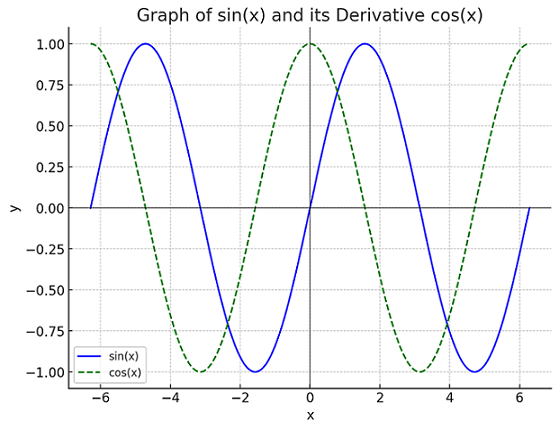
Graph of and its derivative . The slope of the curve at each point matches the value of , illustrating the derivative relationship. This visual supports using these basic trig derivatives as building blocks when differentiating more complicated expressions. Source.
Applying Sum, Difference, and Constant Multiple Rules
Mixed-function differentiation relies on rule layering. These rules ensure derivatives are taken efficiently without resorting to the limit definition.
Structural Principles
• The sum rule states that the derivative of a sum is the sum of the derivatives.
• The difference rule applies identically but with subtraction preserved.
• The constant multiple rule allows constants to be factored out before differentiating.
These rules matter because expressions involving sine, cosine, exponentials, and logarithms often combine terms that change at different rates, and differentiating them separately maintains clarity.
When Trigonometric, Exponential, and Logarithmic Terms Interact
Students frequently encounter functions where these expressions appear together in additive or multiplicative structures. Although this subsubtopic focuses on combining derivative types through sum-based rules, recognizing structural variety is crucial. Mixed expressions typically fall into categories such as:
• A trigonometric function multiplied by a constant or combined with in a sum.
• A logarithmic function appearing alongside trigonometric terms in a model or context.
• An exponential expression added to or subtracted from a trigonometric function.
In each case, derivatives are computed independently for each term, relying on known formulas.
Integrating Known Derivatives into Combined Expressions
Understanding how to integrate multiple derivative formulas begins with identifying each term’s type. Because differentiation is linear, the form of each term dictates the procedure.
Identifying Component Types
• Trigonometric components contribute derivatives involving other trigonometric functions.
• Exponential components maintain their original form after differentiation.
• Logarithmic components produce reciprocal expressions.
The derivative rules interact predictably, reinforcing the importance of recognizing patterns.
Organizing Mixed-Term Derivatives
To maintain clarity, students should differentiate term by term and rewrite expressions cleanly. A structured approach improves accuracy and interpretation.
• Label each term by type before differentiating.
• Apply the appropriate fundamental derivative formula.
• Apply the sum, difference, or constant multiple rule as needed.
• Maintain original structure where possible to preserve interpretive meaning.
This organizational strategy supports the AP requirement to “differentiate expressions that involve sine, cosine, exponential, and logarithmic functions together” by ensuring that the correct derivative formula is applied to each constituent part.
For logarithmic terms with , remember , which will often appear when you differentiate products or sums involving .
Role of Algebraic Simplification
After taking derivatives, simplification helps highlight relationships between terms without altering analytic meaning. Simplification may include factoring constants, combining like terms, or rewriting trigonometric expressions using familiar identities if they clarify structure. Although simplification is not always required, it is often helpful for interpretation, especially when expressions represent changing physical or contextual quantities.
Conceptual Understanding in Context
Because these derivative combinations frequently appear in applied settings, it is important to understand not only how to differentiate them, but also why the rules behave as they do.
• Trigonometric derivatives encode oscillatory change.
• Exponential derivatives encode proportional or rapid growth.
• Logarithmic derivatives encode decelerating growth.
Because and are inverse functions, combined expressions such as frequently appear in calculus models, and their derivatives must be handled together.
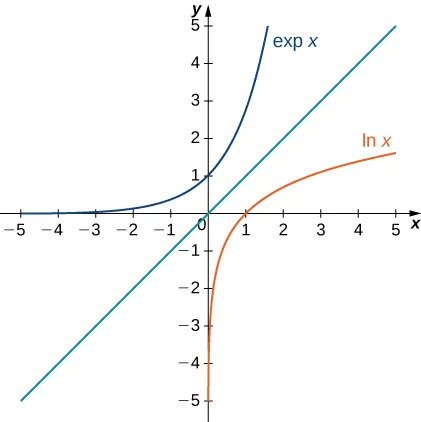
Graphs of , , and on shared axes. The exponential and logarithmic curves mirror across , demonstrating their inverse relationship. This inverse structure explains why derivative rules for exponentials and logarithms often arise together in combined expressions. Source.
Practice Questions
Question 1 (1–3 marks)
Differentiate the function
f(x) = 3 e^x + 2 sin x − ln x.
Give your answer in its simplest form.
Question 1
• Correct derivative of 3 e^x is 3 e^x: 1 mark
• Correct derivative of 2 sin x is 2 cos x: 1 mark
• Correct derivative of − ln x is − 1/x: 1 mark
Final answer: f'(x) = 3 e^x + 2 cos x − 1/x
Question 2 (4–6 marks)
A function is defined as
g(x) = e^(2x) sin x − ln(3x).
(a) Find g'(x).
(b) Hence determine the value of g'(0.5), giving your answer correct to three decimal places.
(c) Explain briefly how the different terms in g(x) influence the sign of g'(0.5).
Question 2
(a)
• Use of product rule on e^(2x) sin x: 1 mark
• Correct derivative of e^(2x) is 2 e^(2x): 1 mark
• Correct derivative of sin x is cos x: 1 mark
• Combine terms to obtain e^(2x)(2 sin x + cos x): 1 mark
• Correct derivative of − ln(3x) is − 1/x: 1 mark
Final expression: g'(x) = e^(2x)(2 sin x + cos x) − 1/x
(b)
• Substitution of x = 0.5 into the correct derivative: 1 mark
• Correct numerical evaluation to three decimal places: 1 mark
(Accept values close to the correct evaluation.)
(c)
• A valid explanation noting that the exponential–trigonometric term is positive at x = 0.5 and typically dominates the negative contribution of −1/x: 1 mark
• Must clearly reference how each component affects the sign of g'(0.5).
FAQ
Begin by identifying each term’s type: trigonometric, exponential, or logarithmic. This classification immediately signals which base derivative formula applies.
Next, look for structural features:
• Separate additive terms using sum or difference rules.
• Pull out constants before differentiating.
• Check for implicit products that may require the product rule.
This approach prevents unnecessary algebra and highlights the correct rule combinations.
Exponential functions grow proportionally, while trigonometric functions oscillate. When combined, their behaviours interact rather than simplify.
As a result:
• Differentiation amplifies the exponential part.
• The oscillatory part introduces alternating signs and phase changes.
This interplay naturally produces more elaborate expressions, even when the original function looks simple.
Consider each term’s contribution separately.
• Exponential terms are always positive and may dominate if large in magnitude.
• Trigonometric terms oscillate between −1 and 1, so their impact depends on phase.
• Logarithmic derivatives contribute a reciprocal term, whose sign depends solely on the sign of the input.
A qualitative comparison of magnitudes often reveals the overall sign.
The most frequent error is forgetting that the derivative of ln(kx) is 1/x, not 1/(kx). The constant k affects only the domain, not the reciprocal value.
Other pitfalls include:
• Treating ln(x) terms as products when they are not.
• Forgetting to apply the chain rule when a logarithm contains a more complex inner function.
Checking the argument of the logarithm helps avoid these issues.
Simplification highlights structural relationships between the resulting terms. This improves readability and helps identify dominant behaviour.
For example:
• Factoring out an exponential term shows how trigonometric components modulate growth.
• Combining reciprocal terms clarifies long-term trends.
• Rewriting expressions symmetrically can reveal cancellation or periodicity.
These insights are especially useful when interpreting real-world rate-of-change models.
