

AP Syllabus focus:
‘Use the quotient rule to differentiate rational functions and simplify the resulting expressions.’
Differentiating rational functions requires careful application of the quotient rule, enabling students to compute derivatives of expressions written as one function divided by another while maintaining algebraic accuracy.
Applying the Quotient Rule to Rational Functions
The quotient rule provides a structured method for differentiating any expression written as a rational function, meaning a function formed by the quotient of two differentiable functions. Mastery of this rule allows students to handle a wide range of algebraic forms that cannot be simplified conveniently before differentiating. Because rational expressions appear frequently in applied contexts, developing fluency with this derivative rule is essential for interpreting change in complex models.
Understanding Rational Functions in Differentiation
A rational function is any function expressible as one differentiable function divided by another nonzero differentiable function. When such a function cannot be simplified into a polynomial or another more convenient form, the quotient rule becomes the main tool for differentiation. Students should focus on identifying structure, organizing derivative components clearly, and recognizing opportunities to simplify before or after applying the rule.
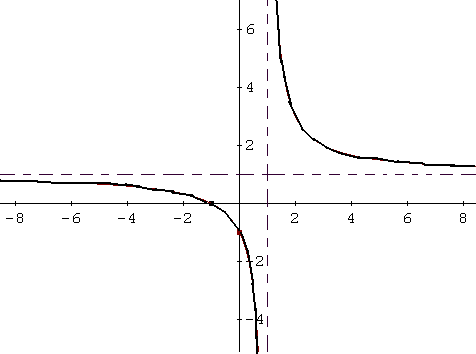
This figure graphs the rational function , illustrating how the numerator and denominator define asymptotes and intercepts. It supports understanding of rational functions as quotients of differentiable expressions, showing how denominator values determine where the function is undefined. The asymptote labels extend slightly beyond the AP Calculus AB quotient-rule subtopic but aid in conceptualizing rational function behavior. Source.
Before introducing the formal rule, it is important to highlight that the derivative of a quotient cannot be obtained by simply dividing derivatives of the numerator and denominator; rather, both the numerator and denominator contribute to the total rate of change. This interdependence motivates the form of the quotient rule.
= differentiable numerator function
= differentiable denominator function, with
and = derivatives of and with respect to
A rational derivative always depends on both how the numerator changes and how the denominator changes. This relationship results in the distinctive “” structure in the rule, reflecting how the growth of one function influences the quotient differently than the growth of the other.
When the Quotient Rule Is Necessary
AP Calculus AB problems often require applying the quotient rule when:
The given expression is explicitly written as and cannot be simplified by algebraic manipulation.
Simplification would require complex factoring or expansion that does not reduce the expression meaningfully.
The functions in the numerator and denominator each change in ways that must be considered independently for accurate differentiation.
A context problem involves a ratio of two varying quantities, requiring the instantaneous rate of change of the entire ratio.
Recognizing these situations helps prevent calculation errors and ensures efficient problem-solving.
Key Structural Features of the Quotient Rule
The quotient rule follows a consistent pattern that students should memorize conceptually, not only symbolically.
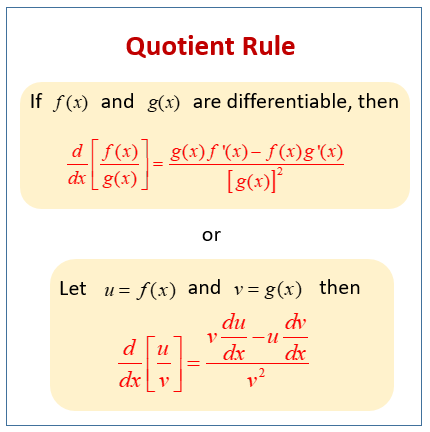
This diagram displays the quotient rule for , emphasizing the structure . It highlights conditions such as and clarifies the “low–d-high minus high–d-low over low squared” pattern. The visual arrangement reinforces the organization students should apply when differentiating rational functions. Source.
Important structural ideas include:
The derivative is built from the product of the derivative of the numerator and the original denominator, minus the product of the original numerator and the derivative of the denominator.
The denominator of the derivative is always the square of the original denominator, ensuring it remains nonnegative and retains the rational structure.
Although the formula is fixed, the order matters; reversing terms leads to an opposite sign, changing the derivative entirely.
The rule balances how the numerator contributes to change with how the denominator contributes, capturing the behavior of ratios accurately.
Students should also understand that subtracting from serves to adjust the overall rate of change by removing the contribution that arises solely from the denominator’s variation.
Strategy for Applying the Rule Effectively
Successful use of the quotient rule depends on organization and attention to detail. When approaching a rational function:
Identify and clearly before finding derivatives.
Compute and separately to avoid mixing components during substitution.
Substitute carefully into the structure with attention to parentheses.
Maintain the denominator squared as , verifying that the function remains defined where required.
Simplify only after substitution; premature simplification can introduce errors.
Check for common factors that may be cancelled after differentiation, but only when permitted by algebraic rules.
Because each function’s behavior affects the quotient differently, careful organization prevents confusion between roles of , , , and .
Importance of Simplification After Differentiation
After applying the quotient rule, the resulting expression often contains multiple algebraic terms that can be combined or factored for clarity. Simplifying is not merely stylistic; it enhances interpretability, reveals structure, and ensures the derivative is expressed in its most efficient form. Additionally, in applied contexts, a simplified derivative is easier to analyze when describing how one quantity changes relative to another.
Conceptual Interpretation of the Rule
The quotient rule captures how two varying functions interact when forming a ratio. The numerator’s rate of change alone is insufficient to describe the behavior of the whole quotient; the denominator’s change modifies how the ratio behaves over time or across inputs. Understanding this interaction strengthens students’ ability to analyze rational models in scientific and econom
Practice Questions
Question 1 (1–3 marks)
A function is defined by h(x) = (3x + 1) / (x - 2).
(a) Use the quotient rule to find h'(x).
(b) State the value of x for which h'(x) is undefined.
Question 1
(a) Correct application of the quotient rule:
h'(x) = ( (3)(x - 2) - (3x + 1)(1) ) / (x - 2)^2
• 1 mark for correct structure of quotient rule.
• 1 mark for correctly expanding and simplifying the numerator to -3 / (x - 2)^2.
(b) h'(x) undefined at x = 2.
• 1 mark for identifying x = 2 as the value that makes the denominator zero.
Question 2 (4–6 marks)
A differentiable function f has derivative f '(x) = 2x - 5. Consider the rational function
R(x) = f(x) / (x + 3).
(a) Use the quotient rule to find R'(x) in terms of f(x).
(b) Given that f(1) = 4, find the value of R'(1).
(c) Explain briefly why the quotient rule cannot be applied at x = -3.
Question 2
(a) Differentiating using the quotient rule:
R'(x) = [ f '(x)(x + 3) - f(x)(1) ] / (x + 3)^2
• 1 mark for correct quotient rule structure.
• 1 mark for correct substitution of f '(x).
(b) Substitution of x = 1:
R'(1) = [ (2(1) - 5)(1 + 3) - f(1) ] / 16
= [ (-3)(4) - 4 ] / 16
= -16 / 16
= -1
• 1 mark for correct substitution.
• 1 mark for correct simplification and final answer.
(c) Explanation: The quotient rule requires the denominator to be non-zero; at x = -3 the function R is undefined.
• 1 mark for stating that the denominator is zero at x = -3 and therefore R(x) is not defined.
• 1 mark for stating that the quotient rule cannot be applied when the function itself is undefined.
FAQ
Simplification is helpful when it removes factors or rewrites the expression in a way that avoids unnecessary quotient rule steps, such as converting a rational expression into a product with a negative power.
However, you should only simplify when it leads to a genuinely easier differentiation path.
Avoid simplifying if doing so introduces more algebraic complexity, such as expanding large polynomials.
The subtraction reflects how the numerator and denominator change in opposite structural roles. Increasing the numerator increases the quotient, whereas increasing the denominator decreases it.
The rule captures this balance, ensuring the derivative measures the net effect of both changing functions.
Think of it as adjusting for the denominator’s contribution so that the final expression correctly reflects instantaneous change in the entire ratio.
Sign errors typically arise from forgetting to distribute a negative across the entire second product in the numerator.
Common pitfalls include:
• Omitting parentheses around fg'
• Incorrectly reversing the order of the terms in the numerator
• Neglecting that the entire numerator expression sits over g(x) squared
Keeping the rule in the consistent structure f'g minus fg' helps avoid these mistakes.
No. The derivative of a quotient is almost never equal to the quotient of the derivatives, except in very special cases where both functions behave proportionally.
The structure of a ratio means both components influence the overall change rate, which is why the quotient rule is required.
The only safe scenario where simplification works is when algebraic manipulation removes the quotient entirely before differentiating.
In many contexts, one quantity is defined relative to another, such as efficiency, density, or average cost. Each of these is naturally represented as a ratio.
The quotient rule allows you to understand how the ratio changes when both numerator and denominator vary simultaneously.
This is especially useful when interpreting trends, such as whether a ratio increases or decreases depending on which quantity changes more rapidly.
