
AP Syllabus focus: ‘Most factors of production, such as land, labor, and capital, are scarce resources that create trade-offs in production.’
Scarcity is easiest to understand by looking at the inputs needed to make goods and services. Because these inputs are limited, every producer and society must choose among competing uses, accepting trade-offs.
Factors of production and the production problem
Factors of production: The resources used to produce goods and services, typically grouped as land, labor, capital, and entrepreneurship.
Producers combine factors of production to transform inputs into outputs. Since most inputs are limited relative to the many ways they could be used, scarcity forces choices such as:
Which goods to produce versus which to forgo
Which production methods to use (more workers vs. more machines)
Which projects to fund now versus later
The four factors of production
Land (natural resources)
Land: All natural resources used in production, including physical space and raw materials (e.g., farmland, forests, water, oil, mineral deposits).
Land is scarce because natural resources are finite, unevenly distributed, and often have competing uses. In microeconomics, “land” includes both renewable and nonrenewable inputs, and scarcity may become more binding as extraction costs rise or as regulation limits use.
Key implications of scarce land:
Firms face higher costs when the best-quality sites or deposits are already in use
Using land for one purpose means not using it for another (e.g., housing vs. agriculture)
Labor (human effort)
Labor: The human time, effort, and skills used to produce goods and services.
Labor is scarce because workers have limited hours, differing skills, and alternative employment opportunities. A firm that hires more workers may need to offer higher wages, train new employees, or accept lower productivity if the additional hires are less well-matched to the job.
Common labor trade-offs:
Hiring more staff vs. investing in equipment
Scheduling overtime vs. expanding the workforce
Using high-skill workers for routine tasks vs. specialized tasks
Capital (produced resources used to produce)
Capital: Man-made, produced goods used to produce other goods and services (e.g., machinery, tools, buildings, trucks, computers).
Capital is scarce because it requires prior production and financing. Choosing to build or buy capital goods uses resources that could have produced consumer goods instead, and capital must be maintained, upgraded, and allocated across different lines of production.
Important distinctions for AP Micro:
Capital ≠ money; money is a financial asset, while capital is a productive input
Capital choices often involve long-term commitments and switching costs
Entrepreneurship (coordination and risk-bearing)
Entrepreneurship is scarce because not everyone is willing or able to identify opportunities, organize production, and bear uncertainty. Entrepreneurs decide:
What to produce (product selection)
How to combine inputs (production method)
How much to produce (scale)
Whether to innovate or enter/exit a market
Entrepreneurial decision-making is central to how scarce inputs are allocated within and across industries.
Why factors are scarce (and why it matters)
Scarcity means that, at any point in time, available factors of production are limited relative to all the possible goods and services society could produce. Scarcity shows up as constraints such as:
Limited arable land, mineral reserves, or suitable retail locations
Limited skilled workers in particular occupations or regions
Limited machines, factory capacity, or logistics networks
Limited managerial attention and organisational capability
Because factors are scarce, using more of one factor typically requires:
Taking it away from another use (an opportunity cost)
Paying a higher price to attract it (bidding resources away from other producers)
Accepting a less suitable substitute (changing the production process)
Scarcity creates trade-offs in production
When factors are scarce, firms and economies face unavoidable trade-offs, including:
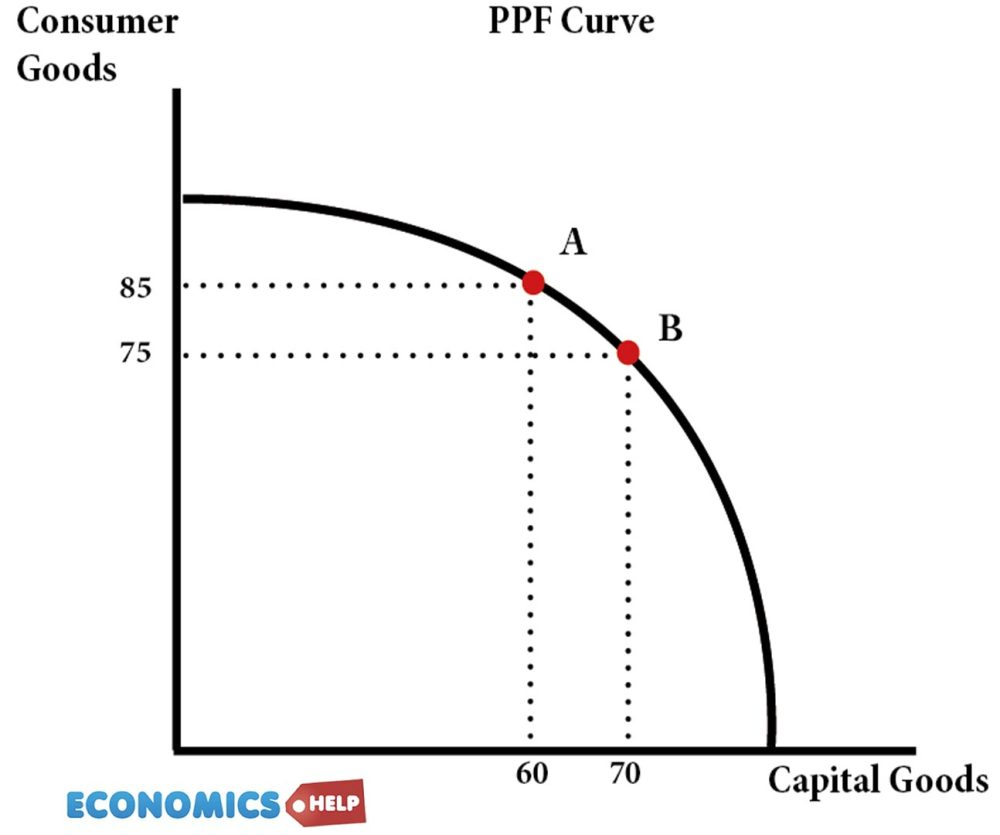
A production possibilities frontier (PPF) with consumer goods on one axis and capital goods on the other, illustrating the economy’s maximum feasible output combinations given scarce resources. Moving along the frontier from one point to another shows the opportunity cost of producing more of one category of output by producing less of the other. Source
Product trade-offs: producing more of one good requires fewer resources for other goods
Input trade-offs: choosing more labor-intensive methods uses fewer machines, and vice versa
Time trade-offs: producing now may reduce resources available for maintenance, training, or future expansion
Location trade-offs: using prime sites for one activity prevents other potentially valuable uses
In competitive markets, the scarcity of factors is reflected in factor prices (wages for labor, rents for land, and returns to capital).
These prices communicate relative scarcity and help ration limited inputs among competing producers.
Practice Questions
(1–3 marks) Define “capital” as a factor of production and give one example. (2 marks)
1 mark: Correct definition: capital is man-made/produced resources used to produce other goods and services.
1 mark: Valid example (e.g., machinery, factory building, tools, delivery vans, computers).
(4–6 marks) Explain how scarcity of factors of production creates trade-offs for a firm deciding whether to expand output. (6 marks)
1 mark: States that factors of production are limited (scarce) relative to wants/possible uses.
1 mark: Links scarcity to the need to choose/allocate inputs among competing uses.
2 marks: Explains at least two specific trade-offs (e.g., hiring labour vs buying machinery; using factory space for Product A vs Product B; spending on new equipment vs maintenance/training), 1 mark each.
1 mark: Explains opportunity cost: more resources used for expansion means fewer resources available elsewhere.
1 mark: Mentions that scarcity can raise factor prices/costs when the firm bids resources away from other uses.
FAQ
Well-defined property rights can make land easier to buy, sell, lease, or collateralise, increasing effective availability to firms.
Weak or disputed rights can reduce usable supply by:
raising transaction costs
increasing risk of expropriation
discouraging long-term investment (e.g., irrigation, soil improvement)
Labour is work effort and time; human capital is the skills and knowledge embodied in workers.
Human capital scarcity matters because skilled labour cannot be created instantly. Training pipelines, licensing, and experience requirements can cause persistent shortages in specific occupations.
Advanced technology often requires complementary scarce inputs:
specialised machines with long delivery times
rare materials and components
skilled technicians to operate and maintain equipment
large upfront financing
So the limiting factor may be capacity, supply chains, or expertise rather than ideas alone.
Higher wages, rents, or equipment costs discourage low-value uses and encourage higher-value uses.
Firms that can generate more revenue from an input are more willing to pay for it, shifting scarce resources toward activities with greater willingness (and ability) to pay.
Yes. Policies can alter labour availability and matching, for example:
immigration rules affecting workforce size and skills
childcare subsidies affecting labour force participation
education/training subsidies affecting skill supply
occupational licensing changing entry into professions