Comprehending the role of the Poisson distribution in linear combinations is vital. This topic illuminates the intriguing property of independent Poisson-distributed random variables summing up to follow a Poisson distribution, a cornerstone concept in statistical analysis.
Understanding the Poisson Distribution
The Poisson distribution is used to model the probability of a number of events happening in a fixed interval of time or space, given a known constant mean rate of occurrence and the independence of events.
- Key Traits of Poisson Distribution:
- Independence of events.
- Constant average rate (λ, lambda).
- Suitable for low-frequency events over large intervals.
Linear Combinations with Poisson Distribution
A linear combination in statistics involves adding or subtracting variables, often multiplied by constants. For Poisson distributions, this translates to combining different Poisson processes.
Examples
Example 1: Combining Two Processes
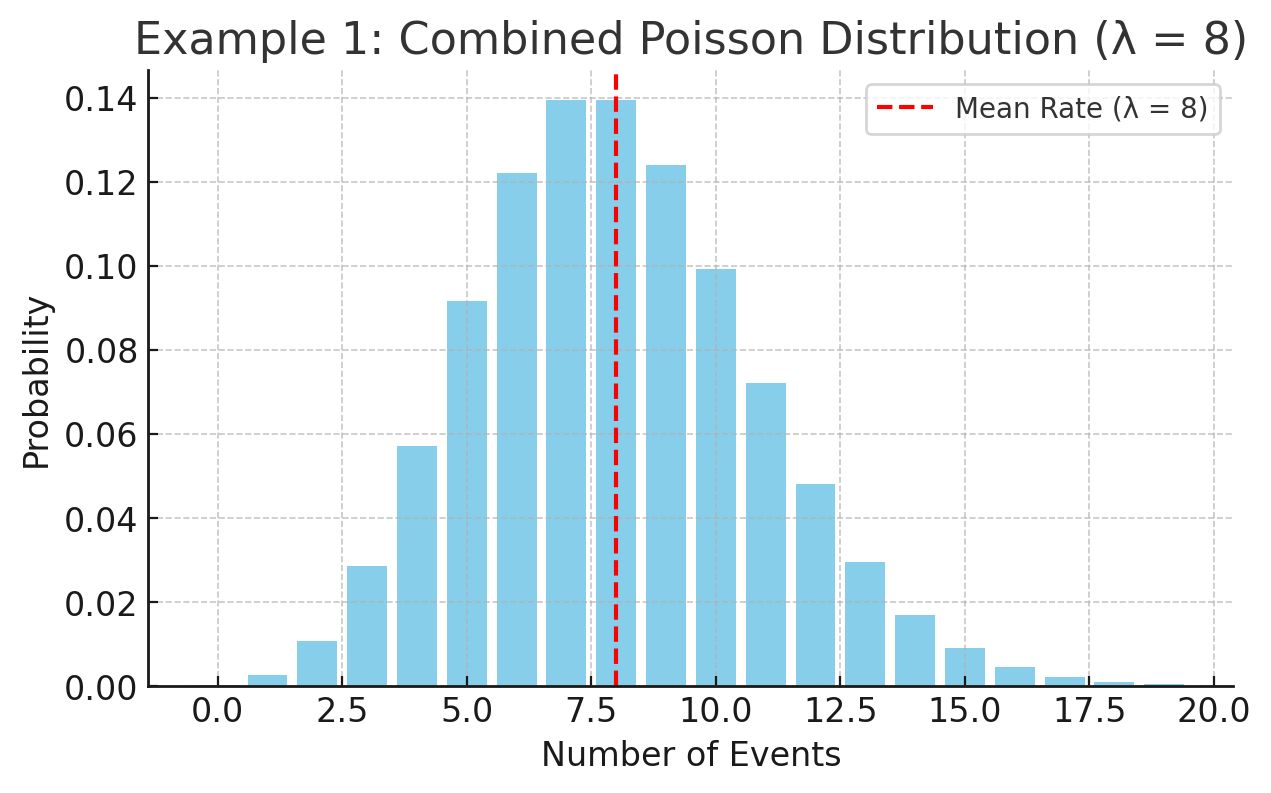
Problem: Two independent Poisson processes have average rates of 3 and 5 events per hour. What is the distribution for the total events in an hour?
Solution:
- Combine the Rates:
- Process = 3, Process = 5.
- Total rate
- Poisson Distribution for Total Events:
- The combined process follows a Poisson distribution with λ = 8.
Example 2: Real-World Call Center
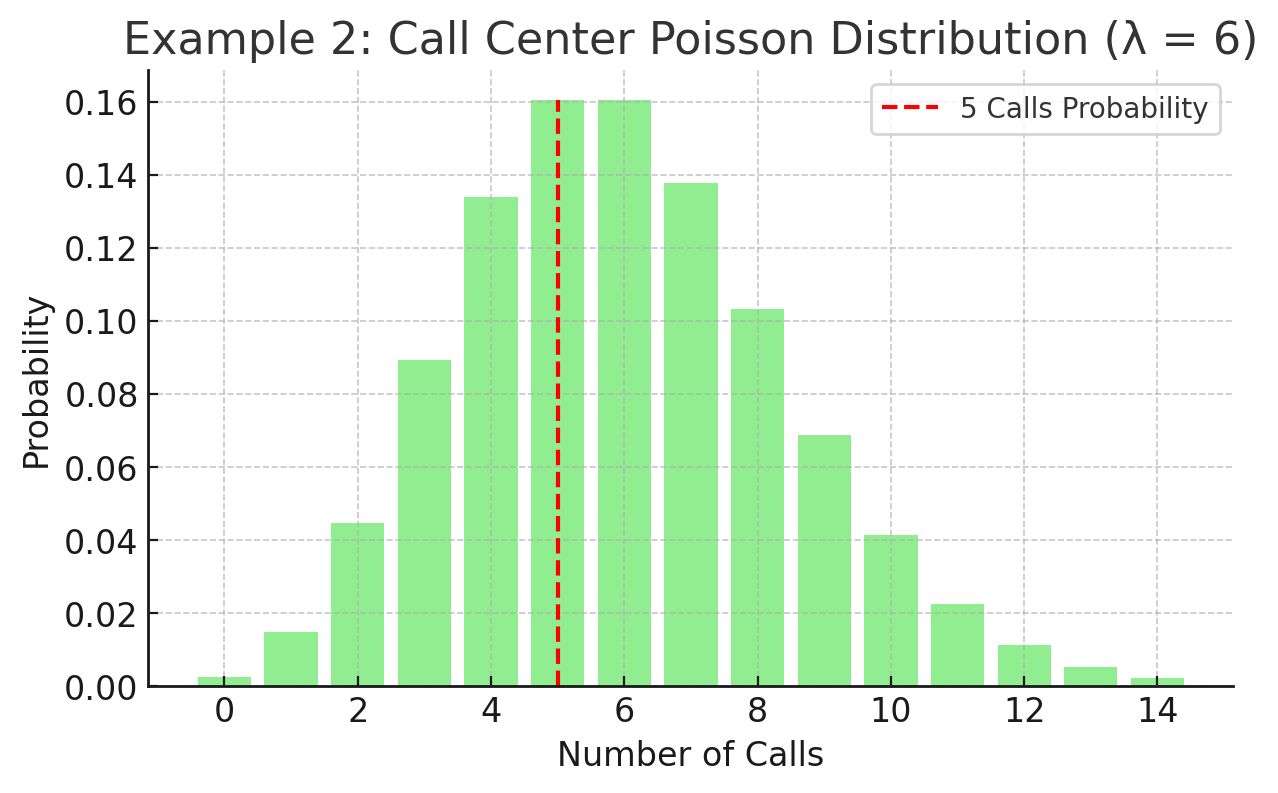
Problem: A call centre gets Type A calls at a rate of 2 per hour and Type B calls at 4 per hour. Calculate the probability of exactly 5 calls in an hour.
Solution:
- Calculate Combined Rate:
- Probability for 5 Calls:
- Use Poisson formula:
- Perform the calculation to find P(X = 5).