

IB Syllabus focus:
'Detailed exploration of how certain substances can inhibit enzymes, focusing on the irreversible changes caused by inhibitors like penicillin.
- Discussion on the development of resistance, such as changes in transpeptidases conferring penicillin resistance.'
The process by which enzymes are inhibited is central to understanding the regulation of metabolic pathways in cells. This regulation is paramount for maintaining cellular homeostasis and responding to various internal and external cues. Delving deeper into these inhibition mechanisms, we'll uncover their biological significance and application.
Competitive Inhibition
Competitive inhibition occurs when a molecule that's structurally similar to the substrate of an enzyme competes for binding at the enzyme's active site.
Competitive Inhibition: A form of enzyme inhibition where a substance resembling the substrate binds to the enzyme's active site, preventing the actual substrate from attaching and thereby slowing or stopping the reaction.
Characteristics:
Structural Similarity: Competitive inhibitors often bear a resemblance to the enzyme's natural substrate, allowing them to fit into the active site.
Reversibility: This inhibition is typically reversible. The binding of the inhibitor can be overcome by increasing the concentration of the substrate.
Vmax and Km: The maximum reaction rate (Vmax) remains unchanged, but the Michaelis constant (Km) increases, indicating that a higher substrate concentration is required to achieve half the maximum rate of reaction.
Michaelis–Menten Equation
v = (Vmax [S]) / (Km + [S])
v = Reaction velocity (rate of enzymatic reaction), typically in μmol/min
Vmax = Maximum reaction velocity when the enzyme is saturated with substrate, typically in μmol/min
[S] = Substrate concentration, typically in mol/L
Km = Michaelis constant, the substrate concentration at which the reaction rate is half of Vmax, typically in mol/L
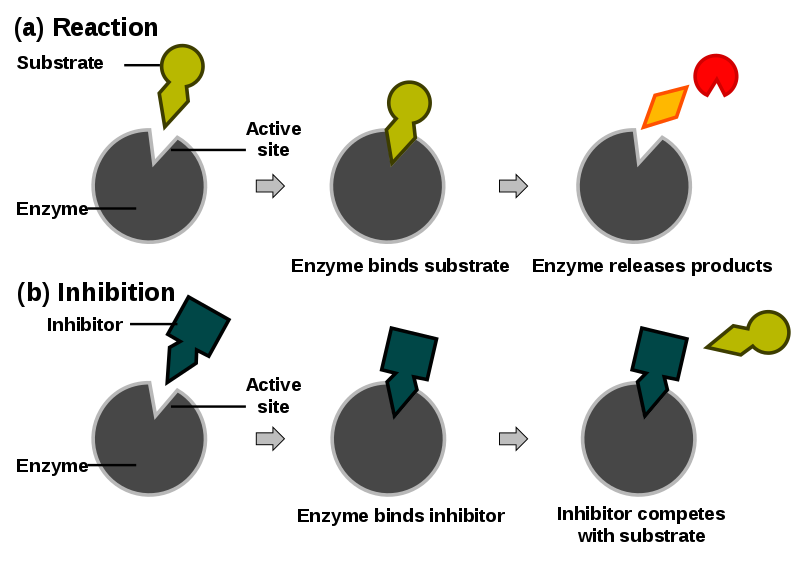
Image courtesy of Jerry Crimson Mann, modified by TimVickers, vectorized by Fvasconcellos
Example: Statins
Statins are a class of drugs prescribed globally to reduce cholesterol levels in patients at risk of cardiovascular diseases.
Mechanism: They act by inhibiting HMG-CoA reductase, a key enzyme in the mevalonate pathway responsible for cholesterol synthesis.
As competitive inhibitors, statins occupy the active site of HMG-CoA reductase, preventing the binding of its natural substrate, HMG-CoA.
Non-competitive Inhibition
Unlike competitive inhibitors, non-competitive inhibitors do not contend with the substrate for the active site but bind elsewhere, leading to an enzyme conformational change.
Non-competitive Inhibition: A type of enzyme inhibition in which the inhibitor binds to an allosteric site, causing a change in the enzyme’s shape that reduces its activity regardless of the substrate concentration.
Characteristics:
Binding Site: Non-competitive inhibitors bind to a location other than the active site, known as the allosteric site.
Vmax and Km: The binding leads to a decrease in the enzyme's Vmax without altering the Km value.
Reversibility: Some non-competitive inhibitors bind reversibly, while others might bind irreversibly, leading to permanent enzyme inactivation.
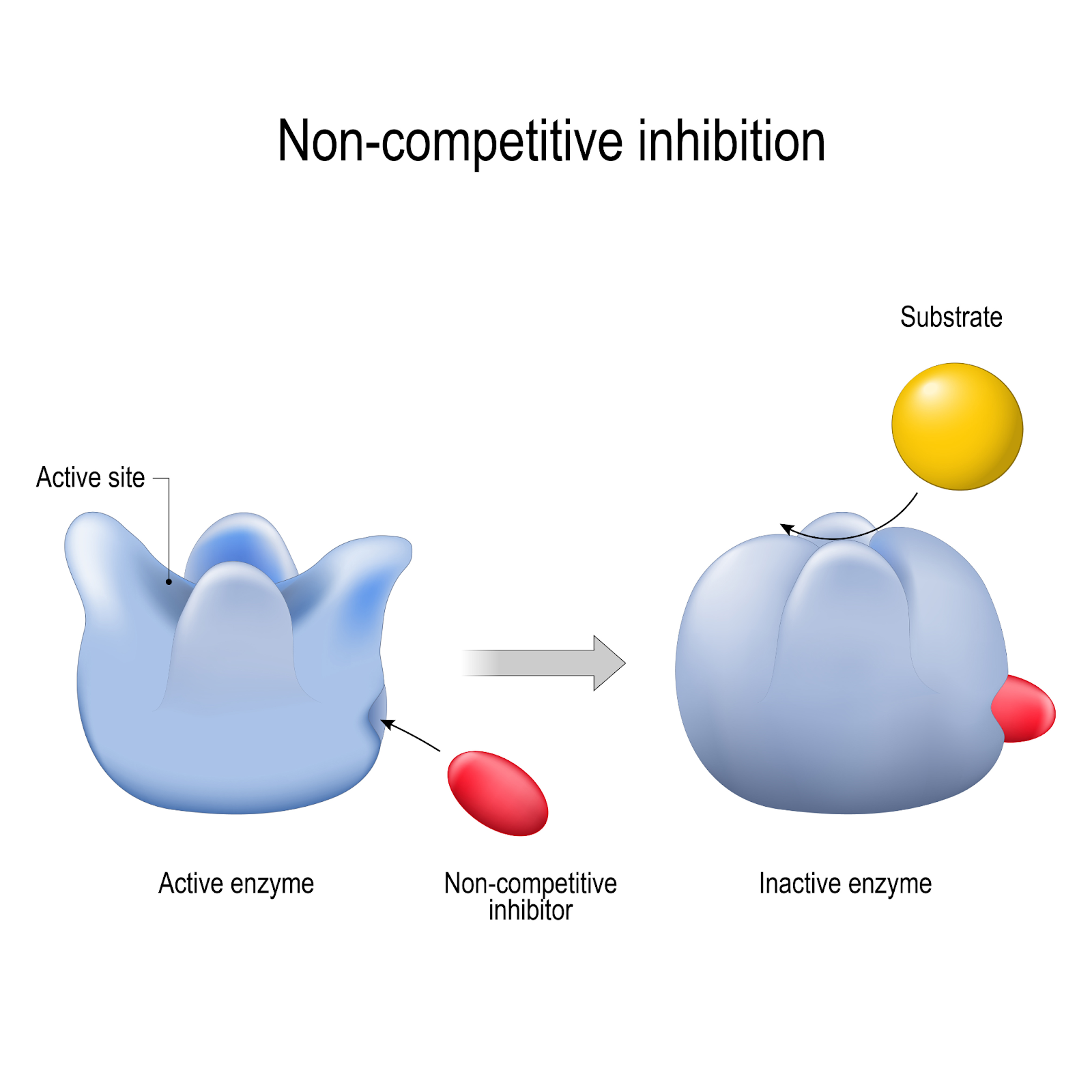
Image courtesy of designua
Feedback Inhibition
Feedback inhibition is an efficient regulatory mechanism wherein the product of a metabolic pathway acts as an inhibitor for an enzyme operating earlier in the sequence.
Feedback Inhibition: A regulatory mechanism in which the accumulation of an end product of a metabolic pathway suppresses the activity of an enzyme involved in an earlier step of that pathway, maintaining metabolic balance.
Characteristics:
Homeostasis: This mechanism ensures that the cell produces only the amount of the end product that it needs, thereby conserving resources and maintaining cellular balance.
Negative Feedback Loop: Feedback inhibition operates as a negative feedback loop. When the end product accumulates and exceeds a threshold level, it inhibits an enzyme early in its synthesis pathway.
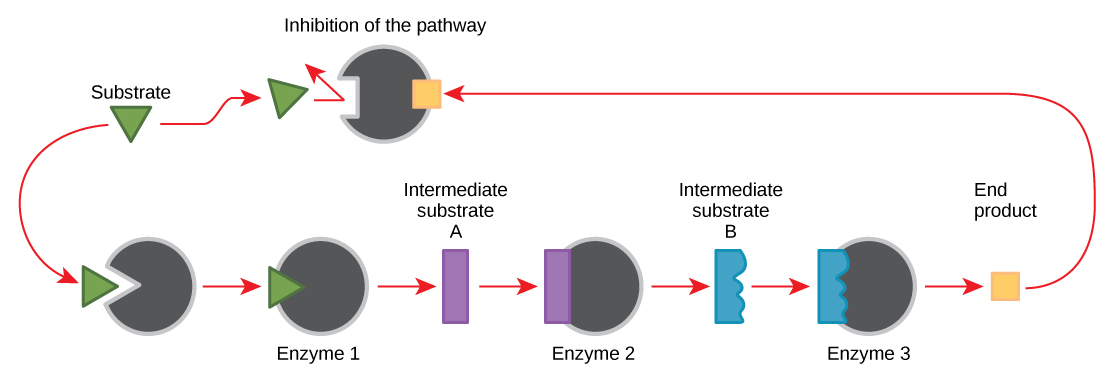
Image courtesy of CNX OpenStax
Example: Isoleucine Synthesis
The amino acid isoleucine is synthesised from another amino acid called threonine.
If isoleucine levels are high, it acts as a feedback inhibitor, binding to the first enzyme in its synthesis pathway.
This halts further production until isoleucine levels drop, at which point the enzyme is freed and can resume its function.
Mechanism-based Inhibition
Mechanism-based or "suicide" inhibition involves the inhibitor binding to the active site and undergoing a transformation to form a covalent bond with the enzyme.
Mechanism-based Inhibition: A process where an initially inactive inhibitor binds to the enzyme’s active site and is converted by the enzyme into a reactive form that forms a covalent bond, permanently inactivating the enzyme.
Characteristics:
Irreversibility: Mechanism-based inhibition results in the irreversible inactivation of the enzyme.
Activation: These inhibitors are initially inactive but become activated after interacting with their target enzyme.
Example: Penicillin
Penicillin, a widely-used antibiotic, targets the bacterial enzyme transpeptidase.
This enzyme is responsible for forming cross-links in bacterial cell walls.
When penicillin binds to transpeptidase, it gets catalytically processed, leading to the formation of a covalent bond.
This bond irreversibly inactivates the enzyme, impeding cell wall synthesis and making bacterial cells susceptible to osmotic lysis.
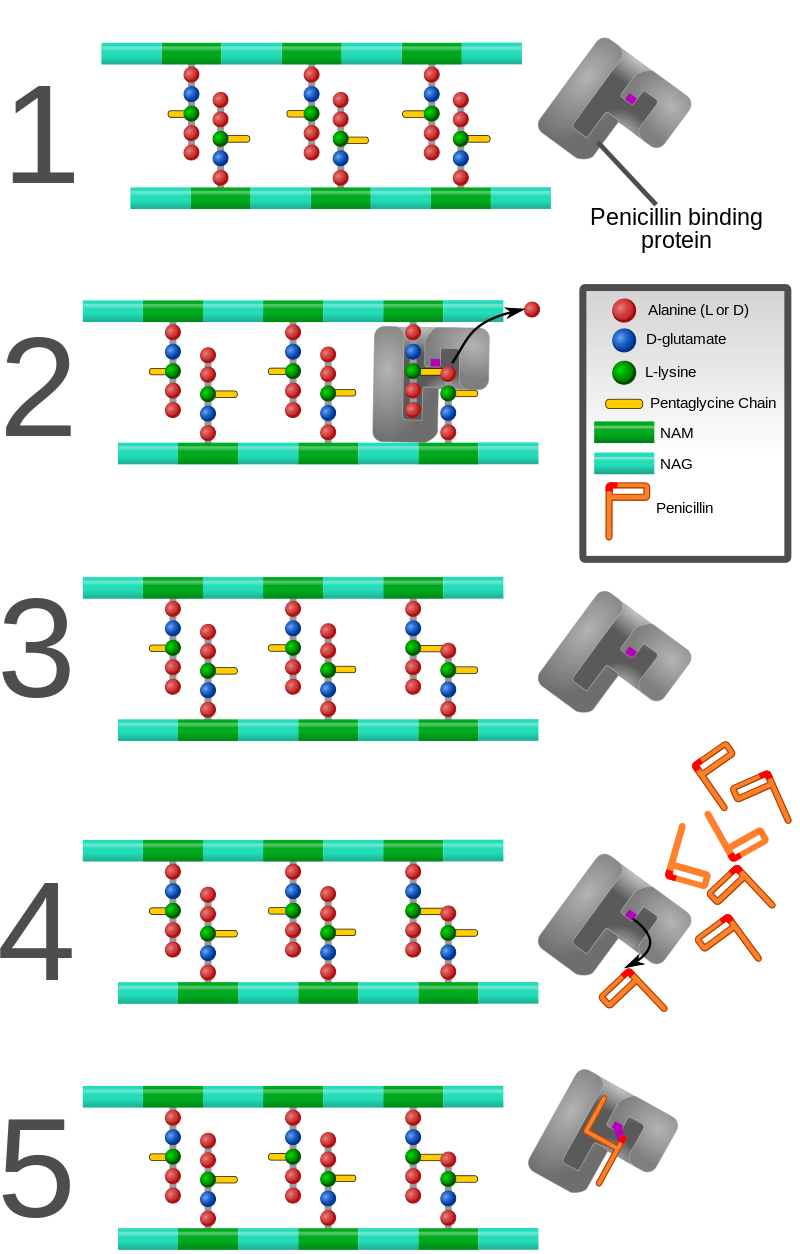
Image courtesy of Mcstrother
Consequences of Mechanism-based Inhibition
Irreversible Loss: Since the enzyme is permanently deactivated, the cell needs to synthesise new enzymes to restore the pathway's function.
Therapeutic Potential: The specificity and irreversibility of mechanism-based inhibitors make them attractive candidates for drug design, especially for targeting enzymes critical to pathogens or cancer cells.
Potential Toxicity: Due to their irreversibility, overdose or unintended targets might lead to undesired side effects or toxicity.
Practice Questions
Competitive inhibition occurs when a molecule, structurally similar to the substrate of an enzyme, competes for binding at the enzyme's active site. The binding of the inhibitor can be overcome by increasing the substrate concentration. An example is statins, which inhibit HMG-CoA reductase by occupying its active site. On the other hand, non-competitive inhibition involves an inhibitor binding to an enzyme at a location other than the active site, causing a conformational change in the enzyme and reducing its activity. The maximum reaction rate decreases, but the affinity for the substrate remains the same. An example would be the inhibition of enzymes by heavy metals like lead.
Feedback inhibition is a crucial regulatory mechanism in metabolic pathways. It ensures that cells produce the right amount of end product, conserving resources and preventing wasteful overproduction. In feedback inhibition, the end product of a metabolic pathway inhibits an enzyme involved earlier in the pathway, operating as a negative feedback loop. An example is the synthesis of the amino acid isoleucine from threonine. When there's an excess of isoleucine, it binds to the first enzyme of the pathway, halting further production. As the isoleucine levels drop, the enzyme becomes active again, ensuring a balance in the production and consumption of isoleucine in the cell.
FAQ
Having both competitive and non-competitive inhibition mechanisms offers cells flexibility in regulating enzymatic reactions. Competitive inhibition is often transient and can be overcome by increasing substrate concentrations. It provides a way for cells to modulate enzyme activity based on substrate availability. Non-competitive inhibition, meanwhile, offers a more robust control mechanism. Even if substrate concentration rises, non-competitive inhibitors will still reduce the enzyme's maximum reaction rate, ensuring that the pathway remains inhibited. Together, these mechanisms allow cells to finely tune metabolic pathways in response to various internal and external cues, ensuring optimal performance and survival.
The Michaelis constant (Km) is a critical parameter in enzyme kinetics. It represents the substrate concentration at which the reaction rate is half its maximum (Vmax). When it comes to competitive inhibition, the presence of a competitive inhibitor increases the Km value. This means that in the presence of an inhibitor, a higher substrate concentration is required to achieve half the maximum reaction rate. This rise in Km, without a change in Vmax, is indicative of the inhibitor's competition with the substrate for the enzyme's active site. However, once the substrate concentration is sufficiently high, it can displace the inhibitor, explaining why Vmax remains unchanged.
The reversibility or irreversibility of enzyme inhibitors is based on the nature of the interaction between the enzyme and the inhibitor. Reversible inhibitors form weak, non-covalent bonds such as hydrogen bonds, van der Waals forces, and ionic bonds with enzymes, making their association temporary and easily displaced by substrates or other molecules. On the other hand, irreversible inhibitors form strong covalent bonds with the enzyme, leading to permanent modifications. The strength of this bond means that the enzyme's active site gets altered, rendering it non-functional. The decision of a cell to use reversible or irreversible inhibition often depends on the level of control it requires over the metabolic pathway.
Yes, mechanism-based or "suicide" inhibition is not just a phenomenon exploited by drugs like penicillin. Some natural metabolic reactions in humans also employ this strategy. For instance, during the detoxification of certain harmful compounds in the liver, cytochrome P450 enzymes get involved. These enzymes can activate some procarcinogens, turning them into carcinogenic metabolites. However, occasionally, these metabolites bind covalently to the enzyme's active site, leading to its irreversible inhibition. This mechanism-based inhibition is a double-edged sword: while it halts the production of more carcinogens, it also inactivates the detoxifying enzyme.
Cells typically have evolved multiple ways to mitigate the harmful effects of mechanism-based inhibitors. One primary strategy is the upregulation of enzyme synthesis. When a critical enzyme gets irreversibly inhibited, cells might increase the transcription and translation of genes encoding this enzyme to compensate for the loss. Detoxification pathways, especially in the liver, might also evolve to recognise and remove such inhibitors from the cell or organism. Lastly, cellular efflux pumps can export harmful substances, including inhibitors, from the cell, thereby reducing their concentration and potential harm. These mechanisms ensure that cellular processes continue smoothly even in the presence of such inhibitors.
