
Mole and the Avogadro constant
The mole is the SI unit of amount of substance; one mole contains the number of elementary entities specified by the Avogadro constant.
An elementary entity may be an atom, molecule, ion, electron, another particle or a specified group of particles.
The Avogadro constant has units and its value is supplied in the data booklet.
Convert amount into number of entities using .
Convert number of entities back into amount using .

One mole represents an extremely large number of entities. The scale comparison helps visualize why the mole is useful for connecting microscopic particles with measurable macroscopic quantities. Source
Molar mass : mass, moles and particles
Molar mass is the mass of one mole of a substance and has units .
Convert mass to amount using .
Rearrange when required: and .
For mass-to-particle questions, first calculate moles using , then calculate entities using .
Always identify the requested elementary entity before giving the final particle number.
Finding an empirical formula
Convert the mass of each element into a relative mole amount using .
For percentage-composition data, treat the percentages as proportional masses and calculate .
Divide every resulting amount by the smallest value to obtain the simplest ratio.
If ratios are close to simple fractions rather than integers, multiply all values by the same small integer and apply sensible approximation.
For combustion experiments, use measured mass changes to determine the relevant elemental masses before converting them into mole ratios.
Write the final empirical formula using the resulting simplest whole-number ratio.
Molar concentration and concentration units
Molar concentration is determined by the amount of solute and the volume of solution.
Use , where is molar concentration and is solution volume.
Rearrange as or when required.
Square brackets represent molar concentration, for example .
When concentration is in , use volume in ; convert between and using molar mass .
Avogadro’s law and gas-volume ratios
Avogadro’s law states that equal volumes of gases at the same temperature and pressure contain equal numbers of molecules.
At fixed temperature and pressure, gas volume is directly proportional to amount: .
Therefore for gases measured under the same conditions.
For reacting gases under identical conditions, use the required mole ratio to determine the corresponding gas-volume ratio.
Check that the gases are compared at the same temperature and pressure before applying the relationship.
Relative masses and
Quantity | Meaning | Exam point |
|---|---|---|
Relative atomic mass, | Atomic mass measured on a scale relative to | Has no units; use the data-booklet values to two decimal places. |
Relative formula mass, | Sum of the values for every atom represented in the formula | Has no units; calculate directly from the chemical formula. |
Empirical formula and molecular formula
Formula type | What it represents | Exam use |
|---|---|---|
Empirical formula | Simplest whole-number ratio of atoms of each element | Determine from mass or percentage-composition data. |
Molecular formula | Actual number of atoms of each element in one molecule | Determine from the empirical formula and molar mass. |
Finding a molecular formula
Begin with the known empirical formula and calculate its formula mass from the relevant values.
Compare this value with the compound’s given molar mass.
Calculate the integer multiplier .
The multiplier should be a positive whole number.
Multiply every subscript in the empirical formula by to obtain the molecular formula.
Standard solutions, serial dilution and calibration curves
For a standard solution, choose volumetric glassware that measures or contains the required volume with appropriate precision.
For dilution from a stock solution, transfer a measured aliquot with a volumetric pipette and make the solution up to the calibration mark in a volumetric flask.
A serial dilution repeats a defined dilution step to produce solutions of progressively lower known concentration.
For a calibration curve, prepare standards of known concentration and measure the relevant experimental response.
Plot experimental response against known concentration, then use the response of an unknown sample to determine its concentration.
Accurate volumetric measurements and consistent experimental conditions improve the reliability of the calculated concentration.
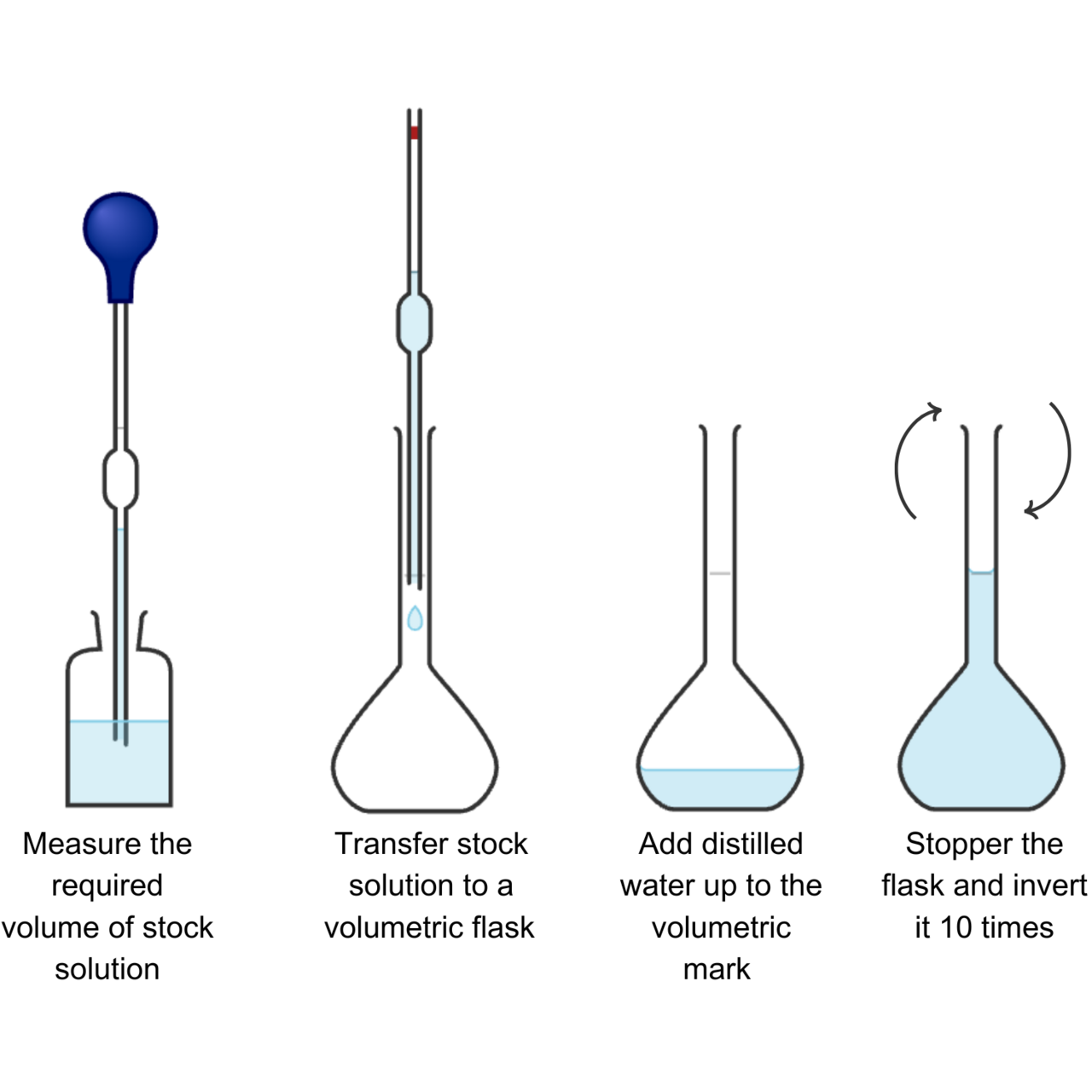
A volumetric pipette transfers a measured aliquot while the volumetric flask fixes the final solution volume. Correct transfer, filling to the calibration mark and thorough mixing are central to preparing solutions of known concentration. Source
Checklist: can you do this?
Can you convert between amount and the number of specified entities using ?
Can you calculate from values and distinguish their units from those of molar mass ?
Can you solve problems linking mass, moles and particle number using ?
Can you determine an empirical formula from masses, percentage composition or combustion mass-change data?
Can you determine a molecular formula from an empirical formula and molar mass?
Can you solve concentration problems using , square-bracket notation and the required concentration units?
Can you explain the roles of appropriate glassware, serial dilution and a calibration curve?
Can you apply Avogadro’s law to gas-volume ratios when temperature and pressure are the same?