
Ideal gas model assumptions
An ideal gas is modelled as moving particles whose individual volumes are negligible.
There are no intermolecular forces between the particles.
All collisions between particles and with container walls are elastic.
In an elastic collision, the particles’ total kinetic energy is conserved.

The diagram represents gas particles in motion and collisions with the container walls. The ideal-gas model additionally assumes negligible particle volume, no intermolecular forces and elastic collisions. Source
Molar volume
Molar volume is the volume occupied by one mole of gas at a specified temperature and pressure.
For an ideal gas, molar volume is constant when temperature and pressure are fixed.
Use when the molar volume at the stated conditions is provided.
The ideal-gas molar volume at standard temperature and pressure (STP) is given in the data booklet.
Temperature–volume relationship
For a fixed amount of ideal gas at constant pressure, volume increases as absolute temperature increases.
The relationship is .
Therefore, when pressure and amount of gas remain unchanged.
A graph of against in kelvin is a straight line through the origin for an ideal gas.
Always use absolute temperature in kelvin when analysing or calculating this relationship.
Combined gas law
For a fixed amount of ideal gas, use .
Subscripts and represent the initial and final conditions.
Convert all temperatures to kelvin before substitution.
Use SI units for pressure and volume as required by the syllabus.
Rearrange the equation first when solving for an unknown pressure, volume or temperature.
Checklist: can you do this?
Can you explain the assumptions of the ideal-gas model?
Can you explain why real gases deviate most at low temperature and high pressure?
Can you use molar volume at specified temperature and pressure, including STP data?
Can you interpret –, – and – graphs for a fixed amount of gas?
Can you solve problems using ?
Can you solve problems using ?
Can you convert pressure and volume to SI units and temperature to kelvin?
Can you calculate the molar mass of a gas from experimental data using the ideal gas equation?
Real gases and model limitations
Real gases do not behave exactly like the ideal-gas model.
Deviation is greatest at low temperature and high pressure.
At low temperature, intermolecular attractions become more significant, contradicting the assumption of no intermolecular forces.
At high pressure, particles are closer together, so their actual particle volume can no longer be considered negligible.
The ideal-gas model therefore becomes less accurate when its simplifying assumptions become significant.
Pressure–volume relationship
For a fixed amount of ideal gas at constant temperature, pressure increases as volume decreases.
The relationship is .
Therefore, when temperature and amount of gas remain unchanged.
A graph of against is a decreasing curve.
A graph of against is a straight line through the origin.
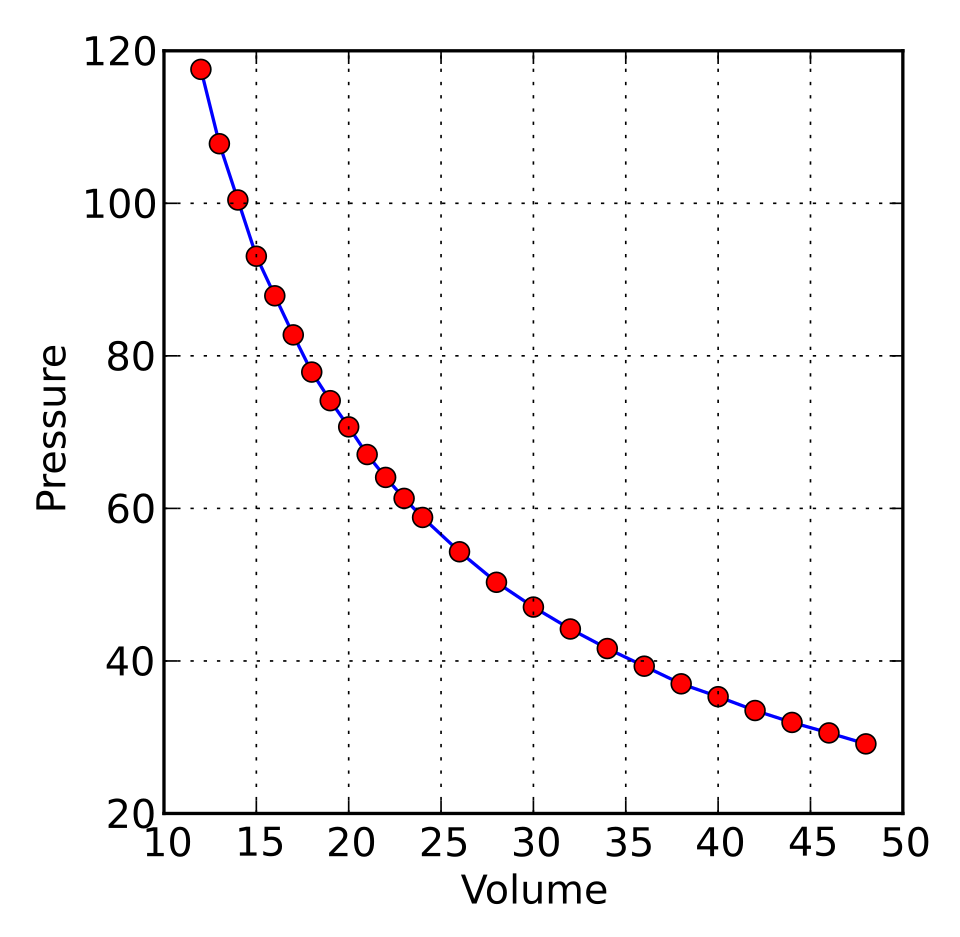
For a fixed amount of gas at constant , increasing causes to decrease. The curved against relationship is consistent with . Source
Pressure–temperature relationship
For a fixed amount of ideal gas at constant volume, pressure increases as absolute temperature increases.
The relationship is .
Therefore, when volume and amount of gas remain unchanged.
A graph of against in kelvin is a straight line through the origin for an ideal gas.
Identify which variable is held constant before interpreting any pressure, volume and temperature graph.
Ideal gas equation and molar mass
Use the ideal gas equation to relate pressure, volume, amount and temperature.
Use in pascals, in , in moles and in kelvin.
The gas constant and the ideal gas equation are provided in the data booklet.
Rearrange before substituting numerical values.
For a gas sample of mass and molar mass , use .
Combining the equations gives , allowing molar mass to be determined from experimental gas data.v