
Systems and the systems approach
A system is a set of interacting or interdependent components organized to create a functional whole.
A systems approach is a holistic way of visualizing a complex set of interactions.
The systems approach can be applied to both ecological and societal situations.
Systems contain storages and flows.
Flows provide inputs and outputs of energy and matter.
Transfers and transformations
Process | What changes? | Meaning |
|---|---|---|
Transfer | Location | Energy or matter moves from one location to another. |
Transformation | Chemical nature, state or energy | The nature, state or energy of matter changes during the process. |
Earth as an integrated system and scale
Earth is one integrated system containing the biosphere, hydrosphere, cryosphere, geosphere, atmosphere and anthroposphere.
The Gaia hypothesis models Earth as a single integrated system.
It links atmospheric composition and temperature through feedback control mechanisms.
The hypothesis was introduced by James Lovelock and further developed by Lovelock and Lynn Margulis.
Systems occur at different scales, from a bromeliad to a rainforest and global atmospheric circulation or Gaia.
Stable and steady-state equilibrium
An open ecosystem will normally exist in a stable equilibrium, maintained by stabilizing negative feedback loops.
A stable equilibrium may be steady-state or may develop over time, as during succession.
Stable equilibrium means a system tends to return to its previous equilibrium following a disturbance.
Steady-state equilibrium occurs when flows continue but inputs are constantly balanced by outputs.
Models: purpose and limitations
A model is a simplified representation of reality.
Models help explain how systems work and predict responses to change.
Models may take the form of a graph, diagram, equation, simulation or words.
Simplification requires approximation, so some accuracy is inevitably lost.
Different climate or population models can therefore produce different predictions.
A laboratory model ecosystem may also differ substantially from the natural ecosystem it represents.
Emergent properties and resilience
Emergent properties arise from interactions between system components and are absent from the isolated components themselves.
Examples include predator–prey oscillations and trophic cascades.
Resilience is a system's tendency to avoid tipping points and maintain stability.
A resilient system can resist damage, recover from disturbance or adapt efficiently.
Greater diversity and larger storages can increase resilience and affect response speed through time lags.
Prairie monocultures illustrate how reduced diversity can lower resilience; a lake's larger storage makes it more stable than a puddle.
Humans can reduce resilience by decreasing storages and diversity, as occurs through deforestation.
Checklist: can you do this?
Can you draw a systems diagram showing storages, flows, inputs and outputs?
Can you distinguish a transfer from a transformation?
Can you distinguish open and closed systems and give syllabus examples?
Can you explain and diagram negative and positive feedback loops?
Can you distinguish stable equilibrium from steady-state equilibrium?
Can you explain a tipping point and regime shift using an example?
Can you evaluate the uses and limitations of models?
Can you explain how diversity, storages and human activity affect system resilience?
Reading and drawing system diagrams
Storages are usually represented by rectangular boxes.
Flows are represented by arrows, with arrow direction showing the direction of the flow.
The sizes of boxes may represent the relative magnitude of storages.
The sizes of arrows may represent the relative magnitude of flows.
Be able to create systems diagrams showing storages, flows, inputs and outputs for laboratory or local natural ecosystems.
Open and closed systems
System type | Exchange across the boundary | ESS example |
|---|---|---|
Open system | Exchanges energy and matter | A local ecosystem; almost all systems are open |
Closed system | Exchanges energy but not matter | Biosphere 2; global geochemical cycles approximate closed systems |
Negative feedback loops and Daisyworld
A negative feedback loop occurs when an output inhibits or reverses the process that produced it.
Negative feedback reduces change and is therefore stabilizing.
It counteracts deviation and can help return a system towards equilibrium.
The Daisyworld model demonstrates how life can regulate planetary temperature through feedback compared with a lifeless planet.
Be able to represent examples of negative feedback using diagrams.
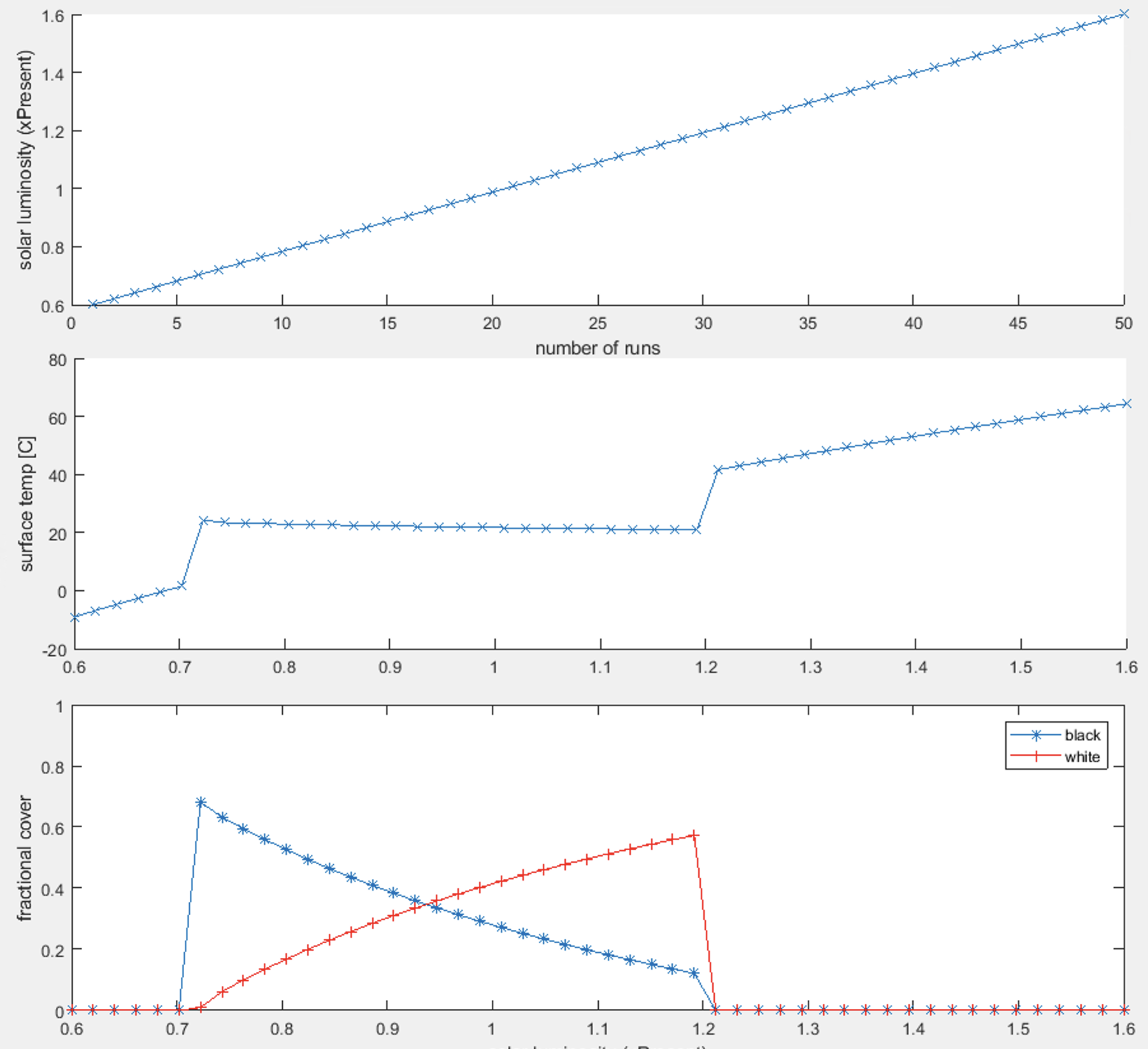
Changing daisy cover counteracts changes in solar input and keeps surface temperature comparatively stable over a range. This demonstrates the stabilizing role of negative feedback. Source
Positive feedback and tipping points
A positive feedback loop occurs when a disturbance amplifies the original disturbance.
Positive feedback destabilizes a system and drives it away from equilibrium.
It can cause either an increase or a decrease in a system component.
Melting ice reduces albedo, increasing warming and causing further melting.
A declining population may have lower reproductive potential, causing further decline.
Positive feedback tends to drive systems towards a tipping point.
A tipping point is the minimum change causing destabilization and a shift to a new stable state.
Tipping points can cause regime shifts; changing nitrate or phosphate concentrations can trigger eutrophication.