
Rise to Power and the 1206 Settlement
The syllabus requires rise to power, uniting rival tribes, military reputation, the 1206 title, and the importance of Genghis Khan’s leadership.
Born Temüjin, he built alliances, defeated rival coalitions and progressively brought the Mongolian steppe under his control.
Victories over major rivals, including the Kereit and Naiman, helped remove competing centres of power.
In 1206, a kurultai, or assembly, confirmed his supremacy and the title Genghis Khan.
He weakened older tribal divisions by reorganizing followers into new military and social units owing loyalty to the khan.
Exam use: link political unification directly to the disciplined manpower later available for external conquest.
Campaign against the Jin Dynasty
The syllabus specifically requires the Mongol invasion of China, attacks on the Jin dynasty and capture of Beijing in 1215.
Genghis Khan began major operations against the Jurchen Jin in northern China in 1211.
Mongol commanders exploited mobility, local defectors and divisions within Jin-controlled territory.
The Jin capital Zhongdu, present-day Beijing, fell in 1215 after prolonged campaigning and siege.
Capture brought immense booty but did not end Jin resistance; complete Jin conquest occurred only after Genghis Khan’s death.
Exam use: Beijing shows both his military success and the limits of what he personally completed.
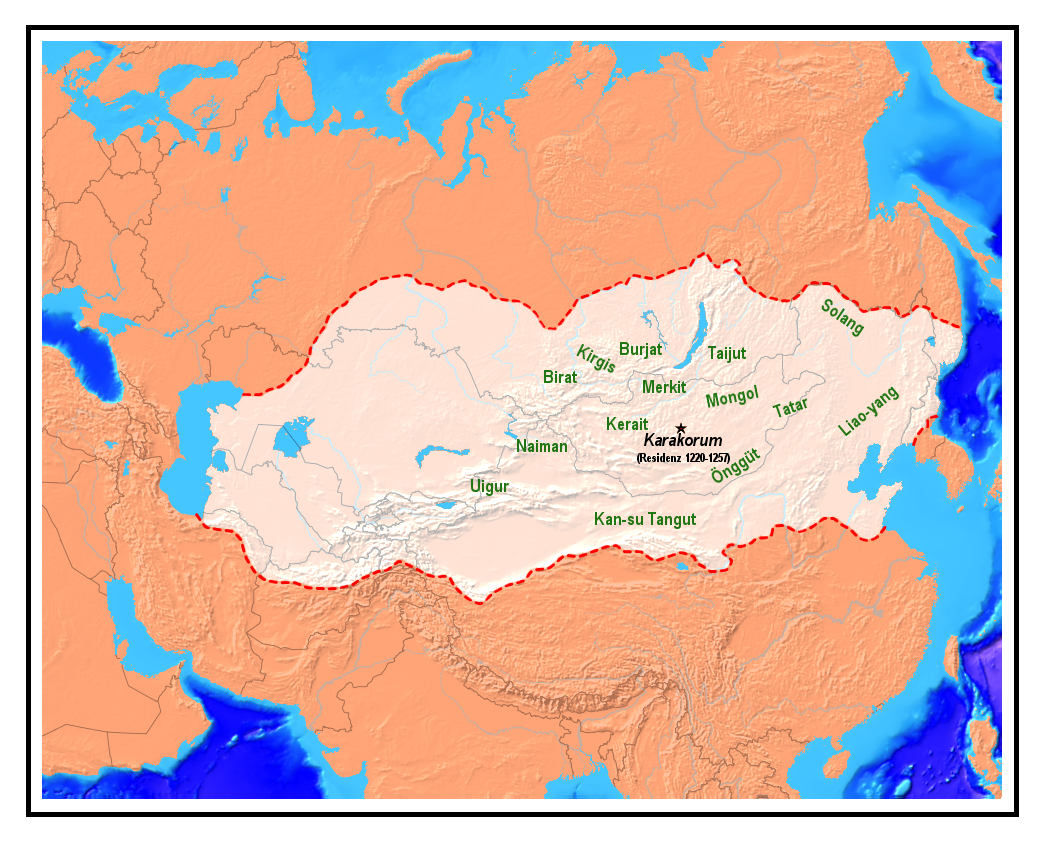
The map demonstrates the enormous territorial expansion achieved by Genghis Khan. Use it to connect the Jin campaigns with the wider geographic scale of Mongol conquest. Source
Strategy and Tactics
Mongol armies emphasized speed, reconnaissance, coordination and manoeuvre rather than relying simply on numerical superiority.
Mounted archers could maintain distance, weaken formations with concentrated missile fire and rapidly reposition.
A feigned retreat encouraged an opponent to pursue, stretch its formation and enter a prepared counterattack or ambush.
Encirclement and attacks from several directions disrupted command and prevented orderly withdrawal.
Multiple horses, dispersed movement and effective scouting allowed forces to travel quickly across very large operational areas.
Psychological warfare and the threat of severe punishment could encourage cities to surrender without prolonged resistance.
Exam use: explain Mongol success as a system in which tactics, communications, intelligence and discipline reinforced one another.
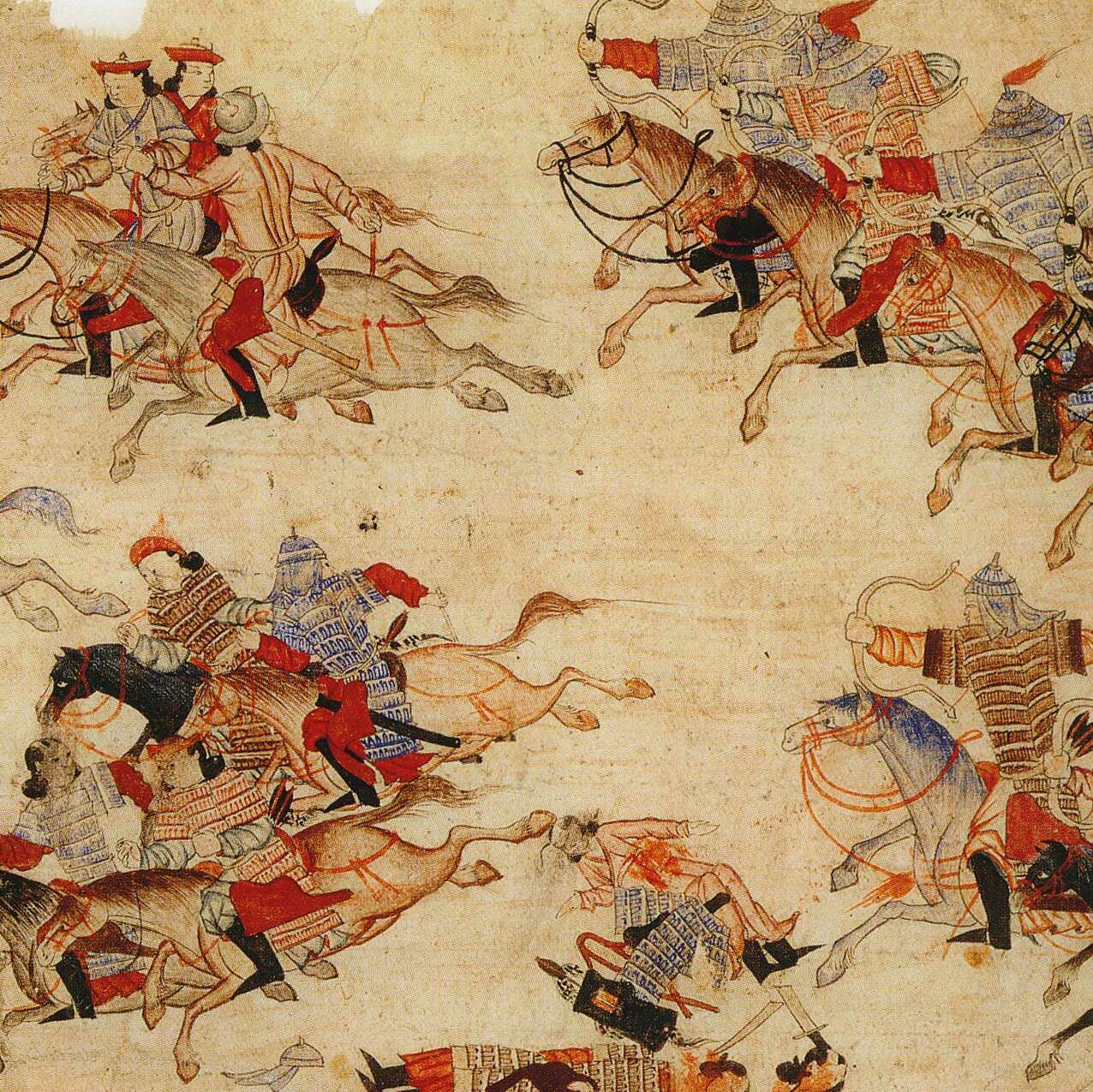
This later medieval depiction illustrates the central importance of mounted combat in Mongol warfare. Treat it as an artistic representation rather than a precise record of Genghis Khan’s equipment. Source
Motives, Objectives and Leadership
Genghis Khan sought to secure Mongol unity, obtain wealth and tribute, expand his authority and develop relations with neighbouring trading states.
Conquest redirected competitive steppe warfare outward and provided followers with booty, resources and opportunities for advancement.
His leadership combined military command with institutional changes designed to reduce rival tribal loyalties.
Promotion increasingly rewarded ability, loyalty and performance, strengthening commanders whose authority depended on the khan.
His military reputation rested on repeated victories, operational adaptability and the huge expansion achieved before 1227.
His objectives were only partly complete: the Mongols dominated extensive territories, but the Jin dynasty survived beyond his lifetime.
Exam use: evaluate leadership alongside organization, mobility, intelligence and weaknesses among Mongol opponents.
Central Asia and Khwarezmia
The prescribed campaign includes the invasion of Central Asia and Iran, especially Khwarezmia from 1219–1221.
After Mongol expansion absorbed Qara Khitai, Genghis Khan’s territory directly bordered the Khwarezmian Empire.
In 1218, the governor of Otrar seized a Mongol-linked merchant caravan and killed its members.
Khwarezmian ruler Muhammad II then rejected Genghis Khan’s demand for redress, contributing directly to war.
From 1219, Mongol armies attacked on multiple axes and captured major centres across Transoxiana and Khurasan.
By 1221, Khwarezmian political power had been shattered, while conquest caused severe destruction and population displacement.
Exam use: the campaign demonstrates mobility, coordinated command, intelligence and punitive warfare operating together.
Political Impact: Administration, Yassa and Meritocracy
The syllabus requires administration, overthrow of existing ruling systems, Yassa and movement towards meritocracy.
Conquest replaced or subordinated existing authorities and created a political order centred on the khan and appointed commanders.
Genghis Khan issued rules and edicts generally associated with the Yassa, covering discipline, government and social obligations.
Historians caution against treating the Yassa as one fully recoverable, fixed written law code.
Appointments increasingly emphasized loyalty and demonstrated ability, helping weaken hereditary tribal privilege.
New administrative practices therefore reinforced both military effectiveness and political centralization.
Exam use: connect political reform directly to the stability and manpower needed for conquest.
Economic Impact and Trade
The prescribed economic impact is the establishment, enhancement and protection of trade routes.
Trade was an important Mongol interest: Genghis Khan actively sought commercial relations with Khwarezmia before invading it.
By 1225, his empire controlled substantial sections of the Silk Road network linking East and Central Asia.
Political unification placed previously divided routes under a single expanding authority, potentially reducing some barriers to long-distance movement.
Genghis Khan also established early yam relay stations primarily for military communication across long-distance roads.
Conquest nevertheless caused severe short-term disruption where cities, agriculture and populations were destroyed.
Exam use: distinguish immediate destruction from the longer-term commercial opportunities created by political unification.
Social, Cultural and Religious Impact
Mongol conquest produced population displacement, enslavement, looting, killing and destruction, especially where resistance continued.
At Zhongdu and Khwarezmian cities, conquest could involve mass violence, seizure of wealth and forced movement of inhabitants.
Exact medieval casualty totals are often unreliable; examination answers should emphasize documented destruction rather than unsupported numbers.
Cultural and technological exchange accompanied conquest as the Mongols adopted skills, specialists and technologies from subjected societies.
Adoption of the Uyghur-derived script for Mongolian illustrates this transfer of administrative and cultural knowledge.
Genghis Khan’s edicts treated different faiths comparatively even-handedly, supporting significant religious tolerance.
Exam use: balance destructive consequences against exchange and religious accommodation.
Checklist: can you do this?
Can you explain how Temüjin united rival tribes and became Genghis Khan in 1206?
Can you evaluate his motives, objectives and leadership without treating leadership as the only cause of Mongol success?
Can you explain the significance of the Jin campaigns and capture of Beijing in 1215?
Can you explain why the Khwarezmian campaign of 1219–1221 began and why it succeeded?
Can you distinguish military organization, technology, strategy and tactics?
Can you explain the political significance of Yassa, administration and merit-based promotion?
Can you assess both the destructive and constructive economic, social, cultural and religious impacts?
Can you support each argument with specific dates, places and named evidence?