
AP Syllabus focus:
‘Differentiate products where one or both factors are trigonometric, exponential, or logarithmic functions by combining product rule and earlier derivative formulas.’
This subsubtopic explains how the product rule extends naturally to products involving trigonometric, exponential, and logarithmic functions, enabling accurate differentiation of many important mathematical and applied expressions.
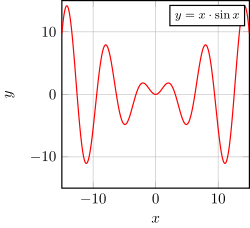
This figure shows the graph of , where the sine wave is modulated by the line , producing oscillations whose amplitude grows with . The trigonometric factor determines the oscillatory behavior, while the algebraic factor controls amplitude. The image also displays that is an even function, which exceeds syllabus requirements. Source.
Product Rule with Advanced Functions
When functions involve trigonometric, exponential, or logarithmic components, the product rule remains an essential tool because it captures how both functions vary simultaneously. These function families appear frequently in modeling oscillations, growth, decay, and multiplicative processes, making mastery of their combined differentiation especially important.
Product Rule: If and are differentiable, the derivative of their product is .
This rule is applied exactly the same way for more complex functions, but attention must be paid to each factor’s individual derivative formula.
Essential Derivative Relationships
Understanding the basic derivative formulas for the functions involved is necessary before applying the product rule in mixed contexts. These rules determine how each component in the product behaves.
= input variable
= trigonometric functions
A sentence here ensures separation before presenting another required derivative relationship.
= input variable
= trigonometric functions
These results support differentiating products containing oscillatory behavior.
A sentence now comes before introducing exponential derivatives.
= natural exponential function
= input variable
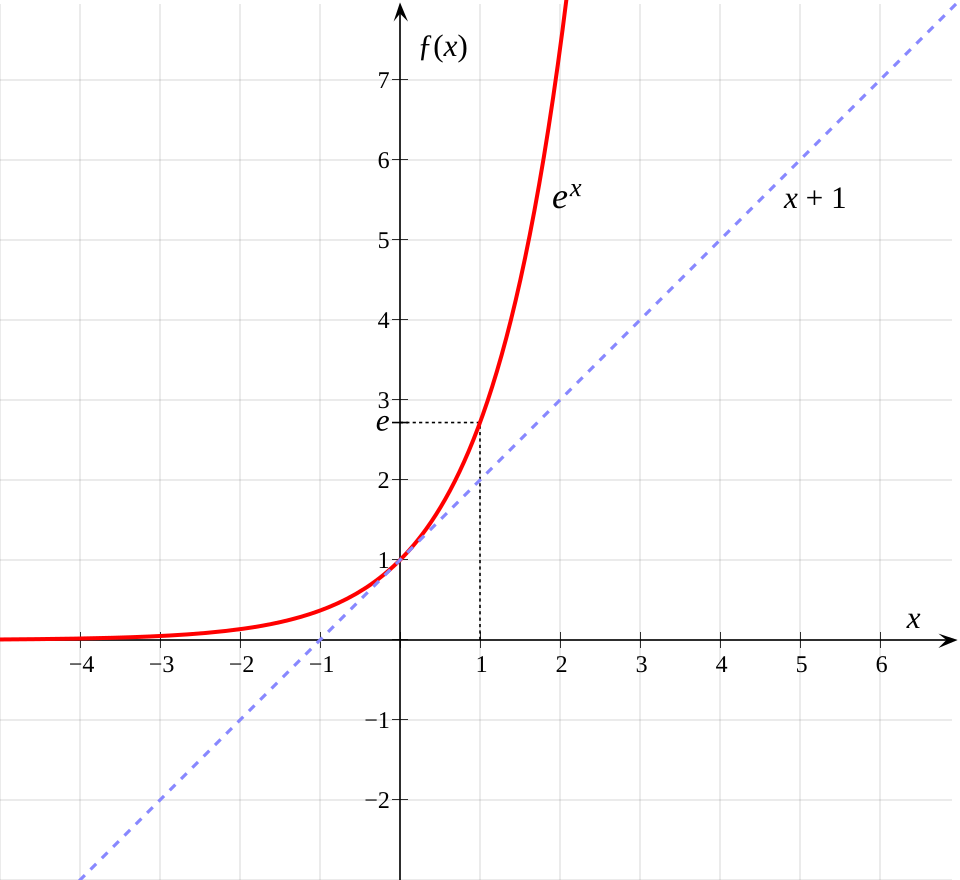
This figure shows the graph of and its tangent line at , whose slope is . This illustrates that the derivative of equals its value at every point. The image adds only curve and tangent information, with no extra modeling detail beyond syllabus needs. Source.
Exponential functions frequently appear in multiplicative models, making their pairing with trigonometric or logarithmic terms common.
A sentence transitions here before the logarithmic derivative.
= natural logarithm
= positive input variable
These foundational derivative rules combine with the product rule to differentiate expressions whose structure is multiplicative rather than additive.
Why the Product Rule Is Needed
The product rule is specifically required when the expression to be differentiated consists of two functions multiplied together and neither can be simplified algebraically to eliminate the product. When trigonometric, exponential, or logarithmic functions appear inside a product, attempting to differentiate without the rule leads to incorrect results because each factor contributes separately to the rate of change.
Key Situations That Require the Product Rule
A trigonometric function multiplies an exponential function, such as a sinusoid with an exponentially changing amplitude.
A logarithmic expression multiplies a trigonometric term, often arising in scaling or modulation contexts.
Two different families of functions appear together in a product, making prior derivative rules insufficient without combining them through the product rule.
Applying the Product Rule to Trigonometric Products
Differentiating expressions involving trigonometric functions within a product requires applying the product rule and recalling the derivatives of sine and cosine. Because trigonometric functions oscillate, their derivatives often change signs or swap identities. This makes it essential to compute each component individually before adding their contributions.
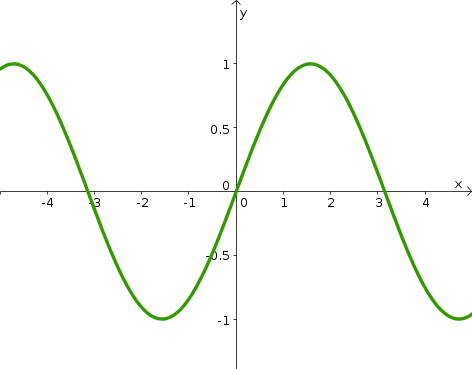
This figure shows the graph of , oscillating between and with period . It provides the fundamental trigonometric shape that is modified when multiplied by algebraic, exponential, or logarithmic factors before applying the product rule. No additional surface or multivariable material from the host site is required for this subsubtopic. Source.
Important Considerations
The derivative of produces , which changes the nature of the resulting expression.
The derivative of introduces a negative sign, requiring careful attention when applying the product rule.
When trigonometric functions multiply non-oscillatory functions, the product rule captures how amplitude and oscillation change simultaneously.
Applying the Product Rule to Exponential Products
Exponential functions maintain their form under differentiation, which simplifies one part of the process. However, their rapid growth or decay amplifies the influence of the accompanying function.
Important Considerations
Since reproduces itself under differentiation, the product rule adds another exponential term multiplied by the derivative of the other factor.
Exponential factors often dominate long-term behavior, so understanding both parts of the derivative helps interpret applied models.
Applying the Product Rule to Logarithmic Products
Logarithmic functions grow slowly, and their derivatives introduce reciprocal expressions that significantly alter the structure of the differentiated product.
Important Considerations
The derivative of introduces the factor , which frequently creates rational expressions in the final derivative.
Logarithmic products commonly appear in modeling elasticity, scaling, and damping, making correct use of the product rule essential.
Combining Multiple Function Families
Some expressions require combining several derivative rules simultaneously. When trigonometric, exponential, or logarithmic functions interact within a single product, each component must be differentiated using its appropriate rule before being assembled using the product rule.
Checklist for Differentiating Mixed-Family Products
Identify both factors clearly.
Determine which derivative formulas apply to each function.
Apply the product rule by multiplying each function by the derivative of the other.
Combine terms carefully, paying attention to signs and the structure of trigonometric or logarithmic expressions.
Practice Questions
Question 1 (1–3 marks)
The function f is defined by f(x) = x e^x sin x.
(a) Using the product rule, write an expression for f ’(x).
(b) State the value of f ’(0).
Question 1
(a) 2 marks
• 1 mark for correctly applying the product rule to any two-factor grouping (for example, x and e^x sin x).
• 1 mark for a fully correct expression for f ’(x), such as:
f ’(x) = e^x sin x + x(e^x sin x + e^x cos x).
(Equivalent correct expansions also earn full marks.)
(b) 1 mark
• 1 mark for correctly substituting x = 0, giving f ’(0) = 0.
Question 2 (4–6 marks)
Let g(x) = (ln x)(x^2 cos x), where x > 0.
(a) Show that g ’(x) can be written as ln x multiplied by the derivative of x^2 cos x, plus x^2 cos x multiplied by the derivative of ln x.
(b) Hence find a fully simplified expression for g ’(x).
(c) Explain briefly how the product rule accounts for the behaviour of both factors in g as x increases.
Question 2
(a) 1 mark
• 1 mark for correctly writing g ’(x) = (ln x)(d/dx of x^2 cos x) + (x^2 cos x)(d/dx of ln x).
(b) 3–4 marks
• 1 mark for correctly applying the product rule to x^2 cos x.
• 1 mark for correct derivative of x^2 (which is 2x).
• 1 mark for correct derivative of cos x (which is -sin x).
• 1 mark for a fully simplified correct expression, for example:
g ’(x) = ln x (2x cos x − x^2 sin x) + (x^2 cos x)(1/x).
A further simplification to x cos x may also be included.
(c) 1 mark
• 1 mark for a reasonable explanation noting that the product rule reflects how both ln x and x^2 cos x vary with x, so changes in either factor influence the rate of change of g.
FAQ
A product cannot be simplified before differentiating when neither factor can be algebraically rewritten to eliminate the multiplication.
Common indicators include:
• A trigonometric function multiplied by a non-constant exponential or logarithmic term.
• Factors with incompatible algebraic structures, such as sin x and ln x.
If no identity or algebraic operation reduces the product, the product rule must be used.
Exponential functions grow rapidly, so their influence on the product amplifies any changes in the accompanying factor.
As a result, each part of the product rule contributes a term that retains an exponential component, leading to expressions with multiple exponential factors.
This can make the derivative appear more complex even though the process remains straightforward.
The product rule separates the contribution from each factor, revealing how oscillations interact with growth, decay, or scaling.
For example:
• Trigonometric terms drive oscillation.
• Exponential or logarithmic terms introduce long-term trends.
The resulting derivative shows how these behaviours combine dynamically, often producing expressions where oscillations grow, shrink, or distort.
The derivative of ln x introduces the reciprocal 1/x, converting part of the product into a rational structure.
When multiplied through the product rule, this term propagates into the resulting expression, often creating rational factors even if none were present initially.
This effect is especially noticeable when ln x multiplies polynomial or trigonometric terms.
A frequent error is treating the expression as if the product rule extends directly to three or more factors in one step.
A safer approach is:
• Group two functions together.
• Apply the product rule.
• Then differentiate the remaining factor as part of a new product.
Another common mistake is forgetting to differentiate one of the factors, especially when a function appears complex or contains its own internal rules.