
AP Syllabus focus:
‘Use reference maps and thematic maps to identify places and show geographic information and patterns.’
Maps provide essential tools for understanding spatial information, and distinguishing between reference maps and thematic maps helps geographers analyze how places are located and how patterns are represented across space.
Understanding Map Categories
Reference maps and thematic maps serve different but complementary purposes in geographic analysis. While reference maps focus on location and basic features, thematic maps highlight patterns tied to a specific subject. AP Human Geography emphasizes the ability to use both map types to identify places and interpret spatial information and patterns. These skills form the foundation for deeper geographic reasoning.
What Are Reference Maps?
Reference maps are designed to show the general spatial arrangement of features on Earth, emphasizing “where things are.” They typically include political boundaries, physical landforms, and major cultural or natural features.
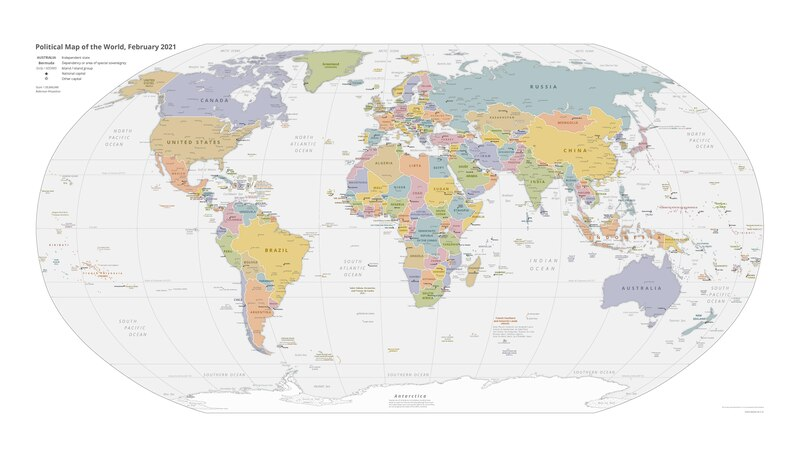
Political world map showing country boundaries and major cities. This reference map emphasizes spatial locations, illustrating how such maps provide a general framework for identifying places. It reflects the role of reference maps in helping users navigate and understand global space. Source.
Geographers and everyday map users rely on these maps for navigation, orientation, and contextual understanding of place.
Reference Map: A map type that emphasizes the location of places and geographic features, providing a general representation of spatial information.
Reference maps tend to be highly standardized, making them useful for broad audiences. Their clarity enables users to identify absolute and relative locations, understand the distribution of major features, and navigate regions effectively. These maps often serve as the baseline upon which more interpretive geographic analysis builds.
Key Types of Reference Maps
Reference maps include several familiar varieties:
Political maps showing boundaries, cities, and human-built divisions.
Physical maps highlighting natural features such as mountains, rivers, and elevation.
Road maps used for transportation and navigation.
Topographic maps depicting terrain through contour lines or elevation shading.
Each type supports analysis by situating phenomena within a recognizable spatial framework. For example, political maps help identify administrative regions, while physical maps aid in understanding environmental context.
What Are Thematic Maps?
Thematic maps focus on specific topics or distributions, allowing users to detect and analyze patterns, trends, and spatial relationships. They answer the question “Where is this phenomenon most and least concentrated?” rather than simply “Where is this place?”
Thematic Map: A map type that presents spatial patterns of a particular variable or theme, emphasizing how a phenomenon is distributed across space.
Unlike reference maps, thematic maps selectively highlight information relevant to one theme, such as population density, climate zones, economic activity, or migration flows.
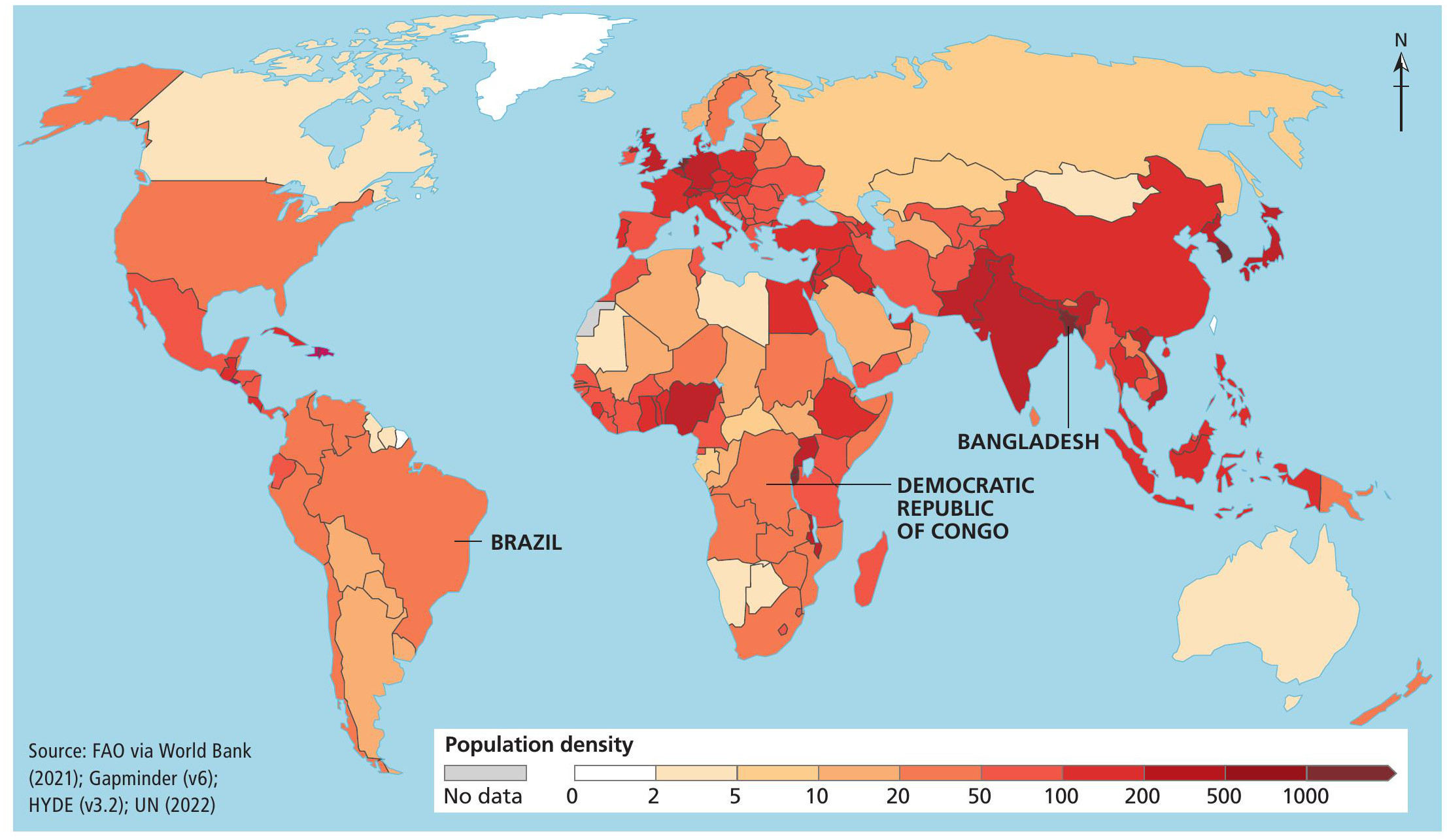
Choropleth thematic map of global population density in 2022, using darker colors to represent higher concentrations of people per square kilometer. The visualization highlights clustering in South and East Asia, demonstrating how thematic maps reveal spatial patterns. The detailed legend extends slightly beyond syllabus requirements but effectively illustrates how data are classified and symbolized. Source.
In doing so, they enable geographers to identify clustering, dispersal, gradients, and regional variations.
Major Types of Thematic Maps
Thematic maps vary widely depending on the subject being visualized. Common formats include:
Choropleth maps, which use color shading to represent data values within defined areas.
Dot distribution maps, placing dots to illustrate the frequency or concentration of a phenomenon.
Graduated symbol maps, using symbol size to represent quantitative differences.
Isoline maps, connecting points of equal value (often used for temperature or elevation).
Cartograms, distorting area to represent data magnitude.
These formats help reveal spatial patterns that are not always visible on reference maps. For example, a choropleth map of population density displays areas of concentration, while a dot map can show micro-scale clustering within a region.
Comparing Reference and Thematic Maps
Understanding the differences between reference and thematic maps is essential for geographic interpretation. Reference maps prioritize accuracy and general spatial representation, while thematic maps prioritize data communication and pattern detection. Both map types rely on map selectivity, meaning cartographers must choose which features to include or exclude based on purpose.
Purpose and Use
Reference maps: Used to locate places, determine distances, and understand spatial relationships of major physical and cultural features.
Thematic maps: Used to analyze the distribution of specific variables, identify spatial patterns, and interpret geographic processes.
In AP Human Geography, students must read both types and understand how they contribute to geographic inquiry. Reference maps provide the spatial foundation, while thematic maps add interpretive depth.
The Role of Scale and Detail
Reference maps often use consistent scales and symmetric detail across a region. In contrast, thematic maps may vary in scale, level of aggregation, or data classification systems. This variation influences interpretation, as thematic patterns can appear dramatically different when viewed at local, regional, or global scales.
A normal sentence must separate definition blocks, and this one provides context about how scale shapes geographic understanding.
Interpreting Patterns Using Both Map Types
The AP syllabus highlights the use of maps to identify places and reveal geographic information and patterns. When reference maps and thematic maps are combined, students can:
Identify key locations and boundaries.
Observe clustering and dispersal of phenomena.
Detect spatial correlations between physical and human variables.
Analyze how geographic contexts influence patterns.
Skills developed through the comparison of these map types strengthen spatial reasoning, enhance geographic literacy, and prepare students to interpret real-world data in a variety of applications.
Why Distinguishing Map Types Matters
Proficiency with reference and thematic maps enables students to evaluate geographic information critically. Recognizing the differences between these map types helps in selecting the appropriate tool for data interpretation, supports analytical accuracy, and builds a foundation for more advanced geographic concepts introduced later in the course.
Practice Questions
Question 1 (1–3 marks)
Explain one difference between a reference map and a thematic map.
Mark scheme:
• 1 mark for identifying a valid difference (e.g., purpose, content, or focus).
• 1 mark for accurately describing the function of a reference map (e.g., shows general location of places and features).
• 1 mark for accurately describing the function of a thematic map (e.g., shows the spatial distribution of a specific variable or pattern).
Question 2 (4–6 marks)
Using a real-world geographical example, analyse how reference maps and thematic maps can be used together to interpret spatial patterns.
Mark scheme:
• 1 mark for identifying an appropriate real-world example (e.g., population density in India, climate zones in Europe).
• 1–2 marks for explaining how a reference map provides spatial context such as political boundaries, physical features, or relative location.
• 1–2 marks for explaining how a thematic map reveals a spatial pattern such as clustering, dispersal, or variation related to the chosen example.
• 1 mark for analysing how combining the two map types improves geographic understanding (e.g., linking patterns to location, environment, or human activity).
FAQ
Cartographers select features based on the map’s intended purpose and the level of detail appropriate for its scale. A small-scale world map, for example, prioritises major boundaries and physical features, while a large-scale city map includes streets and landmarks.
They also follow established cartographic conventions to maintain readability, ensuring that only the most essential features are represented to avoid overcrowding.
Thematic maps depend on design choices such as colour schemes, classification intervals, and symbol sizes. These choices can alter how patterns appear, especially when data are unevenly distributed.
For instance, wide data classes may hide local variation, while colour gradients can exaggerate contrasts. Understanding these design elements helps viewers interpret patterns more critically.
Choropleth maps rely on aggregated units such as counties or countries, meaning the pattern shown depends heavily on the size and shape of these units.
At a larger scale, smaller units reveal more spatial detail, while at a smaller scale, large units may hide local differences. This sensitivity is known as the Modifiable Areal Unit Problem (MAUP), which affects how patterns are perceived.
Dot distribution maps use numerous small dots to represent frequency, giving a visual sense of clustering and density without showing exact numerical values at each location.
Graduated symbol maps, by contrast, use proportionally sized symbols to represent quantities at specific points, emphasising magnitude rather than fine-grained spatial texture.
A cartogram is useful when the goal is to emphasise the importance of a variable rather than maintain geographic accuracy. By resizing areas based on data values, cartograms draw attention to differences that might be visually subtle on conventional maps.
They are particularly effective for illustrating variables such as population, electoral influence, or economic output, where the relationship between area and data magnitude is central to interpretation.