Religions and languages have shaped civilizations, migrated across continents, and influenced cultural identities through different types of diffusion over time.
Language and Cultural Diffusion
Language Families and Origins
Languages, like religions, spread through various processes and have a foundational structure known as a language family, which includes languages that share a common ancestral tongue. This ancestral language, often referred to as a protolanguage, is usually reconstructed through linguistic methods.

Image Courtesy of NamuWiki
The Indo-European language family is the largest in the world, encompassing languages spoken by nearly half of the global population. It includes most of the languages in Europe and several in Asia, such as Hindi and Bengali. The Indo-European family is believed to have originated thousands of years ago and spread via different routes.
There are two dominant theories explaining the spread of this language family:
Anatolian Hypothesis (Sedentary Farmer Theory): Suggests that early farmers from Anatolia (modern-day Turkey) spread Indo-European languages along with agricultural practices. This diffusion occurred gradually as farming communities expanded into Europe.
Kurgan Hypothesis (Nomadic Warrior Theory): Proposes that Indo-European languages spread through conquest by horse-riding warriors from the steppes north of the Black Sea, beginning around 4300 BCE.
These theories reflect the expansion diffusion of language—where a cultural element spreads outward while remaining strong in its origin area.
Language Subfamilies and Branches
Within each language family, there are subfamilies and branches that reflect closer linguistic relationships. The Indo-European family contains several branches:
Germanic Branch: Includes English, German, Dutch, Swedish, and Norwegian. These languages diffused from Northern Europe and expanded westward and southward.
Romance Branch: Includes Spanish, French, Italian, Portuguese, and Romanian. These evolved from Latin, the language of the Roman Empire, and spread across Europe and into the Americas through colonization.
Slavic Branch: Includes Russian, Polish, Czech, and others spoken mainly in Eastern Europe and northern Asia.
The development of these branches illustrates both language divergence (when a language splits into two or more distinct languages) and relocation diffusion (when people migrate and carry their language to new areas).
Language Divergence and Convergence
Language divergence occurs when groups of people with the same language become isolated from one another and develop distinct dialects or entirely new languages over time. For example, Latin diverged into the various Romance languages.
Language convergence happens when different linguistic groups come into contact and blend their languages. An example is the Maltese language, which incorporates elements from Arabic and English.
Lingua Franca, Pidgin, and Creole Languages
A lingua franca is a language used for communication between people who do not share a native language. It is especially common in trade, diplomacy, and business. Today, English serves as a global lingua franca.
A pidgin language is a simplified form of speech developed from two or more languages. It emerges when speakers of different native tongues need to communicate, often for trade. Pidgins typically have limited vocabulary and grammar.
A creole language is a more complex, fully-developed language that evolves from a pidgin. It becomes the native language of a population, such as Haitian Creole, which combines French with African languages and is spoken in Haiti.
Dialects and Isoglosses
Dialects are regional or social variations within a language. These variations may include differences in pronunciation, vocabulary, and syntax. For example, American English has several dialects, such as Southern, Midwestern, and New England varieties.
An isogloss is a geographic boundary that separates different linguistic features, such as the usage of a particular word or pronunciation.
Bilingualism and Language Policy
Bilingualism is the ability to speak two languages fluently. It is common in regions with colonial histories or cultural diversity. In some areas, people grow up speaking both a local language and a former colonial language, such as English or French.
While monolingualism (the use of one language) provides linguistic unity, bilingualism fosters cultural diversity, improves communication, supports economic activities like tourism, and can promote social inclusion.
However, bilingualism can also present challenges:
Education costs may increase when schools must support multiple languages.
Translation requirements in government documents and news media can be burdensome.
Cultural tensions may arise if one language is perceived as dominant.
Some countries have an official language established by law (e.g., French in France, Portuguese in Brazil), while others, like the United States, do not.
Africa is the most linguistically diverse continent, with thousands of distinct languages. Many Africans are multilingual, speaking indigenous languages alongside colonial ones such as English, French, or Portuguese.
Hierarchical Diffusion of Language
Languages often spread through hierarchical diffusion, where influential individuals or institutions promote the use of a language. For example, during the British Raj, English was imposed as the administrative language in India. As a result, English spread from the British elite to the Indian upper class and eventually to broader segments of the population.
Religion and Cultural Diffusion
Types of Religion
Religions are categorized based on their scope and method of diffusion:
Universalizing Religions: Open to all people and actively seek converts. They include Christianity, Islam, and Buddhism. These religions often diffuse widely and rapidly through various forms of expansion and relocation diffusion.
Ethnic Religions: Tied to specific ethnic or cultural groups and typically do not seek new members. Examples include Judaism and Hinduism. They often remain concentrated near their hearths, or points of origin.
Tribal or Traditional Religions: Practiced by small, localized cultural groups. Often involve animism, the belief that natural objects and elements possess spiritual qualities.
Syncretism and Belief Systems
Syncretism is the blending of different religious traditions and practices. An example is the integration of Buddhism with Shinto in Japan.
Animism is particularly common in tribal religions and reflects a belief in spiritual forces residing in natural elements like rivers, rocks, and animals.
Religious Structures
Religious systems are often organized into:
Branches: Major divisions within a religion (e.g., Sunni and Shia Islam).
Denominations: Subgroups within branches (e.g., Lutheranism within Protestantism).
Sects: Small groups that have separated from established denominations.
Religions are also classified by their number of deities:
Monotheism: Belief in one god (e.g., Christianity, Judaism, Islam).
Polytheism: Belief in multiple gods (e.g., Hinduism, Shinto).
Christianity
Christianity is a monotheistic universalizing religion based on the teachings of Jesus Christ.
It spread through hierarchical diffusion during the Roman Empire and later through relocation diffusion as European powers colonized the Americas, Africa, and Asia.
The three major branches are:
Roman Catholicism: Dominant in Latin America and Southern Europe.
Protestantism: Common in North America and Northern Europe.
Eastern Orthodoxy: Found primarily in Eastern Europe and Russia.
Sacred spaces include churches and the city of Jerusalem.
Islam
Islam was founded by the Prophet Muhammad in the 7th century CE.
Its holy book is the Quran, and followers, called Muslims, adhere to the Five Pillars of Islam:
Declaration of faith
Daily prayer
Almsgiving
Fasting during Ramadan
Pilgrimage to Mecca
Islam spread through expansion diffusion across the Middle East, North Africa, and parts of Europe, and through relocation diffusion to Southeast Asia, Sub-Saharan Africa, and the Americas.
The two main branches are Sunni and Shia, with Sunnis being the majority.
Mosques are the primary places of worship.
Buddhism
Founded in the 6th century BCE by Siddhartha Gautama (the Buddha) in what is now Nepal and India.
Aims to achieve Nirvana, a state of enlightenment, by following the Eightfold Path, which emphasizes right conduct and mindfulness.
Two primary branches:
Theravada Buddhism: Traditional form, found in Sri Lanka and Southeast Asia.
Mahayana Buddhism: More inclusive, found in China, Korea, and Japan.
Spread through contagious diffusion, especially along trade routes, and through missionary activity.
Pagodas and temples are sacred spaces in Buddhist regions.
Hinduism
One of the world’s oldest religions, originating in the Indus River Valley (modern-day Pakistan).
Strongly associated with India, where over 80 percent of Hindus live.
Beliefs include reincarnation, karma, and adherence to a caste system that organizes society into rigid hierarchies.
Spread through contagious diffusion within South Asia and through relocation diffusion to places like Bali and the Caribbean.
Sacred spaces include temples, often located within homes, and the Ganges River.
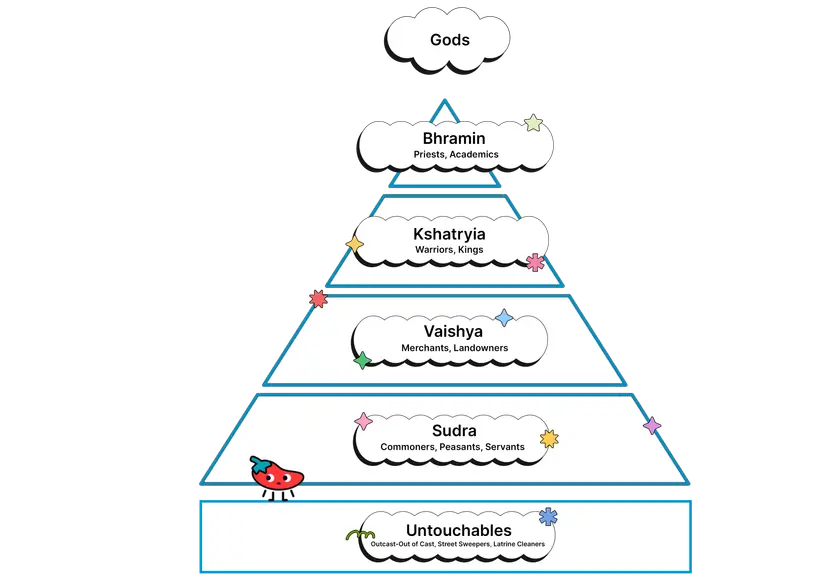
Judaism
A monotheistic ethnic religion founded in the Middle East, particularly in the ancient Mesopotamian region.
Key texts include the Torah and Talmud.
Jews were dispersed through the Diaspora, especially after the Roman destruction of Jerusalem in 70 CE.
Modern distribution includes Israel, the United States, and parts of Europe and Russia.
Zionism is a political movement advocating the return of Jews to their ancestral homeland.
Synagogues and the Western Wall in Jerusalem are sacred spaces.
Interfaith and Intrafaith Boundaries
Interfaith boundaries occur between different religions. Examples include:
The conflict between Hindus and Muslims in India and Pakistan over Kashmir.
The Israeli-Palestinian conflict involving Judaism and Islam.
Conflict in the Balkans between Muslim Bosniaks and Christian Serbs.
Intrafaith boundaries exist within a single religion, such as:
Sunni and Shia Muslims in Iraq and Syria.
Protestants and Catholics in Northern Ireland.
Secularism and Non-Religious Belief Systems
Secularism is the trend of separating religion from public affairs, particularly in Europe and increasingly in other parts of the world.
Autonomous religions, like Islam, often have minimal hierarchical structure and emphasize individual or communal interpretation of faith.
Sikhism is a monotheistic universalizing religion originating in the Indian subcontinent. It emphasizes equality, service, and devotion to God.
East Asian Belief Systems
Confucianism: Based on the teachings of Confucius, this philosophy values social harmony, family loyalty, and civic duty.
Taoism (Daoism): Emphasizes living in harmony with nature and the Tao (the Way). It focuses on balance, simplicity, and the mystical aspects of life.
These systems often coexist with Buddhism and influence cultural landscapes across China, Taiwan, and Vietnam.
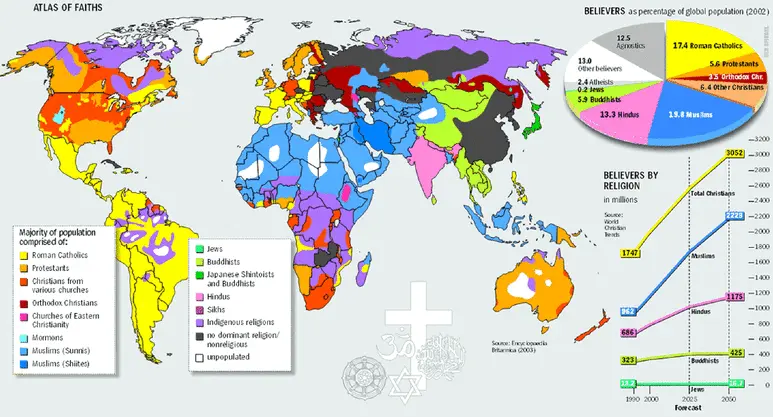
Illustrates modern extents of religions
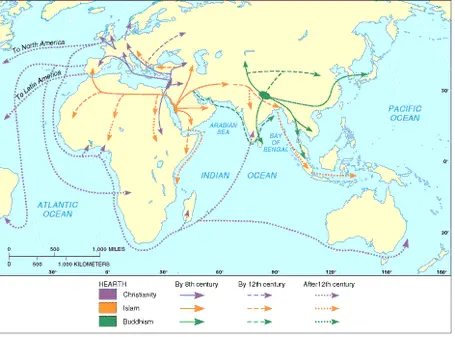
This map depicts the diffusion of the three main universalizing religions within different time periods.
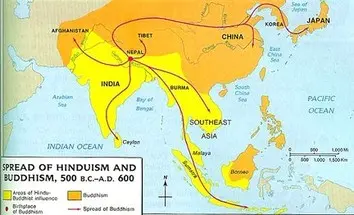
This map depicts the spread of Hinduism and Buddhism.
FAQ
Religious syncretism can significantly reshape a region’s cultural identity by blending elements of different belief systems into new, hybrid practices. This process often occurs in multicultural or colonized areas where religious traditions interact. Syncretism reflects adaptability in religious expression, allowing communities to preserve native customs while incorporating aspects of dominant faiths.
For example, in Latin America, Catholicism fused with indigenous religions, resulting in unique practices like the Day of the Dead.
In Haiti, Vodou blends West African spiritual traditions with French Catholic elements.
These syncretic forms help preserve cultural memory while adapting to social and political pressures.
The resulting religious identity is neither purely traditional nor foreign—it becomes distinct and localized.
Linguistic diversity is higher in mountainous and geographically isolated regions because physical barriers limit interaction and migration, allowing small groups to develop unique languages or dialects over time.
Mountains, forests, or remote islands create natural divisions between communities.
This isolation leads to independent language evolution, reducing linguistic homogenization.
A classic example is Papua New Guinea, where rugged terrain and tribal separation have led to over 800 distinct languages.
The lack of centralized authority or standardized communication also contributes to this linguistic fragmentation.
These regions often contain languages with very few speakers, making them hotspots for endangered languages and linguistic preservation efforts.
Sacred spaces play a central role in shaping the spatial organization of cities and towns, especially in religious societies. They often occupy central or elevated locations and influence the layout and orientation of surrounding areas.
In Islamic cities, mosques are frequently centrally located with markets and homes radiating outward.
In medieval European cities, cathedrals or churches were dominant structures, often influencing street patterns and civic life.
Pilgrimage destinations like Mecca or Varanasi attract infrastructural development, including roads, lodging, and services.
Urban zoning near sacred sites often restricts certain activities or construction to preserve religious sanctity.
These patterns reflect how religion doesn’t just influence belief—it structures how space is used and experienced.
Language policy is crucial in preserving endangered languages by legitimizing them in educational systems, media, and public life. Without institutional support, minority languages often decline in favor of dominant tongues due to economic and social pressures.
Governments may establish bilingual education programs to teach both the national and regional languages.
Official recognition, such as granting co-official status, gives minority languages a place in legal and administrative use.
Policies can support local broadcasting, literature, and signage in indigenous languages.
For example, New Zealand promotes Maori through education and public media as part of its national identity.
Preservation efforts rely on active usage in daily life, not just symbolic recognition.
Globalization has transformed traditional religious practices by increasing exposure to foreign beliefs, secularism, and consumer culture, often leading to either adaptation or resistance.
In many places, traditional religions incorporate elements of global faiths to remain relevant, such as African churches adopting charismatic Christian practices.
Exposure to global media spreads alternative ideologies and religious critiques, sometimes leading to syncretism or hybrid belief systems.
Global NGOs and missionary organizations influence religious conversion, especially in areas with economic instability.
Religious commodification, like selling spiritual artifacts or commercializing holidays, changes sacred traditions into consumer experiences.
At the same time, some communities react by reaffirming orthodox practices in response to perceived cultural erosion.
Practice Questions
Explain how both relocation diffusion and expansion diffusion contributed to the global spread of major world religions. Provide one example of each type.
Relocation diffusion occurs when people physically move from one location to another and bring their religion with them, as seen in the spread of Judaism through the Jewish Diaspora after Roman persecution. Expansion diffusion spreads ideas outward from a hearth while remaining strong at the origin, such as Islam expanding from the Arabian Peninsula through trade, conquest, and missionary work. Both processes illustrate how religions can transcend geographic boundaries—relocation by migration, expansion by influencing neighboring areas—resulting in global distributions that reflect both movement of people and cultural influence.
Describe two ways language contributes to the development of cultural landscapes and explain one example of how colonialism influenced language diffusion.
Language shapes cultural landscapes through signage, place names, and oral traditions, reflecting local identity and historical development. Multilingual signs or indigenous place names reveal complex histories of migration and identity. Colonialism significantly influenced language diffusion, particularly during European imperialism. For example, English became a dominant language in India due to British colonization. The British introduced English in administration and education, spreading it through hierarchical diffusion from colonial officials to local elites. Today, English remains widely spoken in India, impacting education, media, and business, showcasing how colonial power structures led to lasting linguistic and cultural changes.