Cultural diffusion reshapes societies by spreading beliefs, practices, and innovations across geographic and cultural boundaries, transforming identities, landscapes, and traditions over time.
Acculturation
Acculturation is the process in which individuals or groups from one culture come into sustained contact with another culture and begin adopting some of its traits, customs, or social behaviors. This often happens when a minority group moves into a region dominated by a different culture, or when two cultures interact due to globalization, migration, or colonization.
Acculturation is distinct from assimilation in that the original culture is not entirely lost. Instead, individuals integrate elements of the dominant culture while still preserving key aspects of their own. This process is common in multicultural societies, particularly among immigrant communities adapting to a host country.
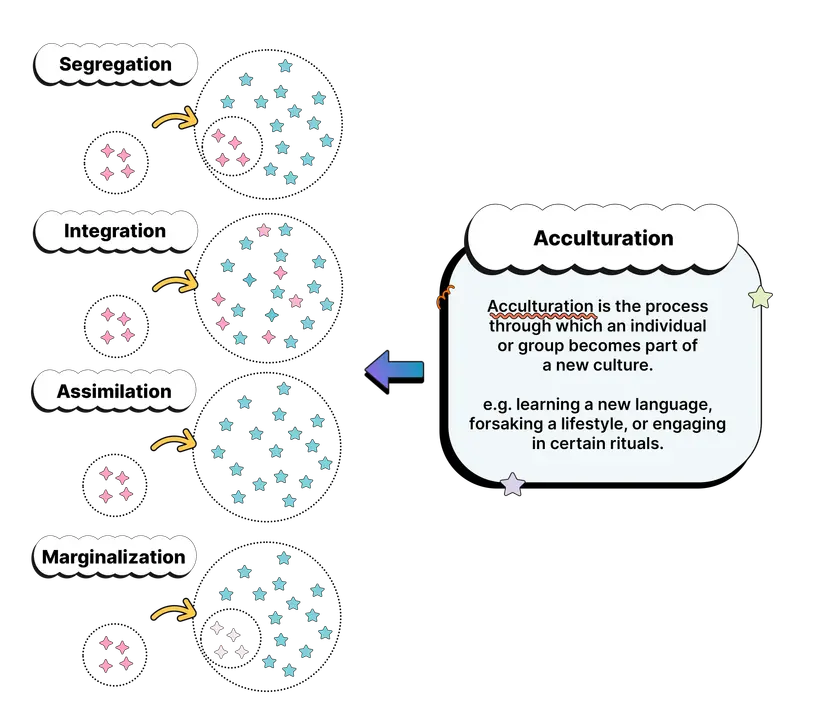
Key Features of Acculturation:
Adoption of dominant language, clothing, or dietary habits.
Continued use of native language within private or community spaces.
Cultural blending visible in hybrid traditions or festivals.
Adaptation of values and norms without fully abandoning original customs.
Examples:
Spanish-speaking immigrants in the United States who learn and use English in public and professional settings but speak Spanish at home and celebrate cultural traditions such as Día de los Muertos.
The Mongol Empire’s elite adopting Confucian bureaucratic practices and Chinese architectural styles during their rule over China, while retaining Mongolian identity.
Acculturation highlights how cultures can coexist and influence each other while maintaining separate identities, contributing to a dynamic and pluralistic cultural environment.
Transculturation
Transculturation is the mutual exchange and fusion of cultural traits between societies of roughly equal influence or power. Unlike acculturation, which often involves a dominant and a subordinate culture, transculturation occurs when both cultures influence each other in meaningful ways, resulting in a blended cultural expression.
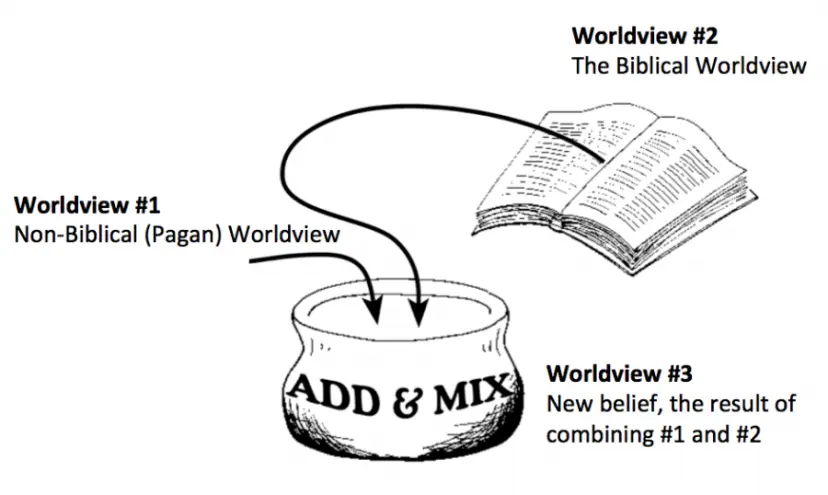
image courtesy of GoodSeed
Transculturation produces new cultural phenomena that reflect the contributions of all participating groups. It often arises in regions with long-term contact between different ethnic, linguistic, or religious communities.
Key Characteristics:
Shared influence: Both cultures contribute and adopt new traits.
Reciprocal change in language, religion, food, and customs.
Creation of hybrid traditions that reflect combined origins.
Examples:
In East Asia, the integration of Confucian ethics with Buddhist spiritual practice created a distinct cultural and philosophical system that influenced family structure, education, and governance across China, Korea, and Japan.
In the Andes, the blending of Catholicism with indigenous spiritual beliefs led to syncretic religious practices that are still celebrated in local festivals today.
Transculturation encourages cultural diversity and the creation of hybrid identities, particularly in multicultural urban centers, where different groups live in close proximity and engage in continuous interaction.
Syncretism
Syncretism is the process by which two or more cultural, religious, or philosophical systems are combined to form a new, unique cultural expression. This often happens when cultural contact occurs over long periods, leading to the blending of beliefs and practices rather than one dominating or replacing the other.
Types of Syncretism:
Religious syncretism: Integration of doctrines, deities, or rituals.
Linguistic syncretism: Fusion of words and grammar from different languages.
Artistic syncretism: Mixing of artistic styles, materials, and symbolism.
Examples:
Sikhism, founded in South Asia, incorporates monotheism from Islam and spiritual philosophies from Hinduism, such as karma and reincarnation.
Shin-Buddhism in Japan combines Shinto animism with Buddhist teachings, especially regarding spirits and the afterlife.
The Bahá'í Faith recognizes prophets from major world religions including Moses, Jesus, Muhammad, and Buddha, promoting unity of all religions.
Syncretism reflects how cultural elements are adapted and transformed, rather than simply transmitted, resulting in forms that are culturally relevant and context-specific.
Assimilation
Assimilation is the process through which a minority group or culture is absorbed into a dominant culture, often resulting in the loss of distinct cultural traits. This process may be voluntary, as individuals seek integration into mainstream society, or involuntary, as a result of policies or social pressures that suppress minority cultures.
Assimilation typically leads to the erosion of language, traditions, religion, and other cultural markers of the minority group. It differs from acculturation in that it involves more complete cultural absorption and loss of identity.
Indicators of Assimilation:
Abandonment of native language for the dominant language.
Loss of traditional clothing, food, and celebrations.
Complete adoption of dominant religious or social practices.
Examples:
Many immigrant families in the U.S. experience assimilation over generations, with grandchildren speaking only English and not participating in ancestral cultural customs.
During the Roman Empire, conquered peoples adopted Latin language and Roman customs, giving rise to the Romance languages and laying the foundation for modern Western European culture.
Assimilation often occurs in nation-states seeking cultural unity, but it can also lead to cultural loss and identity struggles among minority communities.
Cultural Appropriation
Cultural appropriation is the unacknowledged or inappropriate adoption of elements from one culture by members of another, often more dominant, culture. It typically occurs in contexts where one culture has historically oppressed or marginalized another, raising issues of respect, exploitation, and power dynamics.
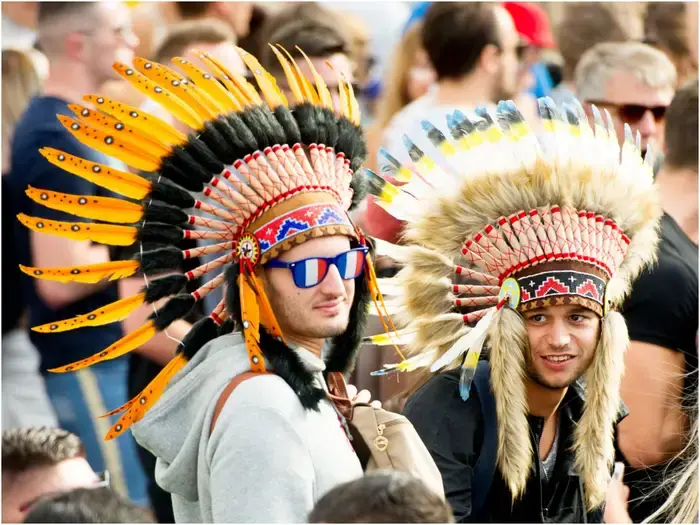
image courtesy of insider
Features of Cultural Appropriation:
Use of cultural symbols without understanding or credit.
Commodification of spiritual or traditional items.
Imitation of clothing, language, or hairstyles in trivialized ways.
Examples:
Sports teams using Native American names and imagery (e.g., the former "Redskins") without respect for the cultural and spiritual significance.
Fashion designers or celebrities wearing sacred tribal headdresses or bindis as accessories.
The marketing of ethnic cuisines without input or benefit to the originating communities.
Cultural appropriation disconnects cultural elements from their context, often reducing them to trends or entertainment while ignoring their deeper significance and histories.
Cultural Imperialism
Cultural imperialism is the dominance of one culture over others, usually through economic or political power, leading to the widespread adoption of that dominant culture’s values, customs, and norms. Unlike cultural diffusion that can be voluntary or reciprocal, cultural imperialism often imposes itself on others, intentionally or unintentionally.
This can result in the suppression or marginalization of local cultures and the rise of global monocultures, where people around the world adopt the same products, media, and lifestyles.
Examples:
The global spread of American pop culture, including fast food chains, Hollywood films, and music, shaping values and tastes across different societies.
Colonial powers enforcing Western education systems, languages, and religious beliefs on colonized populations, often at the expense of indigenous cultures.
Cultural imperialism can erode traditional identities, leading to resistance movements that seek to reclaim and preserve local heritage and languages.
Commodification of Culture
Commodification refers to the process of turning cultural traditions, symbols, or practices into products for commercial sale, often stripped of their original context and meaning. This is a common result of globalization and tourism, where cultural elements are marketed for profit.
Impacts of Commodification:
Loss of authenticity in rituals and customs.
Creation of stereotypes for consumer appeal.
Economic gain for some groups but often exploitation of others.
Examples:
Selling indigenous artifacts in tourist markets without compensating the communities they originate from.
Commercializing religious festivals such as Diwali or Chinese New Year in Western countries without understanding their cultural roots.
Mass production of cultural clothing and symbols by companies with no connection to the culture.
While commodification can increase visibility of certain cultures, it often leads to oversimplification and misrepresentation.
Homogenization of Culture
Cultural homogenization refers to the process where local cultures become increasingly similar, especially as a result of dominant global influences. This occurs through the widespread diffusion of consumer goods, language, entertainment, and social norms, often driven by multinational corporations and global media.
Features of Homogenization:
Standardization of cultural experiences across different regions.
Disappearance of traditional practices and languages.
Erosion of local craftsmanship and uniqueness.
Examples:
The global presence of brands like McDonald’s, Starbucks, and Nike, which offer identical products and experiences in cities worldwide.
The spread of American slang and English-language media, even in non-English-speaking countries.
The replacement of indigenous farming practices with globally standardized agribusiness methods.
Cultural homogenization can lead to a loss of diversity, making societies less reflective of their own histories and values.
Hybrid Cultures
In response to cultural diffusion, many societies develop hybrid cultures that merge traditional practices with foreign influences to form something new. This is especially common in cities and regions where migration, trade, and communication bring together diverse cultural groups.
Characteristics of Hybrid Cultures:
Incorporation of elements from different origins.
Innovation in music, food, language, and religion.
Representation of multicultural identities.
Examples:
K-Pop, which blends Korean language and culture with Western pop music formats and production styles.
Tex-Mex cuisine, which combines Mexican dishes with American ingredients and preparation methods.
The use of Spanglish in bilingual communities in the U.S., representing a fusion of Spanish and English.
Hybrid cultures highlight the creative outcomes of diffusion, showing how cultures are not static but constantly evolving.
Language and Cultural Identity
Language plays a central role in shaping and expressing cultural identity. The diffusion of languages can either empower communication and global participation or threaten linguistic diversity and heritage.
Consequences of Language Diffusion:
Linguistic convergence: The blending of languages or dialects in multilingual areas.
Language loss: When dominant languages replace indigenous tongues, leading to the extinction of native languages.
Code-switching: Switching between languages in different social contexts as a way of expressing identity.
Examples:
The spread of English as a global lingua franca in business, science, and diplomacy.
Creole languages that developed from contact between colonizers and enslaved peoples, forming unique linguistic identities.
Efforts in places like Hawaii or Wales to revive endangered languages through media, education, and law.
The effects of cultural diffusion on language demonstrate how identity is continuously negotiated and reshaped in global and local contexts.
Cultural Landscapes and Spatial Change
Cultural diffusion transforms physical spaces into cultural landscapes that reflect the histories, beliefs, and identities of the people who inhabit them. As cultures diffuse, landscapes are modified to incorporate new structures, aesthetics, and land uses.
Examples of Cultural Influence on Landscapes:
The presence of mosques, temples, or churches in multicultural cities indicates religious diffusion.
Ethnic neighborhoods like Little Italy, Chinatown, or Little Havana reveal patterns of migration and cultural retention.
The adoption of Western architecture in non-Western countries demonstrates cultural influence through education, trade, or tourism.
https://secure-media.collegeboard.org/digitalServices/pdf/ap/ap16_frq_human_geography.pdf
FAQ
Tourism accelerates cultural diffusion by bringing large numbers of outsiders into contact with local communities, often resulting in economic benefits but also cultural changes. Local traditions may be adapted or staged to appeal to tourists, which can dilute authenticity. This phenomenon is known as cultural commodification.
Traditional dances or festivals may be modified for tourist schedules or expectations.
Local crafts are mass-produced for sale, sometimes using cheaper materials.
Indigenous customs are sometimes over-simplified to cater to foreign tastes.
While tourism can financially support communities and preserve cultural expressions, it can also create dependency, exploit cultural symbols, and transform spiritual practices into performances.
Urbanization creates dense environments where diverse cultural groups live and interact daily, making cities hotspots for cultural hybridization. In urban spaces, traditions blend as people adapt to shared resources, public services, and multicultural norms.
Food trucks, fusion restaurants, and multilingual signage reflect cultural mixing.
Urban youth often create hybrid identities, blending music, fashion, and slang from different cultures.
Shared public spaces encourage cross-cultural participation in festivals, religious events, and markets.
Cultural hybridization in cities leads to vibrant new cultural forms, but it can also challenge efforts to maintain cultural heritage in the face of rapid social change and gentrification.
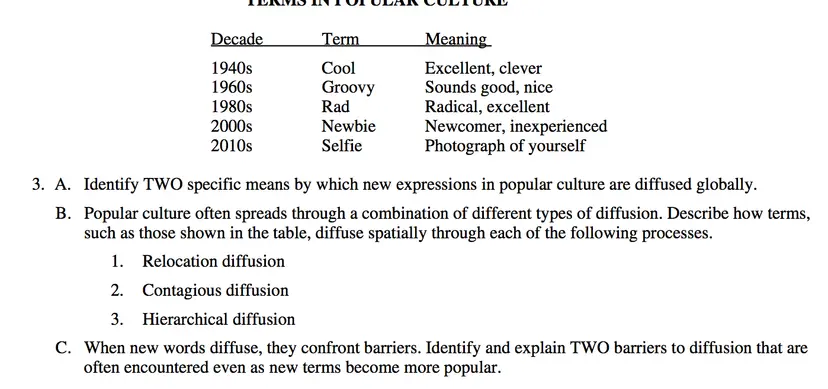
Media and digital technologies exponentially increase the speed and reach of cultural diffusion by allowing instant sharing of information, trends, and ideas across the globe. Unlike traditional face-to-face diffusion, digital platforms enable global audiences to consume and participate in cultural expressions in real time.
Social media apps spread music, dances, memes, and language quickly (e.g., TikTok trends).
Streaming services promote global entertainment, introducing diverse cultures to broad audiences.
Digital activism highlights cultural issues and creates global awareness (e.g., Indigenous rights, language preservation).
This rapid diffusion contributes to both cultural homogenization and diversification, depending on how local communities engage with and reinterpret global content.
Schools are powerful agents of cultural transmission and can either promote assimilation into a dominant culture or preserve minority languages and customs through inclusive curricula and policies.
Standardized curricula often prioritize national histories and languages, leading to assimilation.
Bilingual education and culturally relevant teaching methods support minority students in maintaining their heritage.
Boarding schools historically used assimilation tactics, such as forbidding native languages or religious practices.
Modern multicultural programs celebrate diversity through language clubs, heritage weeks, and inclusive history lessons.
The role of education is pivotal—when done inclusively, it fosters cultural respect and retention; when exclusive, it accelerates cultural loss.
Cultural diffusion introduces new ideas and lifestyles that can challenge traditional gender roles and family dynamics. Exposure to global norms, especially through media and education, often shifts societal expectations.
Western ideas about women’s rights and gender equality influence traditional patriarchal systems.
Changes in family roles, such as increased female participation in the workforce, alter household dynamics.
Adoption of global education models encourages girls to pursue schooling and careers.
Some societies experience tension or backlash as younger generations adopt more egalitarian views than elders.
Practice Questions
Explain the difference between cultural appropriation and cultural syncretism, and provide a real-world example of each.
Cultural appropriation involves a dominant group taking elements from a minority culture without understanding or respect, often for personal or commercial gain. An example is using Native American symbols as sports mascots. Cultural syncretism, by contrast, is the respectful blending of two or more cultural traditions to create something new, often emerging from mutual interaction. An example is the development of Sikhism, which combines aspects of Hinduism and Islam. While appropriation reflects unequal power dynamics and can be exploitative, syncretism demonstrates cultural fusion that preserves and honors elements of all contributing traditions through organic and reciprocal cultural exchange.
Describe how globalization has led to cultural homogenization. Provide an example and explain one possible consequence.
Globalization has accelerated cultural homogenization by spreading dominant cultural traits through media, multinational corporations, and tourism. This results in local cultures adopting similar lifestyles, products, and values. For instance, the global presence of fast-food chains like McDonald’s reflects the widespread diffusion of Western eating habits. A consequence is the loss of traditional food practices and reduced cultural diversity, as global brands replace local businesses. This can weaken cultural identities, making cities around the world appear increasingly alike. Over time, homogenization may limit the preservation of unique languages, customs, and traditions, leading to more uniform and less distinct cultural landscapes.