Political processes shape how power is distributed, expressed, and reorganized in geographic space. These processes include everything from colonization and independence movements to wars and ideological shifts. Understanding these dynamics helps us make sense of how borders, governments, and global interactions have evolved over time.
The Changing Nature of Political Boundaries
Political maps are not static. They reflect the balance of power at specific historical moments and change due to many factors:
War and conquest often redraw national boundaries. Victorious countries may annex territory or impose treaties that reshape borders.
Revolutions and independence movements create new states from old ones, such as the American Revolution leading to U.S. independence or the breakup of colonial empires.
Diplomatic agreements and treaties, like the Treaty of Versailles (1919), reorganized Europe post-World War I.
Name changes and rebranding of states occur to reflect new governments or cultural identities. For example:
Persia became Iran in 1935.
Zaire became the Democratic Republic of the Congo in 1997.
Ceylon became Sri Lanka in 1972.
The process of boundary evolution continues today, with disputes, referendums, and secessionist movements affecting how we understand the political world.
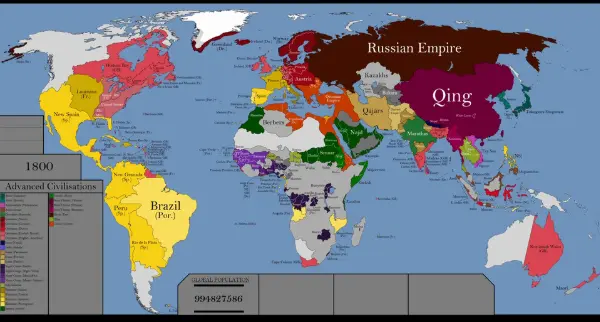
Nationalism and Nation-State Development
The concept of a nation-state—a sovereign state inhabited by people who share a common culture, language, and identity—is a relatively modern political development.
The Rise of Nationalism
Nationalism emerged as a powerful political ideology during the Enlightenment in the 17th and 18th centuries. It supports the idea that people with shared cultural traits should have their own country.
Nationalism was central to the unification of Germany and Italy in the 19th century.
It contributed to the collapse of multiethnic empires like Austria-Hungary, the Ottoman Empire, and later the Soviet Union.
It has also inspired separatist movements, such as those in Quebec (Canada), Scotland (UK), and Catalonia (Spain).
Nationalism can unify a country through shared identity and patriotism, but it can also lead to xenophobia, ethnic conflict, and wars of independence when multiple groups compete for sovereignty within the same space.
Imperialism and Colonialism: Expansion of Political Power
Imperialism Defined
Imperialism refers to a policy of extending a country’s influence over other territories through diplomacy, military force, or economic control. This process often reshapes the political landscape on a global scale.
The 19th century is often called the “Age of Imperialism”, when European powers expanded aggressively into Africa, Asia, and Oceania.
The goal was often to control natural resources, labor, and trade routes.
It also involved cultural dominance, as colonizers imposed language, religion, and education systems.
Colonialism in Practice
Colonialism is a specific type of imperialism where a country settles and governs a foreign territory.
It started with the Age of Exploration in the 1500s when Spain and Portugal established colonies in the Americas.
By the 1800s, Britain, France, the Netherlands, and Belgium expanded colonization to Africa and Asia.
Colonies were governed directly by the colonial power and used for economic gain.
The effects of colonialism persist today through economic underdevelopment, cultural displacement, and border conflicts.
The Berlin Conference and Africa’s Political Reorganization
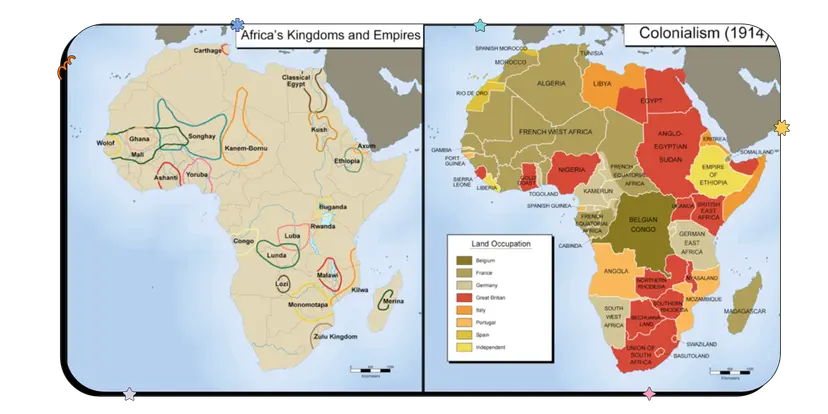
The Berlin Conference of 1884–1885 was a pivotal event where European powers agreed on how to divide Africa without considering indigenous boundaries or governance.
No African representatives were included in the discussions.
New borders were drawn with little regard for ethnic, linguistic, or tribal divisions.
These artificial borders:
Forced rival groups into the same state.
Split homogenous groups across multiple states.
Led to protracted civil wars and political instability in the post-colonial era.
By 1900, only Liberia and Ethiopia remained independent in Africa.
The Political Impact of the World Wars
World War I (1914–1918)
World War I transformed Europe’s political landscape:
Sparked by the assassination of Archduke Franz Ferdinand, the war involved many global powers.
After the Central Powers’ defeat, major empires collapsed:
The Ottoman Empire, Austro-Hungarian Empire, and parts of Germany were dismantled.
Several new countries were formed:
Yugoslavia, Czechoslovakia, Poland, Latvia, Lithuania, and Estonia.
The war’s aftermath also sparked early decolonization movements as colonies sought more autonomy.
World War II (1939–1945)
World War II led to even more dramatic geopolitical shifts:
The defeat of Nazi Germany, Imperial Japan, and Fascist Italy resulted in:
The division of Germany into East and West.
The U.S. occupation of Japan and reform of its political system.
The rise of superpowers: the United States and the Soviet Union.
Eastern Europe fell under Soviet control, triggering the Cold War.
Former Axis colonies in Asia and Africa moved toward independence.
The Cold War: Ideology and Global Power Struggles
The Cold War (1945–1991) divided the world into two ideological blocs:
Western bloc: led by the United States, promoting capitalism and liberal democracy.
Eastern bloc: led by the Soviet Union, promoting communism and authoritarian socialism.
The Cold War influenced political processes through:
Proxy wars in Korea, Vietnam, Afghanistan, and Latin America.
The formation of military alliances like NATO and the Warsaw Pact.
The division of countries:
Germany split into East and West.
Korea split into North and South.
Vietnam experienced decades of conflict.
The Cold War also involved economic imperialism, especially by the U.S. in Latin America, where the government supported dictatorships that aligned with anti-communist policies.
The Era of Decolonization
After WWII, many countries in Asia, Africa, and the Caribbean demanded independence. This decolonization wave was influenced by:
The weakening of European powers.
Ideological shifts favoring self-determination.
Nationalist movements led by figures like Gandhi, Ho Chi Minh, and Kwame Nkrumah.
Key Decolonization Examples
India gained independence from Britain in 1947, followed by the creation of Pakistan.
Algeria fought a bloody war for independence from France, gaining sovereignty in 1962.
Indonesia declared independence from Dutch control in 1945, formally recognized in 1949.
Many African nations gained independence in the 1950s and 1960s, often facing internal conflicts due to colonial-era borders.
Although many former colonies gained political independence, economic dependency and neocolonialism remain significant challenges.
The Post-Cold War Political Order
The collapse of the Soviet Union in 1991 was one of the most significant geopolitical events of the 20th century.
It led to the independence of 15 new countries, including:
Ukraine, Kazakhstan, Latvia, Estonia, and Georgia.
The Warsaw Pact dissolved, and many Eastern European countries turned toward Western alliances like NATO and the EU.
The U.S. emerged as the sole superpower, but multipolarity has since increased with the rise of China, India, and regional blocs.
Former Soviet republics faced challenges such as:
Ethnic tension and civil war (e.g., Chechnya, Georgia).
Economic instability after transitioning from planned to market economies.
Corruption and authoritarianism in some post-Soviet states.
Ongoing and Emerging Political Processes
Political geography continues to evolve with new challenges and trends:
Secessionist movements seek independence (e.g., Catalonia, Scotland, Kurdistan).
Partially recognized states like Taiwan, Palestine, and Kosovo challenge traditional definitions of statehood.
Technology and social media empower grassroots political activism and protest movements.
Climate change drives new forms of political cooperation and conflict over resources like water and arable land.
Migration crises, driven by war, poverty, and environmental change, test political boundaries and international law.
FAQ
Revolutions and wars of independence both result in major political transformations, but they originate from different motivations and have unique effects on state formation and boundary changes.
Revolutions are typically internal upheavals aiming to overthrow existing governments or political systems. Examples include the French and Russian Revolutions. These events often result in regime change but do not always lead to new country borders.
Wars of independence are conflicts where colonies or regions seek to break away from imperial powers and become sovereign nations. The American Revolution and India’s independence from Britain are key examples.
Wars of independence usually create new states and require international recognition of sovereignty, while revolutions may simply shift internal political ideologies or leadership.
In terms of the political map, wars of independence redraw international borders, whereas revolutions typically change the nature of governance within existing borders.
Ideology is a foundational driver in global political processes, influencing who aligns with whom and why states enter into conflicts or partnerships.
During the Cold War, ideological divisions between capitalism (U.S.) and communism (U.S.S.R.) led to the creation of opposing alliances like NATO and the Warsaw Pact.
Liberal democracies often support like-minded states and promote civil liberties, markets, and democratic governance, while authoritarian regimes may band together to resist external interference.
Ideological shifts can cause internal divisions, such as socialist revolutions or movements demanding liberal reforms.
In modern times, ideology still influences foreign policy, trade agreements, and military interventions, as seen in U.S. tensions with authoritarian states like North Korea or Iran.
Ideologies shape not only domestic politics but also international systems of cooperation and conflict.
Indigenous populations often face marginalization due to political processes initiated by colonization and post-colonial governance structures.
During colonization, indigenous peoples were frequently displaced, assimilated, or subjected to violence. Colonial governments prioritized settlers’ interests over indigenous sovereignty.
Post-independence governments have often inherited colonial structures that continue to sideline indigenous communities.
Land disputes are common where indigenous lands were seized during colonization and remain under non-native control.
Indigenous groups struggle for political representation, cultural preservation, and legal recognition of land rights.
Examples include the Aboriginal peoples in Australia, Native American tribes in the U.S., and the Mapuche in Chile—all advocating for autonomy, reparations, and rights-based governance.
Political processes rarely reverse colonial-era inequities without intentional efforts to decolonize governance and law.
Renaming a country is often a symbolic political act reflecting shifts in identity, governance, or independence.
After gaining independence, many countries rename themselves to assert a distinct post-colonial identity. For instance, Gold Coast became Ghana, and Rhodesia became Zimbabwe.
Renaming can also reflect ideological changes. For example, Burma became Myanmar under a military regime, though the name remains contested internationally.
Political name changes may signal a break with colonial or imperial legacies, aiming to reassert cultural or indigenous heritage.
Such renaming also affects international diplomacy, trade agreements, and geopolitical recognition.
In rare cases, names are changed to boost national unity, especially in ethnically diverse states, or as part of rebranding efforts.
These name changes are powerful statements of self-determination and political repositioning on the world stage.
Political processes significantly affect the formation, expansion, and potential fragmentation of supranational organizations like the European Union or the African Union.
These entities form when states voluntarily cede some sovereignty for mutual benefit in trade, security, or governance.
Political stability and shared interests are crucial for their survival. Internal disputes, economic crises, or ideological differences can strain cooperation.
Brexit, the UK’s departure from the EU, is a clear example of a political process leading to fragmentation due to nationalist pressures and debates over sovereignty.
Rising populism, shifting alliances, or external threats can either strengthen integration (e.g., in response to war) or undermine unity (e.g., financial bailouts causing resentment).
Political processes determine not only membership and rules but also the legitimacy and authority of such organizations in the global system.
These entities are constantly evolving, and their longevity depends on ongoing political negotiation and cooperation among member states.
Practice Questions
Explain how the processes of colonialism and decolonization have influenced the current political map of Africa. Provide specific examples in your response.
Colonialism in Africa, especially after the Berlin Conference of 1884–1885, created arbitrary borders that disregarded ethnic and cultural divisions. European powers divided the continent for economic gain, leading to long-term instability. For example, Nigeria contains over 250 ethnic groups forced into one political unit. Decolonization, primarily in the mid-20th century, resulted in the emergence of many independent states like Ghana and Kenya. However, these new nations inherited colonial boundaries, often leading to internal conflict. Ethnic tensions, civil wars, and challenges to national unity remain direct consequences of colonial border decisions and rushed political transitions during the decolonization process.
Describe the impact of the Cold War on the global distribution of political power. Use examples to support your answer.
The Cold War reshaped the global political landscape by dividing countries into two ideological blocs: capitalist, led by the United States, and communist, led by the Soviet Union. This division led to proxy wars in Korea, Vietnam, and Afghanistan, reinforcing ideological conflict without direct confrontation. Eastern European countries like Poland and East Germany were brought into the Soviet sphere, while Western Europe aligned with NATO. The Cold War also influenced the independence movements in Africa and Asia, with superpowers supporting opposing factions. After the USSR collapsed in 1991, 15 new countries gained independence, and U.S. influence became dominant, shifting global power.