Governance refers to the structure and processes by which power is exercised, decisions are made, and authority is distributed across different levels of society. Understanding the various forms of governance is essential to analyzing how states function, how they interact with citizens, and how policies are implemented across regions and populations.
What Is Governance?
Governance is not just about governments or leaders; it includes all institutions, systems, and practices through which societies are organized and managed. It encompasses laws, administrative systems, leadership structures, and citizen participation. Governance can take many forms, depending on historical, cultural, and social conditions, and can be structured through democratic, authoritarian, or mixed systems.
Governance can also be understood in terms of how centralized or decentralized it is. This helps distinguish between unitary and federal states, as well as between democratic and autocratic forms of governance.
Major Political Systems
Democracy
Democracy is a form of governance in which political power belongs to the people. Citizens either make decisions directly or elect representatives to make decisions for them. The system is based on the principles of individual rights, political participation, and rule of law.
There are two major forms of democracy:
Direct Democracy: In this system, citizens participate in decision-making themselves rather than through elected officials. This is more common in smaller political entities, such as towns or regions. For example, Switzerland uses referendums to allow citizens to directly vote on laws and policies.
Representative Democracy: This is more common in larger nations. Citizens elect representatives to a legislative body, who then make decisions on their behalf. This system allows for more efficient governance at a larger scale. The United States, Germany, and India use representative democratic systems.
Key characteristics of democracies include:
Regular, free, and fair elections.
A system of checks and balances.
Protection of civil liberties and human rights.
Multiple political parties and ideologies.
Autocracy
Autocracy is a system in which one individual holds all the power. This person makes decisions without the input of citizens or other branches of government. Autocracies can be seen in the form of:
Absolute Monarchies, where the ruler inherits power and has unlimited control.
Dictatorships, where the leader often takes power by force or manipulation.
Totalitarian States, where the state seeks to control every aspect of public and private life, often using propaganda and surveillance.
Key features of autocracies:
Centralized control with limited political pluralism.
Repression of dissent and censorship.
Lack of meaningful political participation for the general public.
Government institutions often revolve around the ruler’s authority.
Examples include North Korea under Kim Jong-un, and historically, Nazi Germany under Adolf Hitler and Soviet Russia under Joseph Stalin.
Oligarchy
An oligarchy is a form of governance where power is concentrated in the hands of a small group. This group could be defined by wealth, social status, family ties, corporate connections, or military control.
Characteristics:
Decision-making is often based on the interests of the elite group.
Limited opportunity for public participation or representation.
May exist under the guise of democracy or republicanism.
A modern example often cited is Russia, where a small group of wealthy individuals known as oligarchs have significant influence over political decisions.
Anarchy
Anarchy represents a situation where no formal government or central authority exists. This can occur:
Temporarily during state collapse due to war or natural disaster.
As a philosophical stance, where communities voluntarily organize without hierarchical authority, emphasizing mutual aid and cooperation.
In practice, prolonged anarchy often leads to lawlessness or power vacuums that may be filled by militias or warlords.
Historical example: Somalia in the early 1990s experienced years of anarchy after the collapse of its central government.
Federal and Unitary Systems
Beyond who holds power, the structure of governance also involves how power is distributed geographically across a state.
Federal System
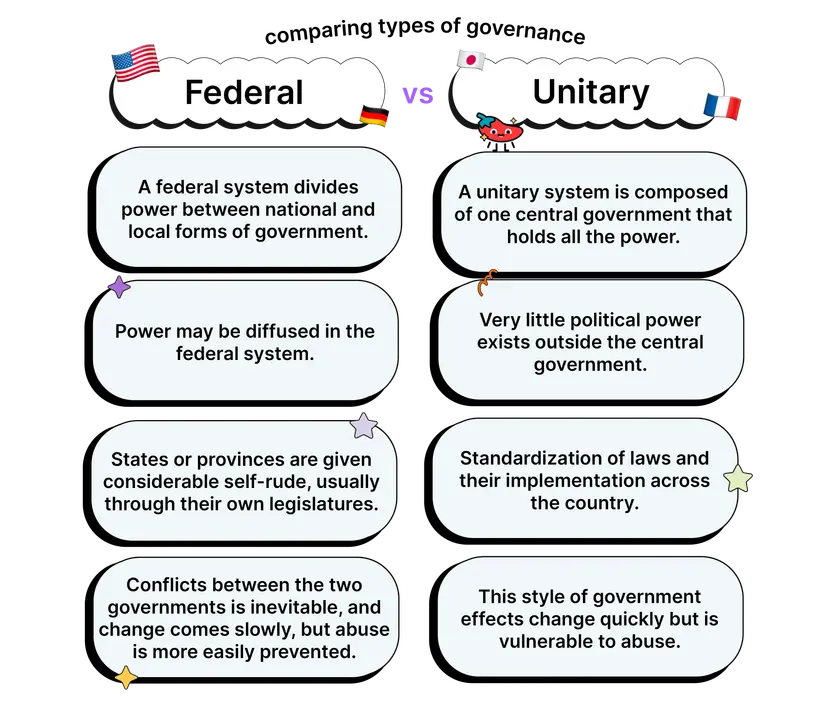
A federal system divides political authority between a national government and various regional governments, such as states or provinces. Each level has constitutionally protected powers and responsibilities.
Federalism allows for:
Regional autonomy and local control.
Representation of diverse groups and interests.
Policy experimentation on a smaller scale.
In a federal system, responsibilities are typically divided:
Federal government: National defense, foreign policy, trade.
State/regional governments: Education, policing, public health.
Countries with federal systems:
United States: Federal laws coexist with state laws; states have their own constitutions and legislatures.
India: Each state has significant power over education and local governance, while the central government manages national issues.
Brazil: States have power over infrastructure, health, and security.
Germany: Bundesländer (states) handle education and policing.
Canada: Provinces manage natural resources, healthcare, and education.
Unitary System
In a unitary system, all major decisions are made by the central government, which may delegate certain powers to regional or local authorities, but retains ultimate control.
Key features:
Uniform laws and policies across the state.
Centralized decision-making and administration.
Regional governments exist primarily to implement central policies.
Advantages:
Greater national cohesion and consistency.
Faster policy implementation.
More efficient in smaller or homogeneous countries.
Countries with unitary systems:
France: Despite some regional bodies, the national government holds the primary authority.
Japan: Prefectural governments are primarily administrative extensions of the central government.
China: The Communist Party holds centralized power, and provinces act under its authority.
United Kingdom: Although devolved powers exist for Scotland, Wales, and Northern Ireland, the UK Parliament retains sovereignty.
Singapore: A centralized city-state with strong national government oversight over all services.
Shapes of States and Governance
The morphology of a state—or its physical shape—can affect governance by influencing how well a government can administer and integrate its territory.
Compact States
Distance from center to any border is relatively equal.
Promotes efficiency in administration and communication.
Examples: Poland, Uruguay.
Elongated States
Long and narrow in shape.
Challenges include difficulty in communication, transportation, and integration.
Examples: Chile, Norway, Vietnam.
Prorupted States
Mostly compact but with a protruding extension.
Extension may access resources or separate other states.
Examples: Thailand, Democratic Republic of the Congo.
Perforated States
A state that completely surrounds another.
The enclosed state may rely on the surrounding state for access and resources
Examples: South Africa (surrounding Lesotho), Italy (surrounding Vatican City).
Geographic shape influences how governance is applied, from infrastructure planning to defense and regional equity.
Effects of Globalization on Governance
Globalization has transformed governance by weakening national borders and enhancing interdependence. States must now share decision-making power with international organizations and corporations.
Transnational Corporations (TNCs)
Operate in multiple countries.
May have more economic influence than some national governments.
Examples: Amazon, Facebook, Apple.
Impacts:
Influence local labor laws and tax policies.
Shift economic power away from the state
Undermine state sovereignty in favor of corporate priorities.
Supranationalism
Countries form organizations that transcend borders to achieve common goals.
Political Supranationalism:
United Nations (UN): Maintains international peace and security.
NATO: Military alliance with mutual defense obligations.
European Union (EU): Shares economic, legal, and political frameworks.
Economic Supranationalism:
World Trade Organization (WTO): Regulates international trade.
ASEAN: Promotes regional economic growth in Southeast Asia.
OPEC: Coordinates oil production and prices.
Benefits:
Enhances global cooperation.
Increases economic competitiveness.
Solves global issues collaboratively.
Drawbacks:
Reduces national control over domestic policy.
May force states to conform to external rules or agreements.
Environmental and Strategic Challenges
Global problems like climate change, pollution, and security threats require cooperative solutions.
Paris Agreement: An international climate accord requiring national commitments.
Military alliances: Ensure collective security but may draw states into conflicts not of their choosing.
These trends reveal how the structure and scale of governance are increasingly affected by global events and international cooperation.
Key Terms Summary
Democracy: Power to the people, through direct or representative means.
Autocracy: Power concentrated in one ruler with limited public participation.
Oligarchy: Rule by a small, elite group.
Anarchy: Absence of a central governing authority.
Federal System: Division of power between national and regional governments.
Unitary System: Centralized power with minimal local autonomy.
Compact State: Efficient and centrally governed due to equal distribution of distance.
Elongated State: Governance challenges due to distance and isolation.
Prorupted State: Compact with a projecting extension.
Perforated State: A state that surrounds another.
Globalization: Increased global interconnectedness and interdependence.
Transnational Corporations: Businesses operating across multiple countries.
Supranationalism: States cooperating in shared institutions and policies.
Economic Supranationalism: Trade and economic alliances that transcend borders.
FAQ
The form of governance greatly influences how efficiently a country can respond to natural disasters and emergencies. In a federal system, state or provincial governments often have autonomy over emergency services, which allows for quick local response but can lead to inconsistent standards and slower national coordination. In contrast, unitary states can implement centralized plans more uniformly and quickly but may lack the flexibility to address regional differences.
Federal systems like the United States allow states to declare emergencies and mobilize resources independently, but federal assistance often requires requests and approvals.
Unitary systems such as Japan can activate nationwide emergency protocols efficiently, ensuring consistency in communication, logistics, and evacuation plans.
The level of intergovernmental coordination, resource sharing, and jurisdictional clarity can determine the success of relief efforts.
Ultimately, while federalism promotes local knowledge and responsiveness, unitary systems benefit from streamlined authority and fewer bureaucratic layers during crises.
In federal systems, subnational governments—like U.S. states or German Länder—do not conduct formal foreign policy, but they play increasingly active roles in international affairs, especially regarding trade, environment, and cultural exchange.
State and provincial governments often form partnerships with foreign regions, sign economic memoranda of understanding, or participate in international conferences.
Examples include California’s environmental agreements with foreign countries and Quebec’s participation in Francophone summits.
While the national government retains legal authority over diplomacy, subnational governments influence global issues through “paradiplomacy”—unofficial international engagement.
This decentralization reflects the growing complexity of governance, where states or provinces pursue their interests on the global stage while operating under national frameworks.
Governance structures influence how minority rights are protected and how cultural practices are preserved across a country. Federal systems tend to allow more regional autonomy, which can support cultural diversity and minority self-governance. Unitary systems often implement national policies uniformly, which can either promote inclusion or suppress regional identities.
In federal states, such as Canada, provinces like Quebec can enact laws preserving French language and culture.
India’s federal design permits states to establish official languages and local education policies aligned with cultural traditions.
Unitary states like France may push for national cohesion, sometimes leading to tensions over regional languages or customs.
Governance design impacts whether minority groups feel represented and whether their rights are recognized through formal structures like regional assemblies or cultural protections.
States may shift their form of governance in response to political, economic, or social pressures. Transitions often occur to address demands for greater regional autonomy, improve administrative efficiency, or stabilize internal conflicts.
A move from unitary to federal governance can help manage diversity and appease separatist movements, as seen in Belgium, which devolved power to accommodate linguistic and regional differences.
Transitioning from federal to unitary may aim to strengthen central authority, especially after internal instability. For example, Sri Lanka has debated centralization to combat fragmentation.
Key drivers include ethnic composition, economic disparities, governance effectiveness, and historical grievances.
Transitions are often complex, requiring constitutional changes, political negotiations, and careful balancing of competing interests to maintain national unity.
Federal and unitary systems approach policy experimentation and innovation in distinct ways due to their structural differences. In federal systems, regional governments act as “laboratories” for policy testing, allowing localized reforms that can inform national models. Unitary states typically implement innovations uniformly, which speeds up broad adoption but may limit tailored solutions.
Federal countries, like the United States, allow states to pilot new policies (e.g., Massachusetts’ early healthcare reform), which may later become federal standards.
Unitary states like the UK can legislate national policies more quickly, but innovation is top-down, often reducing experimentation at local levels.
Federalism encourages bottom-up innovation, while unitary systems rely on centralized decision-making for reforms.
The flexibility of federations supports responsiveness to local needs, while the consistency of unitary systems enables streamlined policy rollout and control.
Practice Questions
Explain the key differences between federal and unitary systems of governance. Use examples to support your response.
Federal and unitary systems differ primarily in how power is distributed across levels of government. In a federal system, power is constitutionally divided between central and regional governments, as seen in the United States and India, where states have autonomy over education and public safety. In contrast, unitary systems centralize power in the national government, with regional authorities serving administrative roles, such as in France or Japan. Federal systems offer regional flexibility and representation for diverse populations, while unitary systems promote national uniformity and policy coherence, often making them more efficient for smaller or more culturally homogeneous states.
Describe how globalization and supranationalism challenge traditional forms of governance. Provide one political and one economic example.
Globalization and supranationalism reduce the autonomy of individual states by encouraging collaboration and shared sovereignty. Politically, organizations like the United Nations influence state behavior through global norms and peacekeeping missions, limiting unilateral decision-making. Economically, trade agreements such as NAFTA or the European Union’s common market force member states to align policies with collective goals, sometimes at the cost of national priorities. Additionally, transnational corporations can pressure governments to adopt favorable regulations, challenging local control. These dynamics illustrate how governance increasingly involves managing international relationships, rather than solely internal affairs, which reshapes how states exercise authority and respond to citizens.