
The Green Revolution was a period of rapid agricultural innovation in the mid-20th century that dramatically increased food production through technology, helping to combat hunger in developing countries.
Definition and Historical Context
The Green Revolution refers to a global campaign of agricultural modernization that began in the 1940s and expanded rapidly from the 1960s through the 1980s, primarily targeting developing countries facing food shortages. Its central goal was to increase food production to keep pace with the accelerated global population growth, particularly in regions like South Asia, Latin America, and parts of Africa.
The movement was driven by a collaboration of governments, scientific institutions, international foundations (such as the Rockefeller Foundation), and aid agencies. Spearheaded by agronomist Norman Borlaug, who later won the Nobel Peace Prize in 1970, the revolution began with the introduction of high-yielding varieties (HYVs) of wheat in Mexico. These efforts expanded to India, Pakistan, the Philippines, and beyond, reshaping agricultural landscapes across the Global South.
Causes of the Green Revolution
Several global challenges and changes motivated the development and expansion of the Green Revolution:
Population Pressure: After World War II, the populations of many developing nations grew rapidly. Without changes in agricultural output, mass famine was predicted in many areas.
Scientific Progress: Innovations in plant genetics, chemical engineering, and soil science laid the groundwork for enhanced crop varieties and nutrient management.
Cold War Strategy: Western governments supported agricultural aid as a way to stabilize countries politically and economically and reduce communist influence in the Global South.
Economic Incentives: Rising global food demand provided motivation for governments and farmers to increase production and invest in agriculture.
Government and NGO Support: Countries like India and organizations like the FAO and USAID invested heavily in research stations, irrigation, infrastructure, and farmer education.
Key Technological Advancements
The Green Revolution's success was largely due to a series of interconnected innovations that together reshaped farming practices.
High-Yield Varieties (HYVs)
Developed through selective breeding and later through hybridization and genetic modification.
HYVs of wheat, rice, and maize were engineered to produce larger grain heads, shorter stalks to prevent lodging (falling over), and greater resistance to disease.
These varieties dramatically increased crop productivity per hectare, particularly in regions with favorable climate and water access.
Synthetic Fertilizers
Replaced traditional organic fertilizers (like manure) with chemical compounds rich in nitrogen, phosphorus, and potassium (NPK).
Enabled plants to grow more rapidly and produce more biomass.
Intensive use of fertilizers allowed for multiple cropping seasons per year, reducing reliance on natural soil fertility.
Pesticides and Herbicides
Introduced to reduce crop losses from insects, weeds, and fungal diseases.
Allowed farmers to maintain monocultures without significant yield reduction from biological threats.
Long-term use raised concerns about soil toxicity, human health, and resistance among pests.
Irrigation Systems
Enhanced through the construction of large-scale canals, reservoirs, tube wells, and drip irrigation systems.
Provided consistent water supplies, especially crucial for HYVs that required precise watering for optimal yield.
In arid and semi-arid regions, irrigation was the key enabling factor for Green Revolution success.
Mechanization
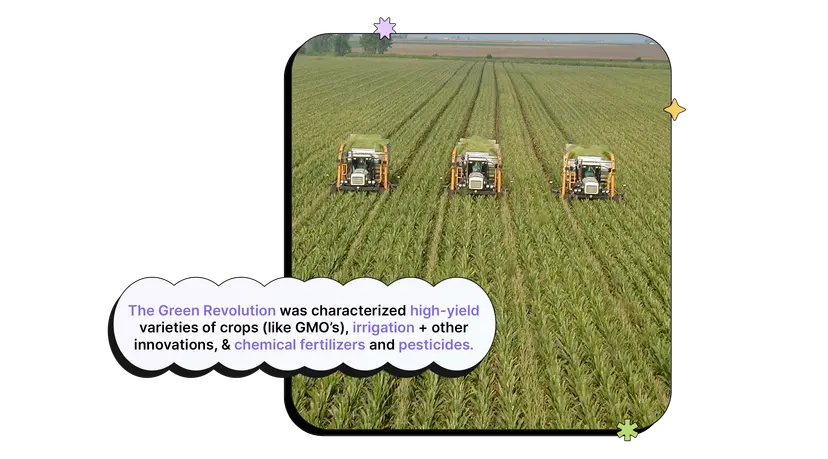
Tractors, harvesters, plows, seeders, and other equipment allowed for the mechanization of previously labor-intensive tasks.
Reduced the need for large rural labor forces and increased land under cultivation.
Expensive machinery created economic divides between large-scale commercial farmers and smallholder farmers unable to afford upgrades.
Biotechnology and GMOs
Later phases of the revolution introduced genetically modified organisms (GMOs) with enhanced resistance to drought, pests, or herbicides.
Biotechnology became a central focus of modern agricultural research, though its adoption sparked ethical, environmental, and health-related debates.
Impacts of the Green Revolution
The Green Revolution produced a wide range of social, economic, and environmental effects, both beneficial and detrimental.
Positive Impacts
Increased Crop Yields
Global grain production more than doubled in many areas where the Green Revolution was implemented.
India, for example, went from being food-deficient in the early 1960s to a net exporter of wheat and rice by the 1980s.
Improved Food Security
Millions of people gained more reliable access to calories, particularly in rural areas of South and Southeast Asia.
Malnutrition and famine were significantly reduced, though not entirely eradicated.
Economic Growth
Boosted agricultural exports, contributing to national economies.
Helped countries invest in rural development, infrastructure, and public services.
Agro-industries emerged to supply and process fertilizers, pesticides, and machinery.
Rural Transformation
Enabled creation of rural cooperatives, extension services, and agricultural banks.
Increased employment in agricultural support sectors like manufacturing, distribution, and retail.
Negative Impacts
Environmental Degradation
Overuse of chemical fertilizers and pesticides led to:
Soil acidification and nutrient depletion
Pollution of rivers, lakes, and groundwater
Loss of beneficial insects and increased pest resistance
Over-irrigation caused:
Waterlogging and soil salinization
Depletion of aquifers and unsustainable water use
Displacement of Small Farmers
The cost of inputs—seeds, fertilizers, machinery—was prohibitive for many subsistence farmers.
Land consolidation increased as larger commercial farms absorbed small plots, leading to rural unemployment and urban migration.
Socioeconomic divides widened in both rural and urban areas.
Loss of Biodiversity
Focus on HYVs led to the widespread abandonment of traditional landraces and indigenous varieties.
Genetic erosion reduced agricultural resilience and adaptability to climate variability and emerging diseases.
Dependency on External Inputs
Farmers became reliant on imported or patented seeds, many of which could not be replanted without losing productivity.
Market volatility made essential inputs unaffordable during economic downturns or inflationary periods.
Health and Safety Concerns
Pesticide exposure became a major health risk for agricultural workers, especially in countries with weak safety regulations.
Food contamination fears arose from chemical residues and concerns about GMOs, particularly in Europe.
Regional Focus: The Case of India
India is one of the most cited examples of Green Revolution success, though the outcomes were complex and varied by region and social class.
Successes
Punjab and Haryana became hubs of high-yield wheat production.
Government investment in irrigation, storage, and roads helped increase farmer incomes and reduce urban food prices.
The country achieved self-sufficiency in staple grains, reducing dependency on imports and food aid.
Challenges
Overuse of water resources in northern India has caused serious groundwater depletion.
Indebtedness among farmers purchasing expensive seeds and chemicals led to social unrest and even suicides.
Southern and eastern regions lagged behind due to weaker infrastructure and limited access to Green Revolution technologies.
Why Some Areas Were Left Behind
Despite its success in parts of Asia and Latin America, the Green Revolution did not reach or succeed equally in all regions.
Africa faced challenges including:
Diverse ecologies that made standardized HYVs less effective
Poor infrastructure and limited irrigation
Political instability and lack of government support
Areas with traditional farming systems often resisted the transition to high-input, commercial agriculture.
Remote regions without access to markets or credit systems remained outside the revolution’s benefits.
Long-Term Influence and Legacy
The Green Revolution’s influence continues to shape agriculture and food systems today:
It spurred the development of the modern agribusiness model, integrating farming with industrial inputs and distribution networks.
Inspired the Second Green Revolution, which aims to address environmental concerns and promote sustainability.
Continues to influence agricultural policy, especially in areas related to food security, climate resilience, and rural development.
In academic and policy circles, the revolution remains both celebrated and criticized—praised for increasing food production but challenged for its social and environmental costs.
Key Terms to Remember
Green Revolution: A mid-20th-century movement focused on increasing food production in developing countries through technological innovation.
High-Yield Varieties (HYVs): Genetically improved crops with greater output potential.
Synthetic Fertilizers: Chemically produced nutrients added to soil to boost plant growth.
Pesticides and Herbicides: Chemicals used to control pests and weeds.
Irrigation Systems: Artificial methods for providing water to crops.
Mechanization: The replacement of human labor with machines in farming.
GMOs (Genetically Modified Organisms): Plants with altered genes for enhanced traits.
Food Security: Reliable access to enough nutritious food for a population.
Environmental Degradation: Harm to ecosystems and natural resources due to unsustainable practices.
Biotechnology: Scientific methods used to modify organisms for agricultural purposes.
FAQ
The Green Revolution often widened social and economic inequalities in rural areas because wealthier farmers had the means to adopt new technologies, while poorer farmers did not.
Wealthy landowners could afford high-yield seeds, fertilizers, irrigation systems, and machinery.
Many smallholders lacked access to credit or government subsidies, preventing them from adopting these costly inputs.
Larger farms became more productive and profitable, while small farms struggled to compete, often leading to land sales or consolidation.
Labor-saving mechanization also reduced demand for rural workers, resulting in job losses for agricultural laborers.
These disparities contributed to rural poverty, migration to cities, and social unrest in some areas.
The Green Revolution shifted dietary patterns by increasing the availability of staple grains but sometimes reduced dietary diversity.
Increased production of wheat and rice made these staples more accessible and affordable.
In regions like South Asia, this helped reduce caloric deficiencies and hunger.
However, focus on cereal crops often meant that farmers reduced the cultivation of legumes, vegetables, and indigenous grains.
This shift contributed to a decline in micronutrient intake, sometimes leading to hidden hunger—malnutrition due to a lack of vitamins and minerals.
While calories became more available, balanced nutrition was not always achieved, especially in low-income households.
International foundations and organizations were instrumental in funding, researching, and spreading Green Revolution technologies across the developing world.
The Rockefeller Foundation funded early research in Mexico that led to the development of high-yield wheat varieties.
The Ford Foundation supported rural development programs and education on modern agricultural practices.
Organizations like FAO (Food and Agriculture Organization) and USAID provided technical expertise and financial aid for irrigation, infrastructure, and machinery.
These efforts aimed to reduce hunger, stabilize economies, and promote political stability during the Cold War.
While their support helped increase food production, critics argue that the approach favored large-scale farming and often neglected local needs and traditional knowledge.
The Green Revolution altered traditional gender roles by shifting labor demands and access to agricultural resources.
Mechanization reduced the need for manual labor, which traditionally involved significant contributions from women.
As tasks like planting and harvesting became machine-dominated, men increasingly controlled farm operations and decision-making.
Access to credit, seeds, and training was often directed at male farmers, sidelining women’s roles in food production.
In some areas, women continued to perform unpaid or low-paid agricultural work but had limited say in resource management.
These changes sometimes deepened gender inequality, particularly in regions where agriculture was a major source of household income.
The Green Revolution significantly shaped the political dynamics of countries by affecting regional development, class relations, and policymaking.
In India, regions that adopted Green Revolution technologies, like Punjab and Haryana, gained political influence due to their agricultural success.
The government strengthened rural investment in infrastructure, credit systems, and procurement policies to support farmers.
Increased food security reduced the need for food aid and enhanced national sovereignty.
However, regional disparities emerged, with less-developed states feeling marginalized, leading to political tensions.
Agrarian movements and farmer protests also arose, especially when input costs rose or subsidies were reduced, pushing agriculture onto the national political agenda.
Practice Questions
Explain one technological advancement from the Green Revolution and describe how it impacted agricultural productivity in developing countries.
One major technological advancement of the Green Revolution was the development of high-yield varieties (HYVs) of staple crops such as wheat and rice. These HYVs were bred to produce more grain per plant, resist diseases, and grow faster. In countries like India and Mexico, HYVs significantly increased crop yields, helping to prevent famines and reduce malnutrition. Farmers who adopted HYVs could grow more food on the same amount of land, improving food security and boosting rural economies. However, these crops required access to irrigation, fertilizers, and pesticides, which sometimes widened the gap between wealthy and poor farmers.
Identify and explain one environmental consequence of the Green Revolution in regions that adopted its agricultural practices.
One environmental consequence of the Green Revolution was soil degradation due to the overuse of chemical fertilizers and irrigation. In regions such as Punjab, India, continuous use of synthetic fertilizers depleted soil nutrients and altered natural soil composition. Excessive irrigation also led to waterlogging and salinization, making the land less fertile over time. These environmental issues reduced long-term agricultural sustainability and required increased input use to maintain productivity. The heavy dependence on non-organic farming methods demonstrated the trade-off between short-term food gains and long-term ecological health in many developing countries.