
The Von Thünen Model explains how different agricultural activities are arranged in concentric rings around a central market based on land costs and transportation expenses.
Origins of the Von Thünen Model
The Von Thünen Model was developed by Johann Heinrich von Thünen, a German economist and farmer, in the early 19th century. Published in his 1826 work The Isolated State (Der isolierte Staat), the model was designed to explain how farmers decide where to grow particular crops or raise animals based on profitability, especially when market access and transportation costs are major considerations.
Von Thünen observed patterns of land use on his own estate and proposed a theory that used economic logic to account for these spatial decisions. The goal was to create a generalized model of agricultural land use that would apply in an idealized, isolated setting. Despite being formulated during a time when transportation technology was basic and markets were largely local, the Von Thünen Model continues to be relevant in the field of human geography as a theoretical foundation for understanding rural land use patterns.
Core Principles of the Model
At the heart of the Von Thünen Model is the idea that transportation costs play a critical role in determining which agricultural activities occur at different distances from a central market. The further a farm is from the city, the higher the cost to transport goods to that market. This means that farmers must balance the cost of land (land rent) and the cost of transportation to decide what crops to grow or animals to raise.
The model assumes that:
Land closer to the market is more expensive due to higher demand.
Products that are perishable or expensive to transport must be located closer to the city.
Products that are less perishable or cheaper to move can be grown farther away.
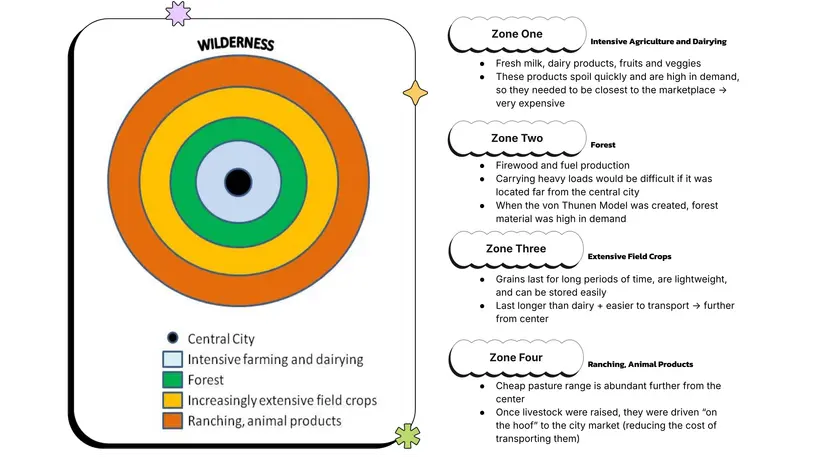
In this way, agricultural land is organized into a series of concentric rings radiating out from the market, with each ring specializing in a different type of agriculture optimized for profitability based on distance and transport cost.
The Concentric Rings of the Model
Center: The Central Market (Urban Core)
At the very center of the model lies the market city, the sole consumer hub for all surrounding agriculture. Farmers bring their products here for sale, and all decisions about agricultural activity are based on how easily and cost-effectively goods can reach this central market. This urban core is not considered one of the rings but is essential to the model as the point from which all other zones are determined.
Ring 1: Intensive Farming and Dairying
Types of products: Milk, butter, cheese, fresh fruits, vegetables, cut flowers, herbs.
Characteristics: These products are highly perishable and in constant demand.
Location logic: Since these items spoil quickly and need to reach consumers while still fresh, they must be produced very close to the market.
Economic rationale: Land is expensive here, but the high returns from selling fresh goods at premium prices justify the cost.
Farming style: Intensive agriculture—high input of labor and capital per unit of land.
Farmers in this ring accept high land prices because they save significantly on transportation costs and can charge higher prices for their goods.
Ring 2: Forests and Wood Lots
Types of products: Firewood, timber, logs, poles, and other forest materials.
Historical importance: During Von Thünen’s time, wood was the primary source of heating fuel and construction material.
Location logic: Timber is heavy and bulky, making it expensive to move long distances. Being near the market minimizes transportation costs.
Modern relevance: In many modern contexts, this ring has diminished due to energy source changes and improved transportation, but it remains important in less developed or heavily forested regions.
This zone reflects the cost-efficiency of minimizing the hauling of dense and heavy materials by keeping them close to the urban center.
Ring 3: Extensive Field Crops
Types of products: Wheat, corn, barley, rye, soybeans, and other grains.
Storage and transport: Grains are non-perishable, lightweight, and easy to store, allowing them to be produced farther from the market.
Farming style: More extensive—requiring large tracts of land with fewer inputs per acre.
Land cost: Land is cheaper here, so farmers can afford the space required for grain production.
These crops can be harvested and stored until transported, making them less sensitive to distance. Though transportation costs are higher than in the inner rings, low land prices offset these costs.
Ring 4: Ranching and Animal Grazing
Types of products: Cattle, sheep, goats, horses—primarily raised for meat, hides, and wool.
Location logic: Animals require large grazing areas. Land in this outer ring is inexpensive and available in large plots.
Transport strategy: In Von Thünen’s time, animals were moved to the city “on the hoof,” meaning they walked to the market. This eliminated the need to transport heavy meat and allowed farmers to raise livestock farther away.
Although the market is far, this distance is acceptable because animals are mobile and can be transported at minimal cost by driving them to market, reducing the impact of distance.
Economic Rationale of the Model
The Von Thünen Model assumes that profitability = market price - production costs - transportation costs. Therefore, for any given agricultural product, the profit is determined not just by how much it can be sold for, but also by:
How much it costs to produce.
How far it needs to be transported.
How expensive that transportation is.
Land closer to the city costs more, so only high-value or perishable products can afford to be located there. In contrast, land farther out is cheaper, which makes it suitable for less perishable and lower-value items that can handle the added cost of distance.
Assumptions of the Von Thünen Model
To function as a simplified and theoretical model, several assumptions were made:
Isolated State: There is only one city (the market), surrounded by uninhabited wilderness.
Uniform Landscape: The terrain is completely flat with no rivers, mountains, or variations in soil fertility.
Equal Access: All farmers have equal access to the market.
Single Transportation Mode: Goods are transported by horse or ox-cart, with transportation cost increasing proportionally with distance.
Rational Behavior: Farmers are rational and seek to maximize profit.
No Government Policies: There are no taxes, subsidies, tariffs, or land use regulations.
No Technological Change: Farming methods and transportation technologies are fixed.
No Trade Between Zones: Goods only move from farms to the market, not between farms or other zones.
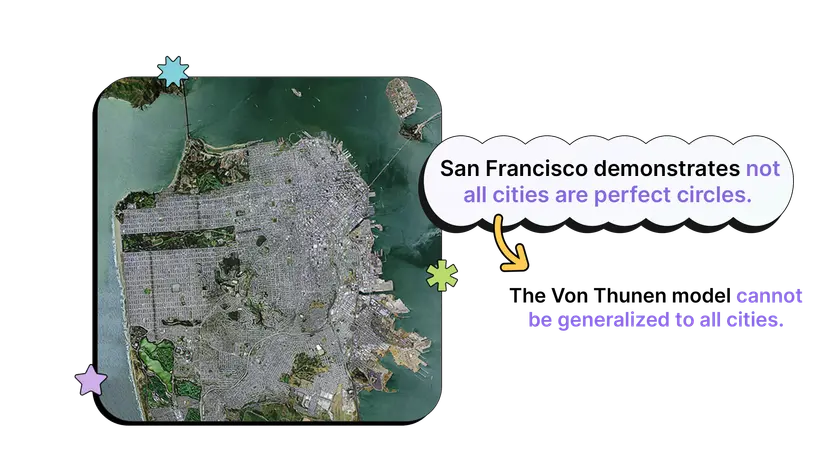
These assumptions create a controlled environment where the only variable is distance from the market.
Real-World Applications and Relevance
Even though modern agriculture operates in far more complex conditions, Von Thünen's ideas remain useful for understanding economic land use theory.
Contemporary Relevance:
Urban farming: High-value crops are still grown near cities, such as hydroponic vegetable farms in warehouses near downtown areas.
Commercial dairying: Despite refrigeration, milk production often occurs close to consumers to ensure quality and minimize spoilage risk.
Specialty agriculture: Cut flowers, herbs, and organic vegetables still follow a similar spatial logic because of perishability and niche market demand.
Exceptions and Deviations:
Modern developments have introduced complications not accounted for by the model:
Refrigerated transport: Allows perishable goods to be grown farther from the market.
Global trade: Markets are no longer isolated; food is shipped internationally.
Government intervention: Policies like subsidies, zoning laws, and tariffs can distort market logic.
Environmental factors: Climate, soil fertility, and water access also play major roles.
Multiple cities: Urban areas are interconnected, and farmers may serve several markets.
Nevertheless, the model remains a valuable conceptual tool for studying how space and economics influence rural land use.
Key Geographic Concepts
Understanding the Von Thünen Model also reinforces several foundational ideas in AP Human Geography:
Bid Rent Theory: Land value decreases with distance from the city.
Land Use Intensity: Closer to the city = more intensive; farther out = more extensive.
Spatial Organization: Geography affects economic decisions.
Agricultural Zoning: The division of land use into distinct patterns and activities.
Distance Decay: The impact of distance on economic viability.
Examples to Illustrate the Model
Urban Dairy Farms: In areas like the U.S. Northeast, dairying often occurs within a short radius of major cities to supply fresh milk to dense populations.
Wheat Fields in the Midwest: The central U.S. produces grain on expansive farms far from major cities, fitting the model's third ring.
Cattle Ranches in Texas or Argentina: These large-scale operations often lie hundreds of miles from urban centers, corresponding to the outermost ring.
Vocabulary and Important Terms
Agricultural Land Use: How farmland is used and organized based on economic logic.
Bid Rent Curve: A graph showing how land prices fall as one moves away from the market.
Concentric Zones: Circular areas radiating out from a central point.
Dairying: The farming of milk-producing animals.
Extensive Farming: Low input per acre, used in outer zones.
Intensive Farming: High input per acre, used in inner zones.
Land Rent: The cost of land, which declines with distance from the market.
Perishability: How quickly a product spoils, influencing its required proximity to markets.
Transportation Cost: A central variable in determining land use.
Urban Market: The core city where agricultural products are sold.
FAQ
The Von Thünen Model does not directly address seasonality, but it can be interpreted within its framework. Seasonality affects what crops can be grown and when they can be harvested, which impacts transportation scheduling and market availability. Perishable seasonal crops like berries or leafy greens, for example, must still be located close to the market due to spoilage risks, especially during harvest season. However, crops that are harvested once a year but can be stored—such as wheat—fit comfortably into outer rings, as they can be transported long distances post-harvest without spoilage.
The model assumes year-round production, which is unrealistic for many crops.
In practice, seasonality may shift land-use patterns temporarily, especially in regions with multiple growing seasons.
Crop rotation and double cropping (multiple harvests per year) are also not addressed in the original model, though they affect real-world spatial planning.
Yes, the logic of the Von Thünen Model can be extended to fisheries and aquaculture, especially when considering perishable products and proximity to consumers. Aquaculture farms, particularly those producing fresh fish, shellfish, or crustaceans, tend to be located near coastal cities to reduce transport time and preserve freshness. Transportation costs for refrigerated goods are high, and demand for fresh seafood often requires proximity to urban centers.
Like dairying or vegetables, seafood is highly perishable and sensitive to delays.
Coastal proximity acts as both a geographic and economic advantage, similar to inner agricultural zones.
The model’s central principle—minimizing transportation cost while maximizing profitability—remains relevant, even if the resource is aquatic instead of terrestrial.
Urban sprawl significantly alters the ring structure of the Von Thünen Model by expanding the central market outward and consuming agricultural land. As cities grow, land once used for intensive agriculture or dairying may be converted to housing, industry, or infrastructure. This forces farmers to relocate their operations further from the market, disrupting the classic concentric zones.
The model assumes a static city center, but in reality, urban areas expand over time.
High land values near cities due to sprawl often make agriculture economically unfeasible.
Some high-value agricultural operations persist near cities in protected or preserved farmland, but the model’s structure becomes fragmented.
Technological innovations in transportation have weakened the strict distance-based structure of the Von Thünen Model. Refrigerated trucks, planes, and improved logistics allow perishable goods to be shipped from great distances while retaining freshness. As a result, high-value items like tropical fruits or flowers may come from other continents rather than nearby farms.
These technologies reduce the penalty of distance, allowing profitable agriculture far from the market.
Global trade networks now substitute for the local rings envisioned in the model.
The core concept of balancing transportation costs and land use still applies, but the scale has shifted from local to global.
Although the Von Thünen Model is built on a circular, isotropic landscape, it can be adapted for irregular terrains by overlaying transportation routes, topography, and urban influences. Instead of perfect rings, real-world adaptations use modified zones shaped by geography, such as valleys, river systems, or roads.
Planners may redraw zones based on accessibility rather than straight-line distance.
Terrain elevation, water bodies, and infrastructure corridors all reshape how land is used.
In mountainous areas, for example, high-value agriculture might occur in narrow valleys while grazing occurs on slopes, breaking the circular pattern but preserving the model’s economic logic.
Practice Questions
Explain how the Von Thünen Model illustrates the relationship between transportation costs and land use in agricultural regions.
The Von Thünen Model demonstrates that as distance from a central market increases, transportation costs rise, which influences the type of agriculture practiced. Farmers closer to the market engage in intensive farming with perishable, high-value goods like dairy or vegetables, where quick delivery is essential. Farther out, where land is cheaper and transport costs are higher, extensive activities such as grain farming and livestock ranching become more viable. This spatial arrangement reflects economic decisions based on maximizing profit while minimizing transport costs, showing how geography and economic logic shape rural land use patterns.
Identify two assumptions of the Von Thünen Model and discuss how one of them limits its applicability in modern agricultural systems.
Two assumptions of the Von Thünen Model are that the land surrounding the market is uniform in quality and that there is only one isolated central market. The assumption of a uniform landscape limits the model’s applicability because real-world geography includes varied terrains, climates, and natural resources, all of which influence land use decisions. In reality, mountains, rivers, and soil differences make uniform agricultural rings unrealistic. This assumption oversimplifies the complexity of modern agricultural systems, which are also shaped by technology, infrastructure, and global trade, reducing the model’s direct applicability today.