
Cities and globalization are deeply interconnected, shaping each other through the movement of people, goods, ideas, and capital across borders in an increasingly interdependent world.
Defining the City in a Global Context
Louis Wirth’s Sociological Perspective
Louis Wirth, a prominent American sociologist, defined a city as a “permanent settlement of relatively large size, relatively high population density, and relatively diverse population with respect to social and economic status, race, and culture.” His definition provides a foundational framework for understanding urban environments, especially within the context of globalization.
Wirth emphasized three main characteristics of cities:
Large size: A city's large population leads to social relationships that are superficial and segmental. Unlike small communities, where everyone knows everyone else, cities foster anonymity and impersonal interactions.
High population density: The dense concentration of people and buildings creates intense competition for limited space and resources, leading to social segregation and specialization in roles and functions.
Social heterogeneity: Cities host diverse populations in terms of ethnicity, occupation, income, religion, and culture. This diversity fosters tolerance but also contributes to social fragmentation.
Wirth’s theory, often referred to as “urbanism as a way of life,” argues that the urban experience changes behavior, social norms, and identity. Urban dwellers become more individualistic, rational, and dependent on formal institutions rather than personal relationships.
Although Wirth’s model is highly influential in Western urban studies, critics argue that it fails to account for the complexities of cities in non-Western regions, where informal social ties and traditional networks may persist despite urban density and diversity.
Examples of Cities Reflecting Wirth’s Model
New York City: High levels of diversity, anonymity, and social complexity.
London: Multicultural metropolis with global political and economic influence.
Tokyo: Dense population, complex urban systems, and advanced infrastructure.
Singapore: Ethnic heterogeneity and centralized urban planning.
Hong Kong: High-rise density, financial power, and cultural mixing.
Cities of Different Sizes and Their Global Role
Cities, regardless of size, play varying roles in the global economy and social order. They are engines of economic development, innovation, and cultural exchange.
Megacities
A megacity is typically defined as an urban area with a population exceeding 10 million. These cities are vital components of the global economy.
Functions: Act as command centers for finance, international trade, communication, and innovation.
Challenges: Struggle with overcrowding, pollution, housing shortages, and infrastructure stress.
Examples: Tokyo, Delhi, São Paulo, Lagos, Jakarta.
Megacities attract migrants, both domestic and international, leading to rapid urban expansion, often outpacing the capacity of municipal services. They often develop informal settlements such as favelas or slums, which lack basic infrastructure.
Large Cities
Large cities typically have populations over 1 million and can be major political, economic, and cultural hubs even if they do not reach the megacity threshold.
Economic role: Serve as regional capitals, transportation centers, and innovation hubs.
Services: Offer comprehensive healthcare, education, and business infrastructure.
Examples: Los Angeles, Toronto, Munich, Nairobi.
Large cities may not rival megacities in scale but can exert significant influence through their specialized industries, such as technology in San Francisco or fashion in Milan.
Small Cities
With populations under 1 million, small cities still play crucial roles in the regional economy and can be part of global supply chains.
Functions: Provide administrative services, manufacturing bases, and cultural uniqueness.
Benefits: Typically have lower living costs, better environmental quality, and tighter community networks.
Examples: Boulder (Colorado), Cambridge (UK), Freiburg (Germany).
In a global context, even small cities can host major research centers, specialized production, or serve as tourism destinations, linking them indirectly to global networks.
Urban Hierarchy and Spatial Organization
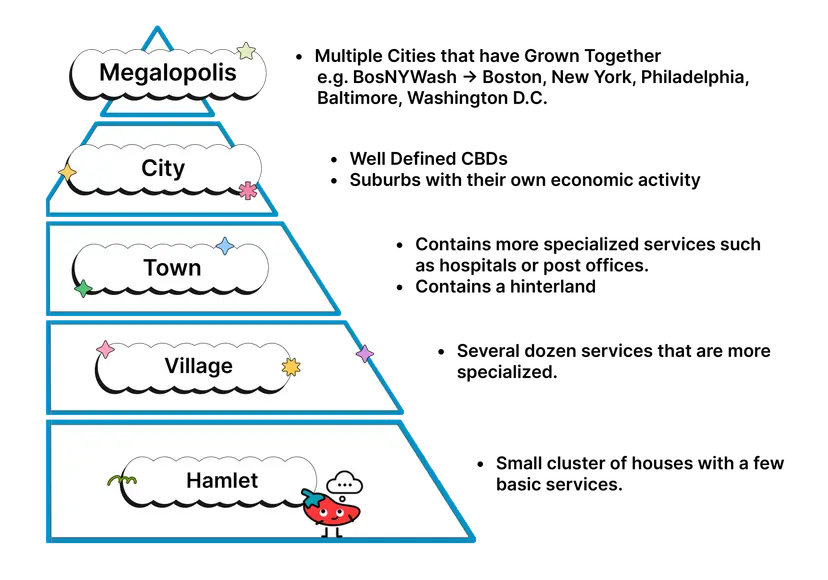
The urban hierarchy is a ranking of settlements based on size, economic functions, and influence. It helps geographers understand how cities relate to one another regionally and globally.
Levels of the Urban Hierarchy
Hamlets and villages: Small rural communities with few services.
Towns: Larger than villages with basic services like schools and local governance.
Cities: Central places offering a full range of services and industry.
Metropolises: Large cities dominating a region economically, culturally, and politically.
Megalopolises: Vast urban regions formed by the merging of multiple metropolitan areas.
Example: U.S. Northeast Megalopolis
This region extends from Boston to Washington, D.C., including cities like New York, Philadelphia, and Baltimore. It represents a continuous urban landscape with interconnected transportation, economic systems, and shared environmental concerns.
The Global Urban System: World Cities
Characteristics of World Cities
Also known as global cities, world cities are highly interconnected urban centers that drive the global economy.
Command centers for global finance, trade, and corporate control.
Cultural hubs with theaters, museums, and international events.
Transportation nodes linking global air, rail, and shipping networks.
Diverse populations with significant immigration and multilingualism.
World cities influence global trends in fashion, finance, media, and governance. They are not always the largest by population but are highly influential in shaping global norms and decisions.
Examples
New York City: UN headquarters, Wall Street, Broadway.
London: Global banking, cultural diversity, political relevance.
Tokyo: Advanced technology, global brands, financial centers.
Paris, Hong Kong, Singapore: Each prominent in specific global sectors such as fashion, trade, or innovation.
Classifying Cities in a Global Context
Cities are classified into tiers to reflect their influence and connectivity. The GaWC classification uses Alpha, Beta, and Gamma levels.
Alpha Cities
Alpha cities have the most extensive global influence.
Attributes:
Centers of finance, corporate headquarters, and global decision-making.
Host to international organizations and cultural industries.
Examples: New York, London, Tokyo, Paris.
Beta Cities
Beta cities have significant but more regionally concentrated influence.
Attributes:
Active participants in global markets.
Often centers of higher education, innovation, and logistics.
Examples: Chicago, Amsterdam, Sydney, Barcelona.
Gamma Cities
Gamma cities are smaller yet important within specific global or regional frameworks.
Attributes:
Serve as subnational economic or cultural hubs.
Less global visibility but integrated into trade and communication systems.
Examples: Richmond (Virginia), Des Moines (Iowa), Spokane (Washington).
These categories are not static. Cities may rise or fall in rank depending on political stability, economic growth, innovation, or shifts in global markets.
The Role of Cities in Global Economic Networks
Economic Activity
Cities are central to global economic systems, facilitating:
Banking and finance (e.g., Wall Street in New York, the City in London).
Manufacturing and logistics (e.g., Shanghai, Shenzhen).
Creative industries and tech (e.g., San Francisco, Seoul).
Urban economies benefit from agglomeration economies, where proximity leads to increased productivity, innovation, and access to labor and markets.
Global Trade
Cities often serve as trade gateways, with airports, seaports, and customs hubs.
Examples: Los Angeles (Pacific Rim trade), Rotterdam (European shipping).
Multinational Corporations (MNCs)
MNCs establish headquarters and regional offices in global cities for access to skilled labor, government institutions, and financial markets.
Example: Apple, HSBC, and Nestlé maintain offices in world cities.
Culture, Migration, and Global Urban Life
Cultural Diffusion
Cities are sites where global culture is both produced and consumed.
Cultural institutions like museums, galleries, and festivals attract global audiences.
Media cities like Los Angeles and Mumbai produce content consumed worldwide.
Universities in cities attract international students and scholars.
Cosmopolitanism
A defining feature of global cities is cosmopolitanism, or the coexistence of multiple cultural identities within one urban space.
Cities support multilingualism, religious pluralism, and mixed neighborhoods.
They encourage cultural fusion in food, fashion, and daily life.
Migration and Demographics
Cities draw in internal and international migrants for job opportunities, safety, and education.
They become melting pots that accelerate social change and demographic diversification.
Transportation and Global Connectivity
Infrastructure and Mobility
World cities have robust infrastructure systems that support both domestic and international mobility.
Key features include:
Major airports (e.g., JFK in New York, Heathrow in London).
Mass transit systems (e.g., Tokyo’s subway, Paris Métro).
Seaports and logistics hubs for global shipping.
Efficient connectivity makes cities attractive for businesses, tourists, and investors.
Urban Forms in the Age of Globalization
Megalopolises
A megalopolis is a sprawling urban region that results from the merging of multiple metropolitan areas.
Examples:
U.S. Northeast Corridor (Boston to Washington, D.C.).
Pearl River Delta (Guangzhou, Shenzhen, Hong Kong).
Such areas require advanced planning coordination across jurisdictions and address common challenges like transportation congestion, pollution, and housing pressure.
Metropolises
A metropolis is a single large urban center with dominant regional influence.
Characteristics:
Diverse economic sectors.
Cultural and political centrality.
Often the national capital or economic hub.
Examples include Bangkok, Buenos Aires, and Cairo.
Global Challenges and Opportunities
Global cities face dual pressures: staying competitive in a global economy while ensuring social inclusion and sustainability.
Opportunities:
Access to capital, innovation, and skilled labor.
Platforms for international diplomacy and cooperation.
Challenges:
Urban inequality, housing unaffordability, environmental degradation.
Need for sustainable growth and inclusive policies.
FAQ
Global cities often serve as platforms for international policymaking through their hosting of multinational institutions, diplomatic events, and transnational networks. These cities shape agendas on climate change, urban development, human rights, and public health through international forums and city-to-city partnerships.
Many global cities participate in networks like C40 Cities or the Global Parliament of Mayors, where urban leaders share policy strategies on sustainability and governance.
Cities such as Geneva and New York host international organizations like the UN and WHO, influencing global standards and diplomacy.
Mayors of global cities often engage directly in international negotiations, bypassing traditional state channels.
These cities use their influence to advocate for global solutions to challenges like migration, economic inequality, and climate resilience.
Globalization has transformed labor markets in global cities by creating polarized job opportunities, increasing demand for both high-skilled and low-skilled labor, and encouraging labor migration.
High demand for tech, finance, and professional services jobs has drawn global talent into sectors like IT, banking, and consulting.
Simultaneously, there is significant growth in low-wage service jobs in sectors such as hospitality, food service, and domestic work.
This dual structure has widened income inequality, particularly in cities like London and New York.
Immigrant labor plays a vital role in supporting both formal and informal sectors, contributing to the cultural and economic diversity of the labor force.
The result is a fragmented labor market where upward mobility depends heavily on access to education and networks.
Technology enables cities to connect instantly with global systems of trade, finance, communication, and data, enhancing their roles as nodes in the global economy.
High-speed internet, digital banking, and real-time logistics systems allow companies in global cities to operate seamlessly across borders.
Smart infrastructure like intelligent transportation and energy grids increases efficiency and attracts international investors.
Cities deploy technologies like surveillance, predictive policing, and data analytics for urban management, making them more attractive for business and residents.
Global cities often lead in tech innovation through startups, research institutions, and universities that contribute to the digital economy.
Cities such as Seoul, Singapore, and San Francisco showcase how technology can redefine global competitiveness and urban influence
Globalization increases demand for real estate in world cities, driving up prices, changing land use, and intensifying urban inequality and displacement.
Foreign investors purchase urban property as a financial asset, reducing housing availability for local residents.
Gentrification pushes out lower-income populations to the urban periphery, replacing traditional communities with affluent newcomers.
Luxury developments are often prioritized over affordable housing due to their profitability in a global market.
Infrastructure investments cater to global business and tourism (airports, hotels, financial districts), not always to residential needs.
This can result in spatial inequality where central areas flourish economically while marginalized communities face overcrowding and declining services.
Cultural industries like media, fashion, design, and the arts are powerful drivers of globalization by exporting urban identity and values worldwide.
Cities like Paris, Tokyo, and Los Angeles act as trendsetters in global fashion, entertainment, and design.
Global cities are hubs for film studios, music labels, publishing houses, and advertising firms that produce content consumed across cultures.
Hosting international cultural events such as fashion weeks, film festivals, and biennales boosts tourism and global recognition.
These industries shape perceptions of urban lifestyles and values, promoting cultural convergence and hybridity.
As centers of creativity, global cities attract artists, writers, and thinkers whose work fosters transnational cultural exchange and innovation.
Practice Questions
Explain how cities function as nodes in the global economy and provide an example of a city that illustrates this role.
Cities serve as crucial nodes in the global economy by concentrating financial services, corporate headquarters, transportation infrastructure, and cultural institutions. They facilitate international trade, attract foreign direct investment, and support flows of information and labor. These urban centers link local economies to global markets through their networks of communication and transport. For example, New York City is a prime global node with Wall Street, the United Nations, and numerous multinational corporations. It influences global finance, politics, and culture, making it essential for understanding the interconnectedness of economic activities in a globalized world.
Describe the classification of world cities using the Alpha, Beta, and Gamma model and explain how this reflects their roles in globalization.
World cities are classified into Alpha, Beta, and Gamma categories based on their global influence, connectivity, and economic functions. Alpha cities, like London and Tokyo, are top-tier global hubs commanding vast economic and political networks. Beta cities, such as Chicago and Sydney, maintain strong regional influence and global connections, though less dominant. Gamma cities, like Richmond and Des Moines, play important but more localized roles within the global system. This hierarchical model reflects the unequal distribution of power in globalization, illustrating how some cities act as command centers while others support specialized or regional functions in the global economy.