
AQA Syllabus focus:
'Features of the working memory model, including coding and capacity.'
Research on the working memory model shows that short-term remembering is not a single system.
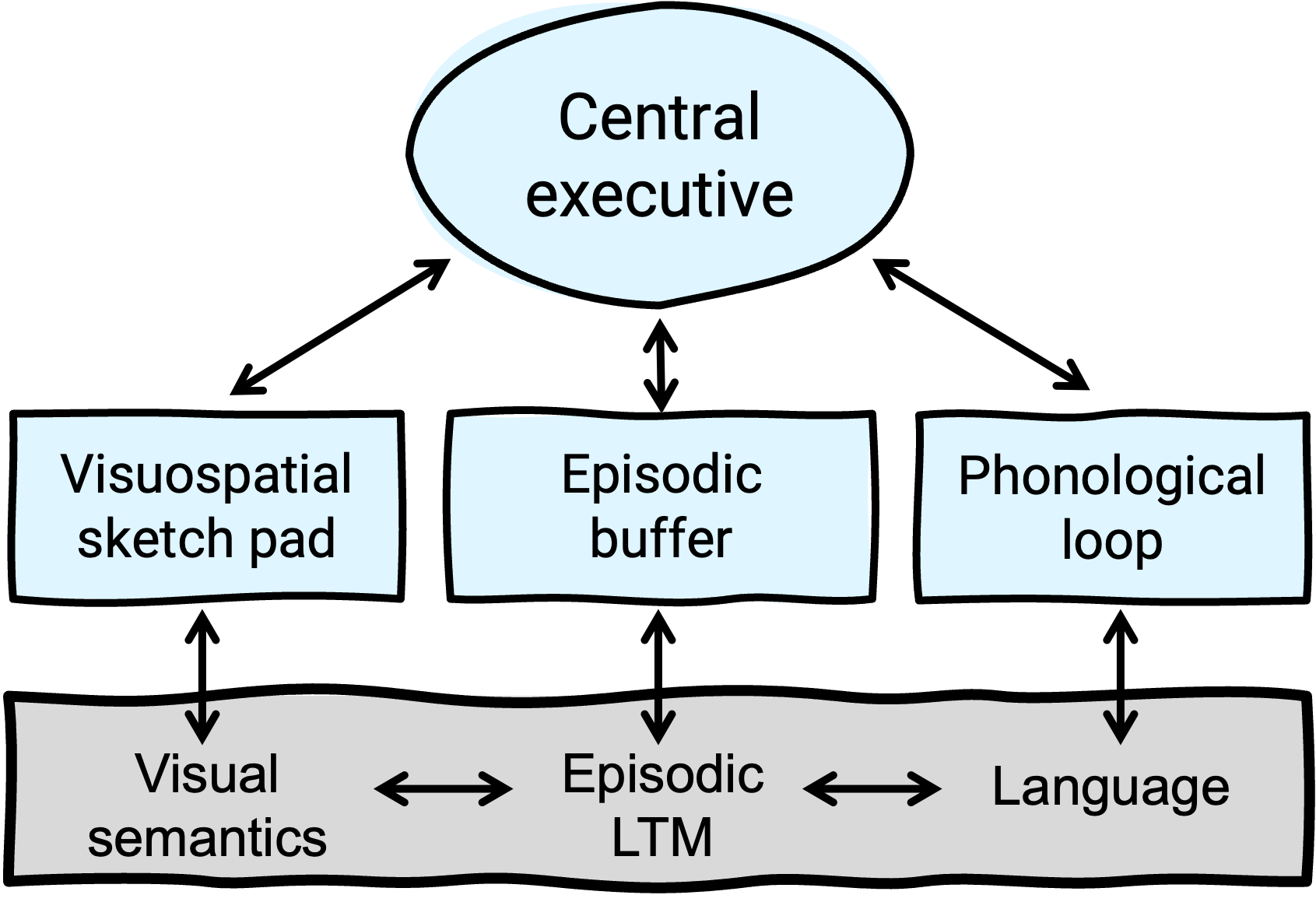
Diagram of Baddeley’s multicomponent working memory model, showing the central executive coordinating the phonological loop (verbal/acoustic), the visuo-spatial sketchpad (visual/spatial), and the episodic buffer (integration). The lower band highlights how working memory interfaces with long-term memory systems (e.g., language, episodic LTM, and visual semantics). Source
Different parts of working memory process information in different forms and have different limits.
Coding in the working memory model
In the working memory model, information is not handled by one general short-term store. Different components deal with different forms of material, so the way information is coded affects interference, recall, and performance on simultaneous tasks.
Coding: The form in which information is represented in memory.
Coding in working memory is mainly modality specific, meaning different components are linked to different types of input.
Modality-specific coding
The phonological loop mainly codes verbal and acoustic information. Spoken words, rehearsed numbers, and inner speech are usually represented in a sound-based form. This helps explain why similar-sounding items are more easily confused.
The visuo-spatial sketchpad mainly codes visual and spatial information. It holds what things look like and where they are. Information here is usually represented as images, patterns, movement, or location rather than as sound.
The episodic buffer is more flexible. It is usually described as having multidimensional coding because it can bind together verbal, visual, and spatial material into one temporary representation.
The central executive is less clearly linked to one code. It is often seen as modality free because its main role is to direct attention and coordinate the other systems rather than store one specific kind of information.
These coding differences are important because they help explain interference. If two tasks depend on the same form of coding, performance is more likely to suffer. If they use different codes, they may be carried out together more successfully.
Capacity in the working memory model
Working memory components also differ in capacity, and this helps explain why performance breaks down when too much information has to be held or processed at once.
Capacity: The amount of information a memory system can hold at one time.
Unlike the multi-store model, the working memory model does not treat short-term memory as having one single fixed capacity.
Limited storage and processing
The phonological loop has a limited verbal capacity. Research suggests this is linked to how much can be rehearsed in about two seconds. This helps explain the word length effect, where short words are usually recalled better than long words because they can be rehearsed more quickly.
The visuo-spatial sketchpad also has a limited capacity, often estimated at around three to four simple items, although this depends on how detailed the material is. Complex images or spatial layouts use up capacity more quickly than simple ones.
The episodic buffer appears to have a small temporary capacity, often described as around four integrated units. Its key feature is not a large amount of storage, but the ability to combine separate sources of information into one meaningful episode.
The central executive has a very restricted attentional capacity. When two tasks both require control, decision-making, switching, or coordination, the system becomes overloaded even if there is not much information to store.
Capacity in the working memory model is therefore not one single number. It varies across components and depends on the kind of information being processed.
Evidence about coding and capacity
Research support
Support for these ideas often comes from dual-task studies. Baddeley and Hitch found that people could carry out a visual task and a verbal task together more successfully than two tasks that both relied on the same subsystem. This supports the view that working memory contains separate components with different codes and partly separate capacities.
Other findings also fit the model well. The word length effect supports the idea of a limited phonological system, because recall depends partly on how much speech-based material can be rehearsed quickly. Studies of visual memory also show that performance falls as more patterns or locations must be held in mind, which supports a limited visuo-spatial system.
Case studies provide further support. Some patients show poor performance on verbal short-term tasks but relatively better visual performance. This suggests that coding and capacity can be selectively disrupted, which would be difficult to explain if short-term memory were only one undivided store.
Evaluation
Strengths and limitations
One strength of the working memory model is that it gives a more detailed account of short-term remembering than the idea of a single STM. It explains modality-specific interference, multitasking, and why different kinds of material are forgotten under different conditions.
However, capacity estimates are not exact. The amount a person can hold depends on task difficulty, presentation speed, practice, and how meaningful the material is. This means capacity in working memory is best understood as limited but flexible, rather than as a completely fixed number.
A further limitation is that the central executive is hard to measure directly. Because it controls attention instead of acting like a simple store, its coding and capacity are less clear than those of the phonological loop or visuo-spatial sketchpad.
The episodic buffer also has less direct evidence than the earlier components. Even so, it is useful because it explains how different codes can be combined, which is important when remembering events that include words, images, and locations together.
Practice Questions
Identify two features of coding in the working memory model. (2 marks)
1 mark for identifying that the phonological loop codes verbal or acoustic information.
1 mark for identifying that the visuo-spatial sketchpad codes visual or spatial information.
Also accept that the episodic buffer uses multidimensional coding.
Also accept that the central executive is modality free or not tied to one specific code.
Maximum 2 marks.
Outline coding and capacity in the working memory model. (6 marks)
Award 1 mark for each accurate point up to 6 marks.
The working memory model does not treat STM as one single store.
The phonological loop mainly codes verbal or acoustic information.
The visuo-spatial sketchpad mainly codes visual or spatial information.
The episodic buffer uses multidimensional coding.
The central executive is modality free or not linked to one specific code.
The phonological loop has limited capacity.
The phonological loop capacity is linked to about two seconds of spoken material.
The visuo-spatial sketchpad has limited capacity, often around three to four simple items.
The episodic buffer has a small capacity, often around four integrated units.
The central executive has limited attentional capacity.
FAQ
This is because the phonological loop seems to depend partly on how much material can be refreshed through rehearsal in a short period of time.
If a person can say or rehearse words quickly, they may hold more of them. If the words take longer to say, recall usually drops. This is why speaking rate can matter as much as the number of items.
Chunking can increase the amount of meaningful material a person appears to hold, but it does not necessarily expand the raw limits of the system.
Instead, it reorganizes separate pieces into larger units:
letters become a word
numbers become a familiar date
separate features become one meaningful pattern
This can make performance look better because fewer units need to be managed.
The central executive is not just a storage box. It is involved in:
focusing attention
dividing attention
switching between tasks
coordinating other components
Because of this, one task may measure several abilities at once. Psychologists call this a task impurity problem: a test of the central executive often also depends on verbal skill, visual skill, or speed.
Not necessarily. Some psychologists suggest that the visuo-spatial sketchpad may contain partly separate systems for visual details and spatial locations.
For example, remembering:
what an object looks like
where an object is
how it moves
may not place exactly the same demands on the system. This helps explain why some visual tasks interfere strongly with each other, while others interfere less than expected.
Articulatory suppression usually involves repeating an irrelevant sound, such as saying “the, the, the” while trying to remember material.
This blocks normal verbal rehearsal. If performance drops under articulatory suppression, it suggests the task depends on the phonological loop.
It is especially useful because it shows whether people are relying on sound-based coding, even when information was first presented visually, such as printed words.