
AQA Syllabus focus:
'Factors affecting the accuracy of eyewitness testimony, including leading questions.'
Eyewitness evidence can strongly influence juries, yet memory reports are vulnerable to suggestion. Understanding how leading questions distort recall helps explain why witness accounts may sound confident but still be inaccurate.
Eyewitness testimony and accuracy
Eyewitness testimony is often persuasive in court because it appears to come from direct observation.
Eyewitness testimony refers to information given by a person about an event they personally witnessed.
However, memory is reconstructive rather than a perfect recording.
Diagram illustrating the misinformation effect: an event is witnessed, misleading post-event information is encountered (e.g., via a question), and later recall is tested. The key idea is that the retention interval is a vulnerability window where suggestion can alter what is later reported as “memory.” Source
When a witness recalls an event, the account can be shaped by expectations, prior knowledge, and the wording used by police, lawyers, or other interviewers.
Why eyewitness accounts can be distorted
A witness may genuinely try to tell the truth and still be wrong. This is because recall involves rebuilding the memory from stored fragments, not playing back an exact copy. As a result, small changes in wording can influence what the witness reports.
Leading questions
A major source of distortion is the leading question, which suggests the answer the interviewer expects or contains information that guides the witness toward a particular response.
A leading question is a question phrased in a way that influences the answer given by a witness.
Leading questions can work in two common ways:
They can use emotionally loaded or stronger words, such as asking how fast cars were going when they “smashed” rather than “hit.”
They can include false assumptions, such as asking, “Did you see the broken headlight?” when no broken headlight was present.
Both forms can reduce the accuracy of eyewitness testimony because they add suggestion to recall. The witness may then report details that fit the question instead of the original event.
How leading questions affect memory reports
One explanation is that the wording changes the witness’s response rather than the memory itself. In this view, the original memory remains available, but the question creates pressure to choose an answer that matches the wording.
Another explanation is that misleading wording actually becomes part of the memory. The new detail is integrated into the witness’s reconstruction of the event, so later recall includes information that was suggested rather than seen.
The effect is often stronger when:
the witness did not pay close attention to the original event
the event was brief or unclear
there is a delay before questioning
the witness assumes the interviewer’s wording must be accurate
Research evidence: Loftus and Palmer
The best-known support comes from Loftus and Palmer (1974). In one study, participants watched film clips of car accidents and were then asked to estimate the speed of the vehicles. The critical question varied only by the verb used: contacted, hit, bumped, collided, or smashed.
Participants who heard the word smashed gave the highest speed estimates, while those who heard contacted gave the lowest. This shows that a single word in a question can alter a witness’s report of an event.
In a second study, participants again watched a traffic accident and were later asked whether they had seen broken glass. There was no broken glass in the film. Those previously asked about cars “smashed” together were more likely to say they had seen broken glass than those asked about cars that “hit” each other or those not asked a speed question. This suggests that leading questions can do more than change a judgment; they can create false recall of details that were never present.
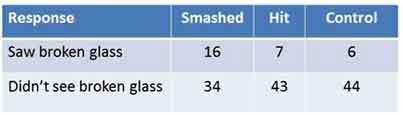
Results table from Loftus and Palmer’s second experiment showing how the verb used in the speed question affected later reports of seeing broken glass. The higher “yes” responses in the “smashed” condition illustrate how post-event wording can increase false recall for non-existent details. Source
What the findings suggest
Loftus and Palmer support the idea that eyewitness testimony is vulnerable to misleading information contained in questions. The study also suggests that wording does not need to be obviously extreme to have an effect; even subtle shifts in language can shape testimony.
Evaluation of research on leading questions
A strength of this research is the high level of control. Because the event seen by participants was the same, researchers could be confident that differences in recall were caused by the wording of the question. This makes it easier to show a clear cause-and-effect relationship.
Another strength is its practical value. The findings have influenced police interviewing and legal practice by showing that neutral wording matters. Investigators must be careful not to contaminate evidence through suggestion.
A limitation is that much of the evidence comes from laboratory tasks, such as watching short film clips. Real eyewitnesses usually observe events in more natural settings and may treat them as more important, so the size of the leading-question effect in everyday situations may differ.
There is also the issue of participant expectations. In an experiment, people may search for clues in the wording because they know they are being studied. This could exaggerate the effect of leading questions compared with some real interviews.
Even so, laboratory findings remain useful because they isolate the influence of question wording. Since real investigations do involve interviews, the risk of suggestion is still highly relevant.
Implications for eyewitness interviewing
To protect accuracy, interviewers should avoid loaded verbs, assumptions, and any wording that introduces new details. Questions should be neutral and should invite free recall before more specific questioning begins.
Examples of safer wording include prompts such as “Describe what you remember” or “What did you notice about the vehicle?” rather than questions that imply a particular answer. The key idea is that the language of the question can become part of the evidence the witness later reports.
Practice Questions
Outline what is meant by a leading question in eyewitness testimony. (2 marks)
1 mark for stating that the question is worded to suggest the expected answer or includes misleading information.
1 mark for linking this to eyewitness testimony by explaining that it can distort what the witness reports or remembers.
Discuss research into leading questions as a factor affecting the accuracy of eyewitness testimony. (6 marks)
1 mark for identifying a relevant study, such as Loftus and Palmer.
1 mark for describing that participants viewed accident clips or a similar witnessed event.
1 mark for describing the wording manipulation, such as different verbs in the critical question.
1 mark for outlining a key finding, such as higher speed estimates after the word “smashed.”
1 mark for explaining that leading questions can reduce accuracy by introducing misleading information.
1 mark for one relevant evaluative point, such as high experimental control or limited ecological validity.
FAQ
Cross-examination often uses short, controlled, yes-or-no questions. That format can make it harder for a witness to give a full answer or correct the wording built into the question.
In an adversarial setting, witnesses may also focus on sounding cooperative or avoiding mistakes, which can make them more likely to accept the interviewer’s wording.
Not always, but younger children are often more vulnerable because they may be more sensitive to authority, less confident about correcting adults, and less skilled at separating what they saw from what was suggested.
That said, some adults can also be highly suggestible, especially if they are tired, confused, or have weaker language comprehension. Vulnerability depends on the person and the interview conditions.
Yes. A translated question may become more or less suggestive depending on the words chosen. A verb that seems neutral in one language may sound stronger in another.
Articles, tense, and cultural norms also matter. A translated question might accidentally imply that an object definitely existed or that the interviewer expects a specific answer. This is why trained interpreters and careful transcript checking are important.
Repeated questioning can signal to the witness that the first answer was not good enough. That pressure may encourage guessing or changing an answer to fit the interviewer’s wording.
Repeated exposure to the same suggested detail can also make it feel more familiar. Later, the witness may mistake that familiarity for a genuine memory from the original event.
They can look for patterns such as:
strong verbs that imply severity
questions that assume a detail was present
forced-choice questions when the witness has not mentioned either option
repeated closed questions after an initial answer
interviewer summaries that add new information
Comparing the witness’s earliest free-recall account with later answers is especially useful, because later details may reflect the wording of the interview rather than the event itself.