

IB Syllabus focus:
'Analysis of standing wave patterns in strings and pipes.
Effects of different boundary conditions on standing waves, including conditions for strings and pipes (open, closed, fixed, free).
Vibration modes in terms of displacement nodes and antinodes.
Exclusion of pressure nodes and antinodes for standing waves in air.'
Standing Wave Patterns
In Strings
The formation of standing waves in strings emanates from the interference of two identical waves travelling in opposite directions. These waves, possessing equal frequency and amplitude, give rise to points of constructive and destructive interference, known as antinodes and nodes, respectively.
Nodes: These are the points where destructive interference occurs, leading to minimal displacement. At the nodes, the two interfering waves cancel each other out, leading to a still point.
Antinodes: Here, constructive interference is witnessed, with maximum displacement. The waves reinforce each other, resulting in points of maximum vibration.

A standing wave as a stationary wave whose amplitude changes over time
Image Courtesy Introductory Physics
The vibrational patterns of strings, be it in musical instruments or laboratory setups, can be analysed by observing the arrangement and frequency of nodes and antinodes.
In Pipes
The behaviour of standing waves in pipes is markedly influenced by the boundary conditions — whether the pipes are open or closed at their ends.
Open Pipes: These support antinodes at both ends, due to the unrestricted movement of air, giving rise to a distinct pattern of standing waves.
Closed Pipes: Characterised by a node at the closed end and an antinode at the open end, owing to the restricted air movement at the closed end.
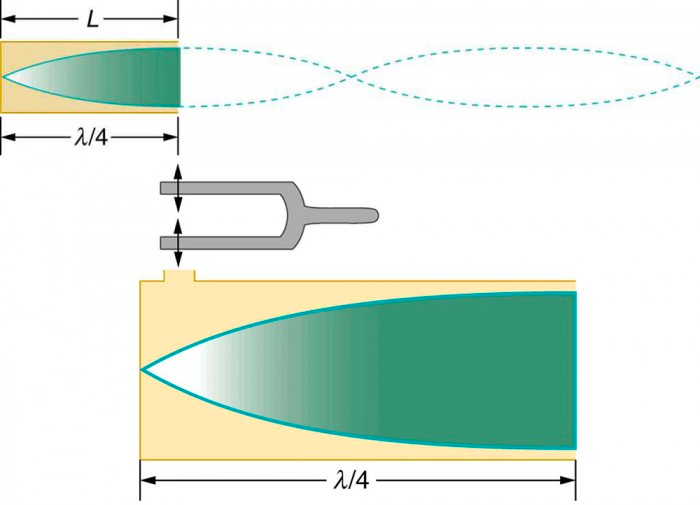
Standing wave created in the tube by a vibration introduced near its closed end
Image Courtesy OpenStax
Effects of Boundary Conditions
On Strings
The fixation or freedom at the ends of a string profoundly influences the formation of standing waves.
Fixed Ends: When both ends of a string are fixed, nodes are established at these points. The fixed points, incapable of displacement, naturally become nodes where the amplitude of the wave is zero.
Free Ends: These give rise to antinodes at the ends, leading to a distinct set of standing wave patterns as compared to fixed ends.
An in-depth exploration of these conditions reveals a rich tapestry of wave behaviours, contributing to the diversity of sounds in stringed musical instruments and the varied phenomena observed in laboratory settings.
On Pipes
The boundary conditions of pipes, much like strings, significantly influence the wave patterns.
Open-Open: Antinodes are established at both ends, leading to the formation of symmetrical wave patterns.
Open-Closed: With a node at the closed end and an antinode at the open end, the wave patterns are distinctly different, leading to an asymmetrical configuration.
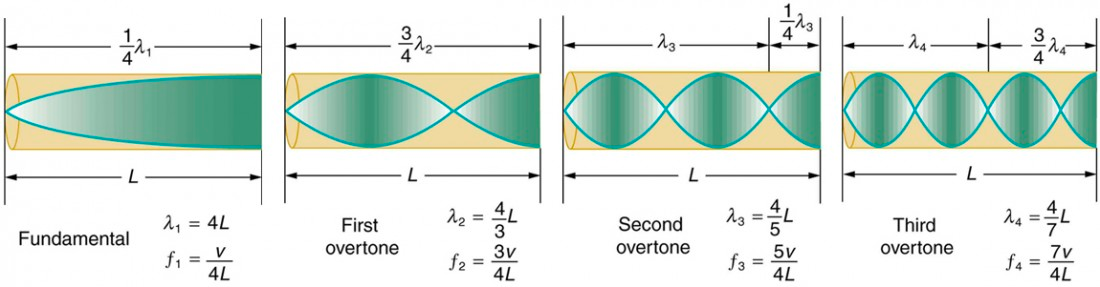
Standing waves formation near close end with a node at the closed end and antinode at the open end
Image Courtesy OpenStax
These variations in wave patterns have profound implications, especially in the context of musical instruments, where the tonality and pitch are directly influenced by the boundary conditions.
Vibration Modes
The distinct oscillation patterns of waves in various mediums are classified as modes. Each mode, characterised by a specific arrangement of nodes and antinodes, resonates at a unique frequency.
Strings
First Mode: Also known as the fundamental frequency, it has one antinode in the middle and nodes at both ends.
Second Mode: Characterised by two antinodes and three nodes, including the ends, oscillating at twice the frequency of the first mode.
Third Mode: This mode has three antinodes and four nodes, including the ends, and vibrates at thrice the frequency of the first mode.
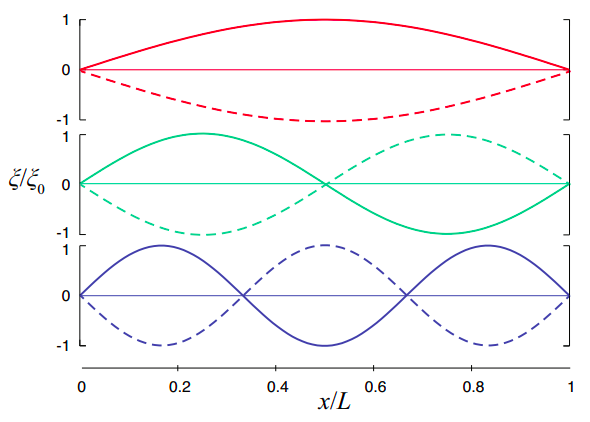
The three lowest-frequency normal modes of vibration of a string held down at both ends
Image Courtesy Gea-Banacloche, J. (2019). University Physics I: Classical Mechanics. Open Educational Resources
Each successive mode illustrates a higher frequency of oscillation, adding to the complexity and richness of wave behaviour in strings.
Pipes
Open Pipes: The first mode, akin to strings, features antinodes at both ends, leading to a symmetrical wave pattern.
Closed Pipes: This setup results in an asymmetrical pattern, with a node at the closed end and an antinode at the open end.
Understanding these modes provides insights into the rich and diverse world of sound, offering explanations for the varied pitches and tones emanating from different types of pipes and wind instruments.
Exclusion of Pressure Nodes and Antinodes for Standing Waves in Air
Standing waves in air, especially within pipes, require a nuanced approach, wherein the conventional nodes and antinodes associated with displacement in strings are addressed, while the concept of pressure nodes and antinodes is eschewed.
Complexity of Air Waves
Compression: This phase sees air molecules closely packed, leading to increased pressure.
Rarefaction: Here, the air molecules are spaced apart, leading to decreased pressure.
These variations in air pressure, integral for the propagation of sound, aren’t as distinctly classified into nodes and antinodes as in mechanical waves like strings.
Sound Wave Considerations
In the realm of sound waves propagating through air, the displacement of air molecules is the focus. Musicians and physicists alike pay heed to the displacement antinodes and nodes formed at the open and closed ends of pipes. These points play a pivotal role in determining both the pitch and timbre of sounds produced, rather than the subtle variations in air pressure within the pipe.
Insights for Enriched Understanding
While delving into the profound world of standing wave patterns and boundary conditions, a comprehensive grasp of the interplay between nodes, antinodes, and the corresponding boundary conditions is indispensable. This knowledge not only elucidates the enigmatic behaviour of waves but also unveils the underlying principles governing the symphony of sounds in musical instruments and the plethora of wave-related phenomena in various physical and engineering contexts. The concepts discussed are foundational stepping stones, instrumental for students aiming to traverse the enriching pathways of wave mechanics and acoustics, equipped with the vital tools to decipher the complex choreography of waves under varied conditions and settings.
Practice Questions
The boundary conditions of a string significantly influence the formation of standing waves. With fixed ends, the string is constrained, leading to the creation of nodes at these points where there’s no movement. In contrast, free ends result in antinodes at the boundaries due to unrestricted movement. Fixed ends lead to symmetrical patterns of standing waves with nodes at both ends. Conversely, free ends give rise to asymmetrical wave patterns characterised by greater complexity, enhancing the richness of wave behaviour, instrumental in diverse applications like musical instruments.
Pressure nodes and antinodes are excluded in air because sound waves propagate through the compression and rarefaction of air molecules, making it complex to distinctly identify pressure variations. In strings, waves are transverse, allowing clear identification of displacement nodes and antinodes. In air, the focus shifts to displacement of molecules rather than pressure variations. This exclusion aids in a simplified yet comprehensive analysis of wave behaviour, particularly in musical instruments, where the pitch and timbre are influenced by displacement nodes and antinodes at the ends of pipes.
FAQ
The material of a string significantly influences its density and tension, both pivotal in determining the wave speed and, subsequently, the standing wave patterns. A denser material results in a slower wave speed, while increased tension elevates the wave speed. These variations directly impact the frequency and wavelength of the standing waves formed. Different materials, owing to their inherent physical properties, facilitate a range of standing wave patterns, contributing to the diversity of sounds in stringed musical instruments and offering a varied scope for experimental observations in laboratory settings.
Mathematical methods like Fourier analysis are instrumental in dissecting standing wave patterns. Fourier analysis decomposes complex wave patterns into simpler sinusoidal waves, facilitating an in-depth analysis of the wave’s characteristics, including its frequency, amplitude, and phase. Wave equations, derived from the principles of classical mechanics, are also essential tools. They provide insights into wave behaviour under varying boundary conditions. By employing these mathematical tools, physicists and engineers can predict, analyse, and manipulate wave behaviours for diverse applications, from musical instrument design to advanced communication systems.
In musical instruments, knowledge of standing wave patterns and boundary conditions is paramount in achieving specific acoustic characteristics. For instance, in string instruments like violins or guitars, the placement of nodes and antinodes is manipulated through finger positioning to achieve desired notes. In wind instruments, the length of the air column, effectively altering the boundary conditions, is adjusted to generate different tones. Thus, the intentional manipulation of standing wave patterns and boundary conditions, grounded in the principles of wave mechanics, is fundamental in instrument design and playing techniques to produce a diverse array of musical sounds.
As the frequency increases, the vibrational modes in closed pipes exhibit a distinct pattern, with a rise in the number of nodes and antinodes. Each subsequent higher mode involves an additional node and antinode pair, leading to more complex wave patterns. This intricacy results from the increased energy and frequency, causing more points of constructive and destructive interference within the pipe. Such diversification of vibrational modes directly influences the sound produced, particularly evident in musical instruments, where different notes and tones are generated by exciting specific vibrational modes.
Yes, the concept of boundary conditions and standing wave patterns extends beyond strings and pipes, applicable to any medium where waves can reflect and interfere. For instance, in electromagnetic waves, boundary conditions can arise at the interface of different media, leading to phenomena like reflection, refraction, and the formation of standing waves under certain conditions. These principles are instrumental in understanding a wide range of physical phenomena and engineering applications, including optics, telecommunications, and microwave engineering, where wave behaviour at boundaries defines system performance.
