

IB Syllabus focus:
'Determination of the wavelength and frequency of the nᵗʰ harmonic given the length of the string or pipe and the speed of the wave.
Understanding the lowest frequency mode as the first harmonic.
Analysis of standing waves in terms of harmonics.'
Determining the Wavelength and Frequency of the nth Harmonic
Harmonics emerge from the intricate oscillations of waves. These oscillations, patterned in a systematic manner, yield integral multiples of a fundamental frequency. Each distinct harmonic narrates a unique tale of wave vibration, showcasing varied patterns and behaviours.
Wavelength
The formula
λn = 2L / n
unravels the mystery of calculating the wavelength of the nth harmonic. In this relationship, L embodies the length of the string or pipe, and n signifies the harmonic number, an integer count of the frequency multiples. Each increment in n unfolds a new chapter in the narrative of wave behaviour, revealing distinct patterns and characteristics.
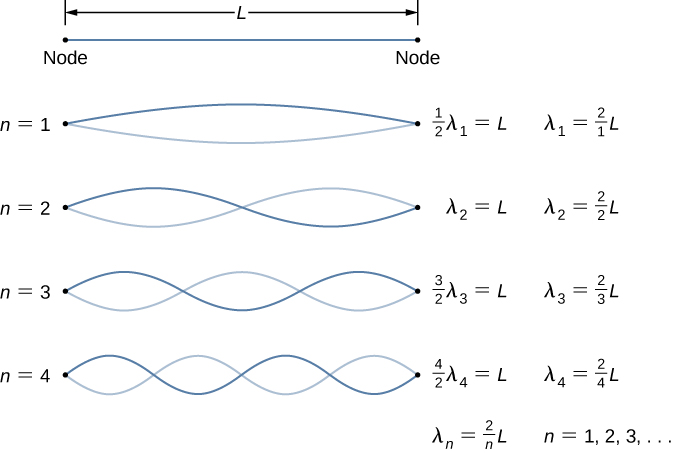
The wavelength for the first four modes of vibration for a string fixed at both ends
Image Courtesy OpenStax
Illustrative Scenario
Consider a scenario featuring a string of 1.5 meters in length. Tasked with uncovering the third harmonic, the enigmatic wavelength unveils itself through the equation
λ3 = 2 * 1.5 / 3 = 1 metre.
This outcome, an artistic portrayal of wave behaviour, encapsulates the essence of the wave’s oscillatory dance at the third harmonic.
Frequency
Harmonics exhibit a profound kinship with frequency, articulated eloquently through the equation
fn = n * v / 2L.
Here, v signifies wave speed, a parameter intrinsic to the wave’s identity, encapsulating its propensity to traverse space over time.
Wave Speed
An instrumental aspect of this discourse, wave speed, finds its voice in the equation
v = sqrt(T / μ),
where T denotes the tension gracing the string, and μ represents the mass per unit length. The symphony of these variables, in harmony, bestows upon us the wave speed, a testament to the wave’s journey through space.
An Exemplary Exploration
A string, 0.75 meters in length and graced with a wave speed of 150 m/s, invites us to explore the frequency of its 2nd harmonic. This exploration, guided by the formula, yields a frequency of 200 Hz, a narrative of the wave’s oscillations echoing 200 times per second.
The First Harmonic
The first harmonic, a sentinel of fundamental frequency, inaugurates the harmonic sequence. It’s a serene dance of the wave, oscillating at its lowest frequency, laying the foundational narrative for the harmonics that follow.
Characteristics
Nodes: Bookending the wave, two nodes stand sentinel, regions of minimal energy where the wave appears eerily silent.
Antinodes: Amidst the silent nodes, an antinode sways, a crest of maximum energy, where the wave dances with utmost vivacity.
Wavelength: The inaugural wavelength spans twice the length of the string or pipe, a spatial narrative of the wave’s inaugural oscillation.
A Mathematical Excursion
The mathematical journey to unveil the first harmonic is both enlightening and profound. With n = 1, the wavelength and frequency equations, akin to mystical keys, unlock the secrets of this foundational harmonic.
Analysing Standing Waves in Terms of Harmonics
Standing waves, the enigmatic offspring of two parent waves journeying in opposite directions, yet of identical frequency and amplitude, reveal a world where harmonics reign supreme.
Node and Antinode Formation
Nodes: Points where silence reigns, marked by zero displacement, a testament to the destructive interference of waves.
Antinodes: Crescendos of energy, marking points of constructive interference, where the waves converge in unison, amplifying each other’s existence.
Harmonic Modes Unleashed
1. First Harmonic:
Marked by simplicity, a dance between two nodes and a solitary antinode.
An oscillatory dance, weaving the foundational narrative of harmonic motion.
2. Second Harmonic:
A complex dance, unveiling an additional node and antinode.
A symphony where the wavelength is halved, and the frequency doubles, echoing the intricate oscillations of the wave.
3. Higher Harmonics:
Each harmonic, a narrative woven with additional nodes and antinodes.
A dance growing in complexity, where wavelengths contract and frequencies ascend.
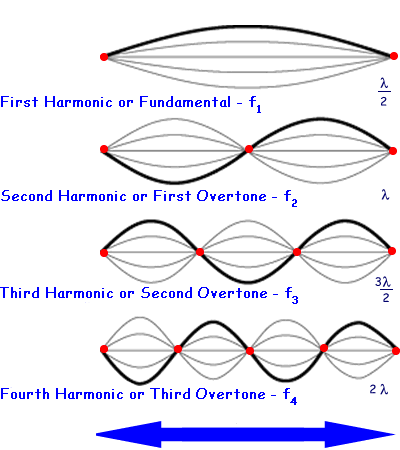
Node, antinodes and wavelengths of first four harmonics
Image Courtesy Cyberphysics
Visual Representation
The harmonics, akin to visual poetry, can be illustrated through diagrams. Each harmonic, etched on paper, unveils the intricate dance of nodes and antinodes, offering a visual narrative to the mathematical symphony.
Mathematical Nuances
The mathematical representation of harmonics is a journey into the world of equations. The displacement of a standing wave finds eloquent expression in
y(x, t) = 2A sin(kx) cos(ωt),
where y(x, t) narrates the tale of displacement at each point x, at each moment t. The amplitude A, wave number k, and angular frequency ω join hands to weave this narrative.
The Realm of Applications
Harmonics echo in the corridors of music, engineering, and beyond. In the realm of music, harmonics paint auditory masterpieces, each harmonic lending a distinct hue to the melody. The quality, texture, and essence of sound are sculpted by the harmonics, a symphony of frequencies echoing the intricate dance of waves.
Embracing the Journey
Embarking upon the journey of harmonics and wave analysis, we traverse a landscape where mathematics, physics, and artistry converge. Each harmonic, a narrative; each equation, a key; unlocks the enigmatic dance of waves, echoing the symphony of the cosmos in each oscillation.
Practice Questions
The frequency of the 4th harmonic can be calculated using the formula fn = nv / (2L), where n is the harmonic number, v is the wave speed, and L is the length of the string. Substituting in the given values, we get f4 = 4250 / (21.2) = 833.33 Hz. Therefore, the frequency of the 4th harmonic is 833.33 Hz. It is essential to use precise values while doing the calculations to ensure accuracy and reliability of the results, aligning with the core principles of measurement and evaluation in physics.
In the 3rd harmonic, there are four nodes and three antinodes. The nodes are points of minimal or zero displacement due to destructive interference, while antinodes are points of maximum displacement due to constructive interference. For the 3rd harmonic, the wavelength can be determined using the formula λn = 2L / n. With a string length of 0.9 meters and n = 3, the calculation becomes λ3 = 20.9 / 3 = 0.6 meters. Hence, the wavelength of the 3rd harmonic is 0.6 meters. Understanding the interplay of nodes and antinodes, alongside precise calculations of wavelengths, forms the foundation of wave analysis in physics.
FAQ
Yes, standing waves with different harmonic numbers can coexist on the same string or pipe, a phenomenon referred to as superposition. When multiple waves of different frequencies (harmonics) are present, they combine to form a complex wave pattern. Each harmonic maintains its distinct pattern of nodes and antinodes. This simultaneous existence of multiple harmonics is particularly evident in musical instruments. For example, a plucked guitar string can exhibit a complex vibration pattern resulting from the superposition of various harmonics, each contributing to the overall sound produced, and thus creating a rich and sonorous musical note.
The amplitude and energy of a wave among different harmonics can vary significantly. Higher harmonics often correspond to lower amplitudes but have increased energy due to their higher frequencies. The amplitude is a measure of the wave's displacement from its equilibrium position, while the energy is related to the frequency and amplitude of the wave. In musical instruments, for example, higher harmonics, although having lower amplitudes, contribute to the richness and brightness of the sound. This is due to the increased energy levels associated with the higher frequencies of the upper harmonics, which add complexity and richness to the overall sound wave.
The harmonic series and overtone series are interconnected. The harmonic series refers to the sequence of frequencies that are integral multiples of the fundamental frequency. In contrast, the overtone series comprises all the frequencies above the fundamental frequency, excluding it. The first overtone corresponds to the second harmonic, the second overtone to the third harmonic, and so on. This relationship is essential in music, as the overtones (or higher harmonics) add richness and complexity to the sound produced by musical instruments, affecting the timbre and tone quality, and contributing to the distinct sound characteristics of different instruments.
Changing the tension in a string directly affects the wave speed and, consequently, the frequencies of the harmonics produced. Increasing the tension increases the wave speed, following the formula v = sqrt(T/μ), where T is the tension and μ is the mass per unit length. A higher wave speed results in higher frequencies of all harmonics, according to the formula fn = nv / (2L). This principle is often applied in musical instruments; for example, tightening a guitar string increases its tension, leading to a higher pitch sound, while loosening the string decreases the tension, resulting in a lower pitch. Understanding this relationship is crucial for tuning and playing instruments effectively and is a fundamental aspect of the physics of music and sound.
The harmonic number directly influences the complexity of the standing wave’s pattern. A higher harmonic number corresponds to more complex wave patterns with a greater number of nodes and antinodes. With each increment in the harmonic number, an additional node and antinode are introduced into the wave pattern, increasing the wave’s spatial complexity. The increased number of nodes and antinodes augments the oscillatory and vibrational complexity of the wave. This is crucial in real-world applications, especially in musical instruments, where higher harmonics contribute to richer and more intricate sound textures and tones, offering a diverse auditory experience.
