
Vision statements
A vision statement describes the business’s broad, long-term aspiration: what it ultimately wants to become or achieve.
It gives the organization direction and helps guide major future decisions.
An effective vision is normally clear, ambitious and memorable, rather than a detailed short-term target.
The vision should provide a reference point when the business develops its strategic objectives.
For AO2, be able to explain the purpose of a vision statement in a business context.
Growth objectives
A growth objective aims to increase the size or reach of the business.
Growth may involve higher sales, more customers, greater output or expansion into additional locations or markets.
Growth can strengthen the business’s position and create opportunities for higher future returns.
Managers should consider whether the desired growth supports the organization’s wider objectives and available capabilities.
In an exam, identify exactly what is expected to grow and why this matters to the business.
Protecting shareholder value
Shareholder value concerns the financial worth shareholders receive from owning shares in a business.
Protecting shareholder value means safeguarding or increasing the owners’ financial interests over time.
Returns may include dividends and increases in the value of the shareholders’ investment.
Protecting shareholder value is broader than maximizing immediate profit because decisions can affect the business’s future worth.
Managers may therefore balance current returns against decisions intended to maintain longer-term performance and shareholder confidence.
Strategic and tactical objectives
Feature | Strategic objectives | Tactical objectives |
|---|---|---|
Purpose | Big-picture goals designed to fulfil the business mission | More specific objectives designed to implement strategic goals |
Time horizon | Usually longer-term | Usually shorter-term |
Scope | Whole organization or major business direction | Particular departments, teams or activities |
Management level | Mainly senior management | Mainly middle management |
Relationship | Provide direction for tactical objectives | Must support the broader strategic objectives |
Ethical objectives
Ethical objectives establish standards or targets for behaviour that the business considers morally responsible.
Examples include fair treatment, honest business practices, responsible sourcing and reducing harm to people or the environment.
Ethical objectives may sometimes increase costs or restrict opportunities to maximize short-term profit.
They can also strengthen trust, reputation and relationships with those affected by the business.
In AO2 answers, explain both the ethical objective and why the organization might choose to pursue it.
Checklist: can you do this?
Can you explain the difference between a vision statement and a mission statement?
Can you explain growth and profit as business objectives?
Can you explain what protecting shareholder value means?
Can you explain an ethical objective using an appropriate business example?
Can you distinguish strategic objectives from tactical objectives?
Can you explain how a tactical objective should support a strategic objective?
Can you explain what CSR means and identify relevant business actions?
Can you evaluate the likely benefits and drawbacks of CSR in a given business situation?
Mission statements
A mission statement explains the business’s current purpose and how it intends to work towards its vision.
It communicates what the organization exists to do and provides a common sense of purpose.
The mission helps connect business activities and objectives with the organization’s overall direction.
A vision focuses on the desired future; a mission focuses more closely on the organization’s present purpose and approach.
For AO2, clearly explain this distinction rather than simply memorizing definitions.
Profit objectives
A profit objective focuses on generating a financial surplus from the business’s activities.
Profit provides a potential return to owners and resources that can support future business decisions.
Managers may emphasize immediate profit or accept lower current profit in pursuit of longer-term objectives.
Profit objectives can therefore create trade-offs with growth expenditure or ethical commitments.
In an exam, explain why a particular level or direction of profit matters in the specific business context.
Corporate social responsibility (CSR)
Corporate social responsibility (CSR) means a business taking responsibility for the effects of its decisions and activities on society.
CSR integrates social, environmental and ethical concerns into business operations and decision-making.
Examples include reducing environmental harm, supporting fair working practices, treating consumers responsibly and preventing corruption.
Potential benefits include improved trust, reputation, risk management, customer relationships and employee relations.
Possible disadvantages include additional costs and tensions with short-term financial objectives.
For AO3, evaluate CSR using the organization’s circumstances, affected groups, costs and likely longer-term effects.
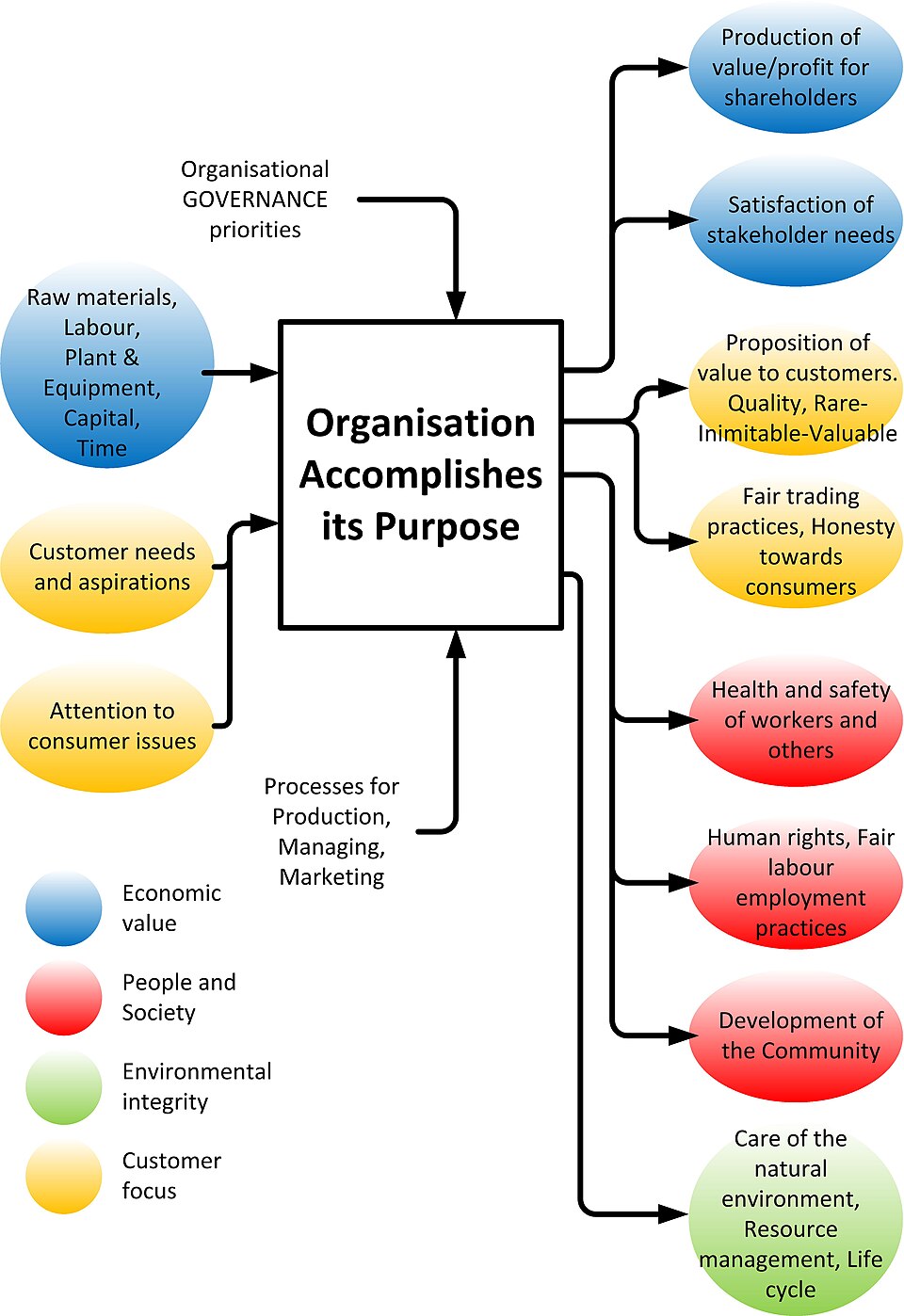
CSR requires businesses to consider wider social and environmental effects alongside financial objectives. The diagram helps visualize why responsible decisions may involve competing business priorities. Source