
Core meaning and assessment focus
An MNC is an enterprise with linked operations or entities in more than one country that can coordinate their activities.
The host country is the country in which the foreign MNC operates; the parent enterprise is based in its home country.
This cheat sheet is limited to 1.6 Multinational companies (MNCs) as specified.
The syllabus focus is the impact of MNCs on host countries, taught at AO3.
Strong answers analyse both benefits and costs and explain why the overall impact depends on the host-country context.
Employment, wages and skills
MNCs may create direct employment in their own operations and indirect employment through suppliers and supporting services.
Employee training can develop skills, managerial knowledge and human capital that remain useful within the host economy.
MNC employment can contribute to higher living standards when wages and working conditions are favourable.
The ILO identifies employment, training, working conditions and industrial relations as major areas through which MNCs affect host societies.
Benefits may be limited if operations use few local workers or mainly provide low-skilled jobs.
Weak labour protection can increase the risk of poor conditions or insecure employment.
Government revenue and public benefits
MNC activity can generate tax revenue through corporate taxes and taxes linked to employment and spending.
Higher government revenue can help finance infrastructure and public services when taxation is effectively collected.
Governments may offer tax incentives or subsidies to attract MNC investment, reducing the immediate financial benefit.
Base erosion and profit shifting (BEPS) can allow MNCs to shift profits towards lower-tax jurisdictions and reduce host-country tax revenue.
Developing economies can be particularly affected because they often depend more heavily on corporate income tax.
Evaluate whether tax revenue and wider benefits justify the incentives offered to the MNC.
Why host-country impacts differ
The impact depends on the scale and nature of investment, not simply whether an MNC is present.
Benefits are stronger when investment creates productive capacity, employment, skills and meaningful technology transfer.
Greater local supplier linkages increase the amount of income, knowledge and demand retained within the host economy.
Strong skills, institutions and domestic firms improve a country's absorptive capacity for technology and knowledge spillovers.
Effective labour, competition, tax and environmental regulation can reduce adverse impacts.
Highly mobile operations may create greater dependency and relocation risk if the host economy becomes heavily reliant on one foreign investor.
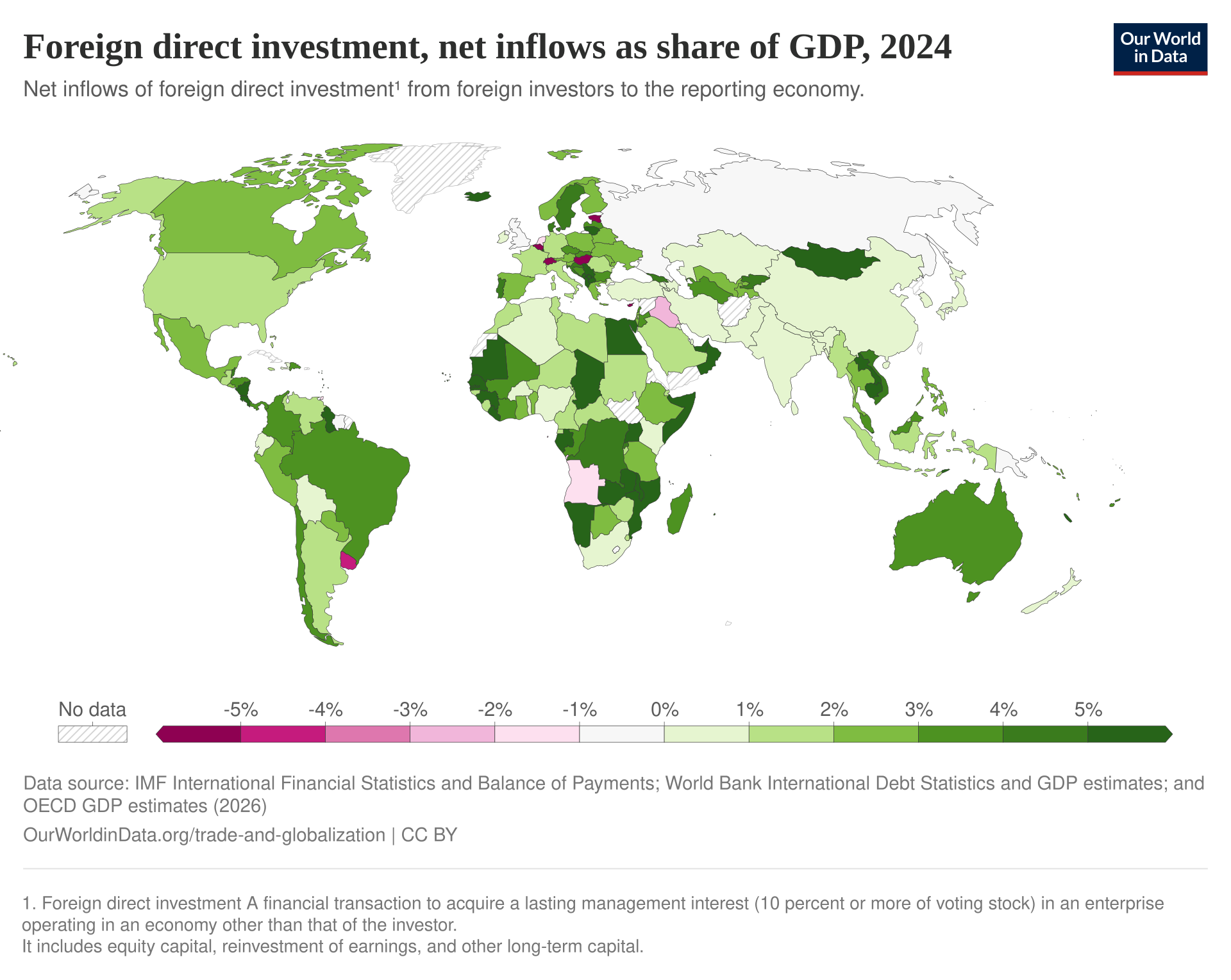
The map shows that countries receive very different levels of FDI relative to the size of their economies. Greater FDI exposure can increase the potential scale of MNC impacts, but the map alone cannot show whether those impacts are beneficial or harmful. Source
Investment, output and growth
MNCs bring foreign direct investment (FDI) that can increase productive capacity, business activity and economic output.
New factories, offices and facilities can stimulate infrastructure development, exports and demand for supporting industries.
Spending by MNCs can create wider economic activity through purchases from suppliers and employee spending.
FDI can strengthen productive capacity, employment and technology transfer, but these development gains are not automatic.
Some profits may be repatriated to the home country, reducing the income retained within the host economy.
The strongest benefits occur when substantial value is created and retained locally.
Technology and local business spillovers
MNCs can introduce advanced technology, production methods, management practices and international quality standards.
Local suppliers may gain new contracts and improve their efficiency to meet MNC requirements.
Workers moving between firms can spread knowledge and skills through the domestic economy.
Local businesses may gain access to global value chains and international markets through relationships with foreign MNCs.
However, technology and productivity spillovers are not automatic and depend on the capabilities of local firms and workers.
Benefits are smaller when MNCs import most inputs and develop few connections with domestic suppliers.
Competition and consumers
MNC entry can increase competition, encouraging businesses to improve efficiency, quality and innovation.
Consumers may benefit from greater choice, better products and potentially lower prices.
Competition from an MNC can encourage domestic firms to adopt improved technology and management practices.
However, large MNCs may possess greater finance, economies of scale, technology and brand strength than local competitors.
Domestic firms can lose market share or leave the market if they cannot compete effectively.
International tax planning can also give some MNCs a competitive advantage and contribute to greater market concentration.
The outcome depends strongly on domestic competition and the strength of local businesses.
Social, environmental and strategic risks
Risk | Possible host-country impact | Key evaluation |
|---|---|---|
Labour practices | Poor wages, conditions or employment security can harm workers. | Strength of labour laws and enforcement. |
Environmental damage | Pollution, resource depletion or environmental harm can impose costs on communities. | Sector, regulation and environmental responsibility. |
Dependency | Employment and exports may become vulnerable if an MNC relocates. | Diversification and strength of local linkages. |
Bargaining power | A major investor may pressure governments for favourable taxes or regulations. | Institutional strength and importance of the MNC to the economy. |
AO3 exam approach
Start with case evidence showing what the MNC has actually changed in the host country.
Build a chain of reasoning: MNC action → stakeholder effect → wider host-country consequence.
Explain both the immediate impact and possible longer-term consequences.
Balance a benefit against a relevant limitation rather than presenting an unconnected advantages-and-disadvantages list.
Consider employees, local businesses, consumers, government and communities where relevant.
Base the final judgement on context such as regulation, skill levels, local sourcing, investment size and dependence on the MNC.
Avoid claiming that MNCs are always beneficial or always harmful.
Checklist: can you do this?
Can you explain what an MNC and a host country are?
Can you analyse how MNC investment can affect economic activity and employment?
Can you explain how skills, technology and knowledge spillovers may benefit a host country?
Can you analyse effects on local businesses and competition?
Can you explain how MNCs can affect government tax revenue?
Can you analyse possible social and environmental impacts?
Can you explain why the impact of the same MNC may differ between host countries?
Can you make a context-based judgement rather than giving a generic list of benefits and costs?