
Conservation of energy and work
The principle of conservation of energy states that energy is conserved during transfers and transformations.
Work done by a force is equivalent to an energy transfer.
Track energy entering, leaving and changing form within the chosen system.
The work done by the resultant force on a system equals the change in energy of that system.
Work done by a constant force
For a constant force, work is .
Only the component of force along the displacement contributes to the work done.
For , .
For , .
A force with a component opposite to the displacement does negative work.
Identify , and the angle carefully before substituting.
Mechanical energy conservation
Mechanical energy is the sum of kinetic, gravitational potential and elastic potential energy.
Without frictional or resistive forces, the total mechanical energy of a system is conserved.
Work can represent energy transformed between different mechanical energy forms.
A decrease in one mechanical form can therefore correspond to an increase in another.
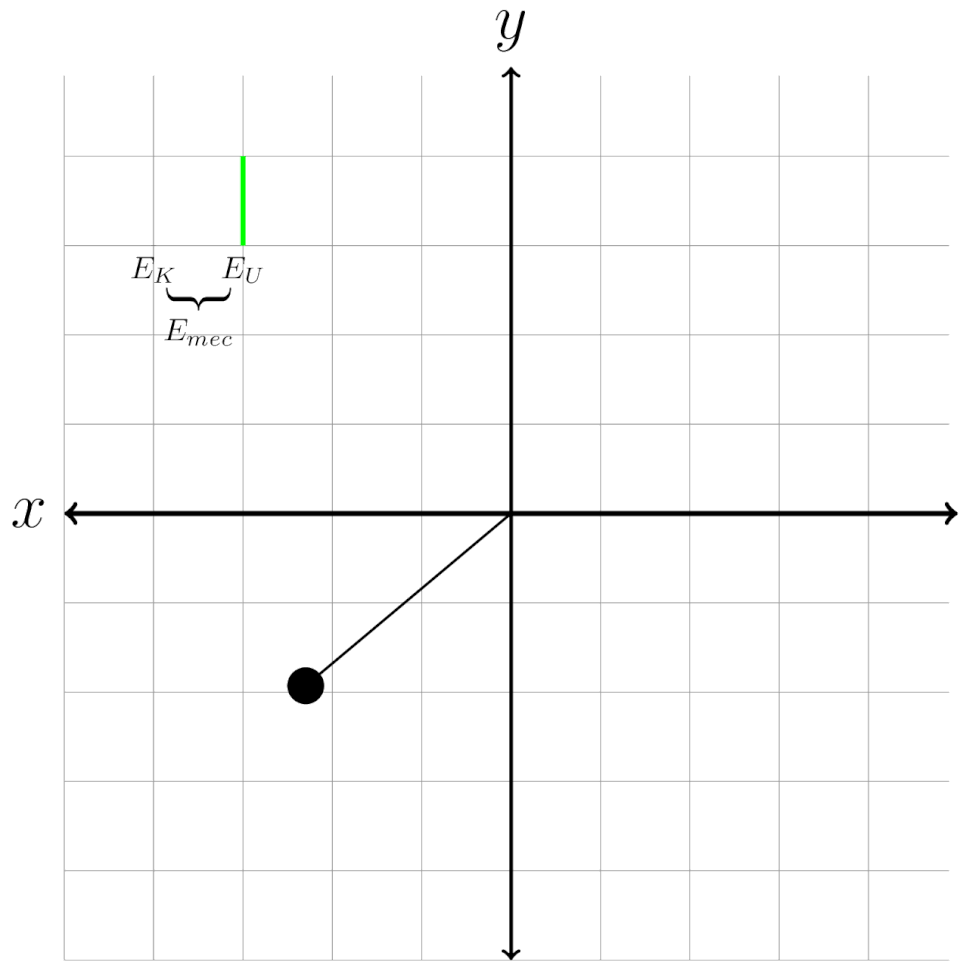
As the pendulum moves, energy transfers between gravitational potential energy and kinetic energy. In the absence of resistive effects, the total mechanical energy remains conserved.
Power
Power is the rate of doing work or the rate of energy transfer.
Greater power corresponds to more work done in the same time, or the same work done in less time.
Use consistent work or energy and time quantities when calculating power.
Non-conservative forces
When frictional or resistive forces act, total mechanical energy need not remain constant.
Interpret the change in mechanical energy as work done on the system by a non-conservative force.
The total energy is still conserved even when energy is transferred away from mechanical energy forms.
Sankey diagrams
Sankey diagrams represent energy transfers through a system.
Identify the energy supplied to the system and the different output pathways.
Use the energy values shown to relate input energy to output energy.
Check that the represented transfers are consistent with the conservation of energy.
Resultant work and energy change
Resultant work determines the change in the energy of a system.
Positive resultant work corresponds to an increase in system energy; negative resultant work corresponds to a decrease.
An energetics approach can therefore be used to solve motion problems by tracking energy changes.
Mechanical energy equations
Quantity | Equation | Exam use |
|---|---|---|
Translational kinetic energy | Use either speed or momentum | |
Change in gravitational potential energy | Applies close to the surface of the Earth | |
Elastic potential energy | Uses spring constant and deformation | |
Mechanical energy | Sum the mechanical energy forms |
Efficiency and fuel energy density
Efficiency compares the output of an energy transfer with its input.
Use the energy ratio when energies are supplied and the power ratio when powers are supplied.
Energy density of fuel sources is used to compare how concentrated the available energy is between different fuel sources.
Do not mix an energy ratio with a power ratio in the same efficiency calculation.
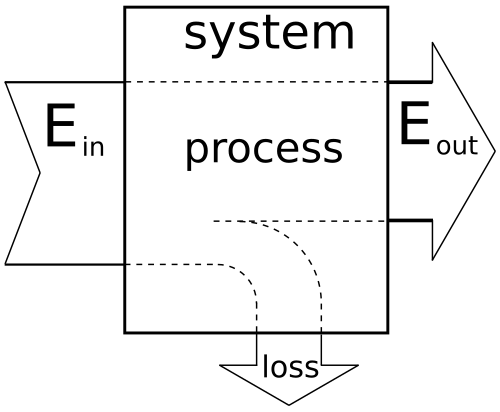
The diagram connects energy input, energy output and transferred energy with the idea of efficiency. Compare the input and output quantities when applying the efficiency ratio.
Checklist: can you do this?
Can you explain the principle of conservation of energy and how work transfers energy?
Can you interpret energy transfers represented on a Sankey diagram?
Can you calculate work using ?
Can you determine the change in system energy from the resultant work done?
Can you use the equations for kinetic, gravitational potential and elastic potential energy?
Can you predict whether mechanical energy is conserved when frictional or resistive forces act?
Can you calculate power using ?
Can you calculate efficiency and compare the energy density of fuel sources?