
AQA Syllabus focus:
'Explanations for obedience, including the agentic state and legitimacy of authority.'
Obedience often appears to reflect personal cruelty, but these explanations show how ordinary people may obey because of authority relationships and shifts in perceived responsibility.
Agentic state
One explanation is that people obey when they enter an agentic state.
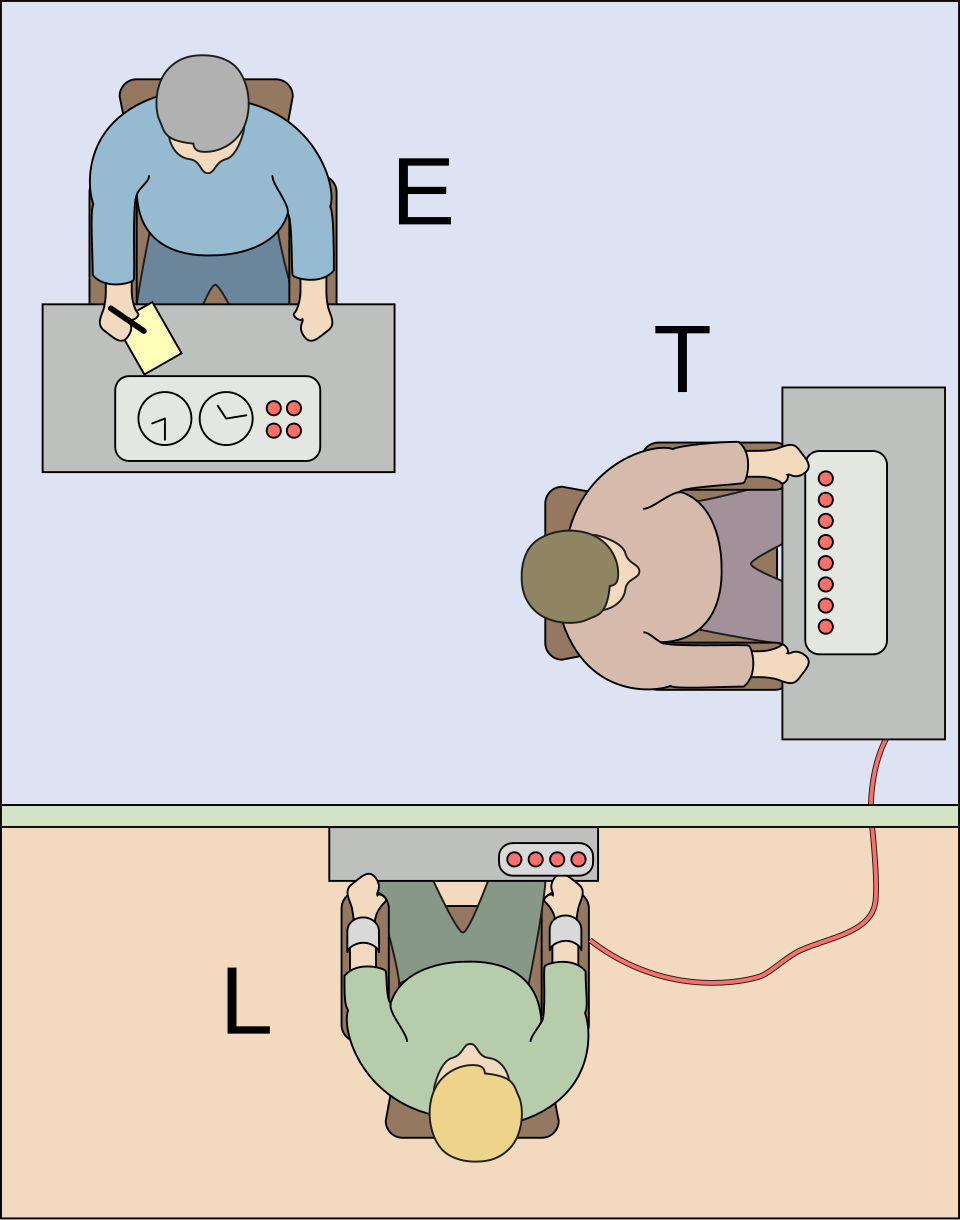
Diagram of the Milgram obedience study roles and information flow: the experimenter issues instructions to the participant (“Teacher”), who delivers shocks to the “Learner.” The layout highlights how authority is positioned as the source of commands, while the teacher performs the action—an arrangement that makes it easier for responsibility to feel displaced upward. Source
In this state, they stop seeing themselves as acting independently and instead see themselves as carrying out another person’s wishes.
Agentic state: A psychological state in which a person sees themselves as an agent for another person and feels less personally responsible for their actions.
Before this shift occurs, the person is in the autonomous state, meaning they see themselves as responsible for their own behavior and guided by personal conscience. According to the theory, an agentic shift happens when the individual recognizes an authority figure as entitled to direct their actions.
How the agentic state produces obedience
The person accepts the authority figure’s definition of the situation.
Responsibility is transferred upward to the authority figure.
The individual becomes an agent acting on behalf of another person.
Obedience can continue even when the order causes moral conflict.
This explanation helps make sense of the tension often seen in obedience research. People may sweat, tremble, hesitate, or verbally object, showing that they have not become indifferent to harm. Instead, they experience conflict because they still understand the action is wrong, but feel that the authority figure is answerable for the outcome. In other words, the action is performed by the individual, yet responsibility is psychologically located elsewhere.
The theory also helps explain why people often ask questions about who will be responsible if something goes wrong. Responsibility matters because obedience is easier when the individual believes they are not the final moral decision maker. However, the explanation has limits. Many obedient people still feel guilty or distressed, which suggests that responsibility is reduced rather than completely removed. The agentic state may therefore explain a major part of obedience, but not every part of it.
Another strength is that the explanation focuses on the social situation rather than assuming obedient people are naturally cruel. It suggests that ordinary people can commit harmful acts if the situation encourages them to hand over responsibility to someone higher in a hierarchy.
Legitimacy of authority
A second explanation is legitimacy of authority.
People are more likely to obey when they believe the person giving the order has a recognized right to do so and that compliance is expected.
Legitimacy of authority: The extent to which an authority figure is seen as having a valid, socially accepted right to give orders and expect obedience.
Legitimacy is linked to the way society is organized. From an early age, people are socialized to accept that some individuals have authority over others, such as parents, teachers, police officers, and judges. These roles are backed by social rules and institutions, so obeying them often feels normal, reasonable, and necessary for social order. This means obedience is not only about fear or pressure; it is also about shared beliefs concerning who is entitled to command.
Sources of legitimacy
Role: The authority figure occupies an officially recognized position.
Institution: The command is linked to a respected organization or system.
Expertise: The authority is seen as knowledgeable or specially qualified.
Social hierarchy: People believe higher-status individuals can direct lower-status individuals.
This explanation is important because it accounts for destructive authority. An authority figure may use a legitimate role to get other people to behave in ways that are harmful. If the role is accepted as lawful, expert, or institutionally supported, individuals may obey even when the order clashes with their own values. The problem is not simply authority itself, but how authority can be used.
There is research support for this explanation because obedience tends to be stronger in settings and cultures where respect for authority is emphasized. The idea also fits everyday life, where people usually obey instructions from recognized authority figures without needing to question every command. However, legitimacy is not automatic. People are less likely to obey when they doubt the authority figure’s right to give orders, when the command seems outside that person’s role, or when the institution behind the authority loses credibility.
Legitimacy of authority therefore explains why obedience can appear reasonable from the participant’s point of view. If the authority is seen as proper and socially approved, obedience may feel like the correct response, even when the consequences are troubling.
How the explanations fit together
These two explanations are closely connected rather than competing. Legitimacy of authority helps explain why a person accepts the authority figure in the first place. Agentic state then explains the psychological change that follows, where the person sees themselves as carrying out the authority’s wishes instead of acting fully on personal responsibility.
Together, they offer a strong situational account of obedience. They show how social hierarchy, socialization, and responsibility can combine to produce obedient behavior in ordinary people. At the same time, obedience is not inevitable. Some people still question the authority, reject the role relationship, or continue to feel too personally responsible to obey. This means agentic state and legitimacy of authority are valuable explanations, but they do not guarantee obedience in every situation.
Practice Questions
Briefly explain what is meant by an agentic state. (2 marks)
1 mark for stating that the person sees themselves as acting on behalf of an authority figure.
1 mark for stating that personal responsibility is reduced, displaced, or seen as belonging to the authority figure.
Outline and briefly evaluate legitimacy of authority as an explanation for obedience. (6 marks)
AO1 (up to 3 marks):
1 mark for explaining that people obey when they see the authority figure as having a valid right to give orders.
1 mark for referring to social hierarchy, socialization, or recognized social roles.
1 mark for explaining that this can lead to obedience, including destructive authority.
AO3 (up to 3 marks):
1 mark for a strength, such as research or everyday relevance showing the importance of recognized authority.
1 mark for a limitation, such as legitimacy depending on whether the authority is accepted as genuine.
1 mark for development of either evaluative point, for example explaining why some people still disobey despite apparent legitimacy.
FAQ
Binding factors are psychological pressures that keep a person committed once obedience has started. They can include politeness, a desire to appear cooperative, fear of seeming rude, and reluctance to interrupt a formal procedure.
They matter because they make withdrawal feel socially awkward or difficult, even when the person is uncomfortable. This helps explain why someone may continue obeying after already showing signs of conflict.
Yes. Legitimacy can weaken if the authority appears confused, unfair, incompetent, or outside their proper area of responsibility.
It can also collapse if the institution behind them no longer seems credible. Once people stop seeing the authority as valid, obedience often becomes much less likely because the order no longer feels socially justified.
Institutions give authority a wider social backing. A person may seem more legitimate when they are connected to a school, court, hospital, or other formal system with accepted rules.
This means obedience is often directed not only to the individual, but also to what they represent. The role can therefore carry power even when the authority figure is personally unknown.
Conflicting authorities create uncertainty about who has the real right to command. This weakens the clarity that usually supports obedience.
When responsibility can no longer be handed to one clear superior, people are more likely to pause, think independently, or refuse. Competing authorities can therefore reduce the strength of both legitimacy and the agentic state.
Not exactly. The agentic state is a psychological explanation of what may happen during obedience, when responsibility feels shifted upward.
“I was just following orders” may reflect that state, but it can also be a later excuse or rationalization. So the phrase might describe a genuine perception of reduced responsibility, or it might be a defense used after the event.