
AQA Syllabus focus:
'Situational variables affecting obedience, including proximity and location, as investigated by Milgram, and uniform.'
Milgram’s variation studies showed that obedience is not fixed. Changes in the immediate situation—especially proximity, location, and uniform—can sharply increase or reduce the likelihood that people will obey authority.
Milgram’s baseline study as a reference point
Milgram investigated obedience by asking participants to give what they believed were electric shocks to a “learner” when mistakes were made on a memory task. The participant was always the “teacher,” while the learner and experimenter were confederates. In the original Yale University procedure, the learner was in another room and the experimenter gave orders face-to-face. Under these conditions, 65% of participants continued to the maximum 450-volt level.
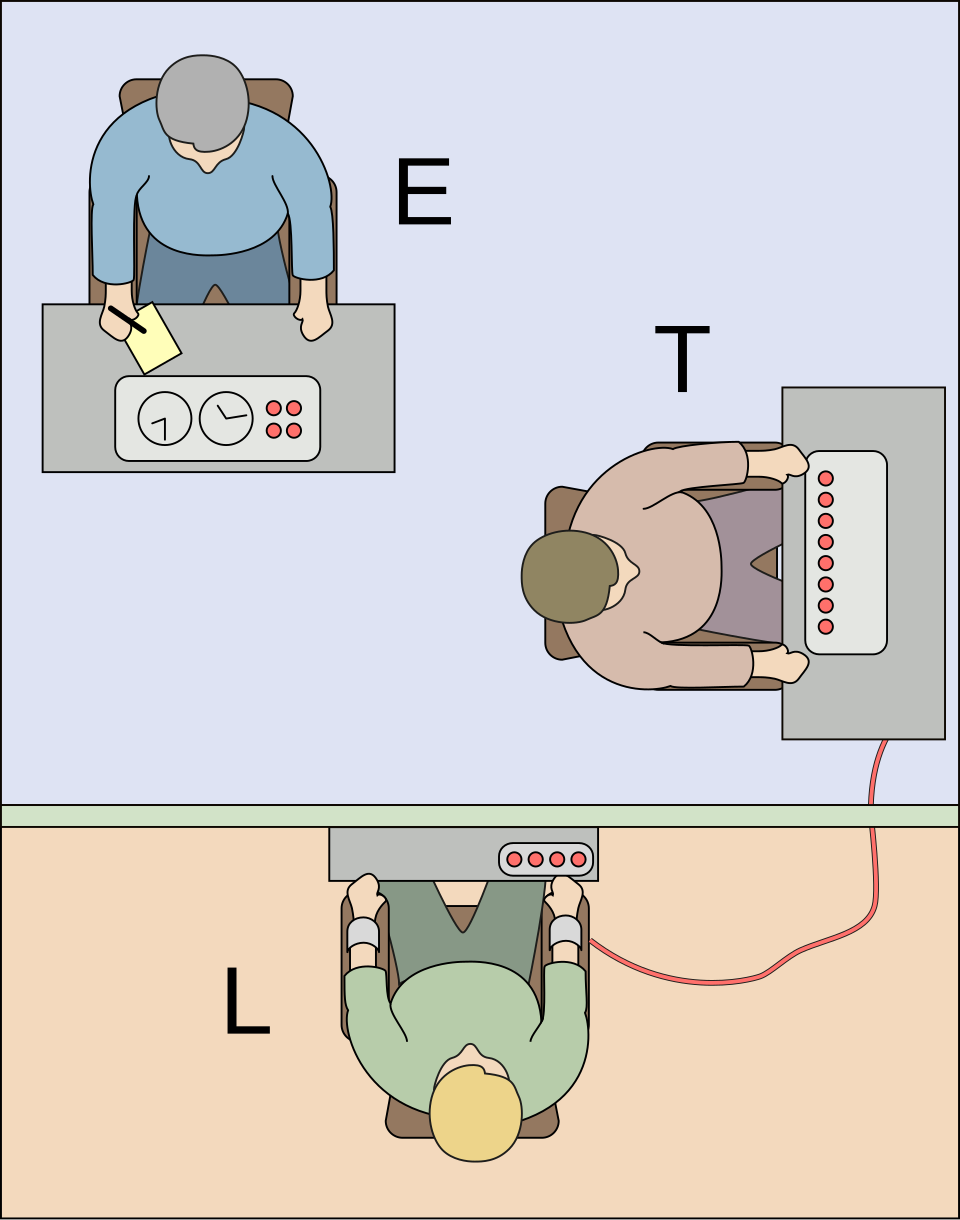
Schematic diagram of the Milgram obedience setup, labeling the Experimenter, Teacher (participant), and Learner (confederate) and showing how the task is structured around administering escalating shocks. This helps you visualize the baseline arrangement that Milgram later altered to test situational variables like proximity and the authority figure’s presence. Source
This baseline matters because Milgram then changed features of the situation to see whether obedience would stay the same. The variations showed that obedience depends strongly on the immediate environment, not just on individual character.
Proximity
What proximity means
Proximity was one of the clearest situational variables in Milgram’s research.
Proximity means how close or distant the authority figure and the victim are from the person being asked to obey.
Milgram changed the distance between the participant and the learner, and also the distance between the participant and the experimenter.
Proximity of the learner
In the baseline study, the learner was in a different room. This allowed participants to hear protests but not see the learner directly. When Milgram moved the learner into the same room, obedience dropped from 65% to 40%.
This suggests that physical closeness to the victim makes obedience harder. Seeing the learner makes the consequences of the participant’s actions more immediate. It is more difficult to ignore signs of suffering when the victim is nearby.
Milgram created an even stronger variation called the touch proximity condition. Here, the participant had to force the learner’s hand onto a shock plate. Obedience dropped further, to 30%.
This finding shows that the less distance there is between the participant and the victim, the less likely the participant is to obey destructive orders. Physical contact reduces the ability to remain detached from the harm being caused.
Proximity of the authority figure
Milgram also varied how close the experimenter was to the participant. In one variation, the experimenter left the room and gave instructions by telephone. Obedience fell to 20.5%.
When the authority figure was less physically present, participants felt less pressure to continue. Some even pretended to administer shocks or gave lower shocks than instructed. This suggests that direct surveillance and immediate commands make obedience more likely.
Overall, Milgram’s proximity variations show that obedience is highest when the authority figure is close and the victim is more distant.
Location
Milgram also investigated location, meaning the place where the obedience study happened. The original study took place at Yale University, a highly respected institution. In a variation, Milgram moved the study to a run-down office building in Bridgeport, Connecticut. Obedience dropped from 65% to 47.5%.
This change shows that setting matters. Yale may have given the study an impression of seriousness, expertise, and trustworthiness. A less impressive location reduced the pressure to obey because the situation seemed less official.
The location variation is important because it shows that people do not respond only to direct orders. They also respond to contextual cues in the environment. The setting can make authority appear stronger or weaker, even when the basic task remains the same.
Location therefore affected obedience by changing how credible and powerful the whole situation seemed. Even though the task was identical, the lower-status environment made resistance easier.
Uniform
Another situational variable Milgram investigated was uniform. In the baseline study, the experimenter wore a gray lab coat, which marked him out as an authority figure connected to science and formal research.
In a variation, the experimenter was called away and replaced by an ordinary member of the public wearing everyday clothes. Obedience dropped sharply to 20%.
This suggests that clothing can act as a powerful signal of authority. A uniform or official outfit can make instructions seem more important and harder to challenge. When that visual symbol of authority disappeared, many participants no longer felt compelled to continue.
The uniform variation shows that obedience is affected by outward signs of status, not just by the content of an order. People may obey because the person giving orders looks as though they have the right to do so.
What Milgram’s variations demonstrate
Taken together, Milgram’s variation studies show that obedience is highly sensitive to situational factors. People were most likely to obey when the authority figure was nearby, the victim was more distant, the setting seemed prestigious, and the authority figure looked official.
These findings matter because they show that obedience can change when the social situation changes. Even small differences in distance, surroundings, or appearance can alter whether people carry out orders.
Milgram’s research therefore suggests that obedience is not a fixed response. Instead, it is shaped by the immediate conditions in which an order is given and how powerful or direct that authority appears to be.
Practice Questions
Outline one situational variable that Milgram found affected obedience. (2 marks)
1 mark for correctly identifying a situational variable, such as proximity, location, or uniform.
1 mark for outlining its effect on obedience, for example that obedience fell when the authority figure was less close, the setting was less prestigious, or the authority figure lacked a uniform.
Explain how two situational variables affected obedience in Milgram’s research. (6 marks)
Up to 3 marks for one variable.
Up to 3 marks for a second variable.
Credit accurate knowledge such as:
Proximity: obedience decreased when the learner was closer, when participants had to touch the learner, or when the experimenter gave orders by telephone.
Location: obedience decreased when the study moved from Yale University to a run-down office building.
Uniform: obedience decreased when the experimenter was replaced by someone in ordinary clothes.
Level of detail:
1 mark for basic identification of effect.
2 marks for some explanation linked to Milgram’s variation.
3 marks for clear explanation with accurate detail, such as the direction of change in obedience and how the situational change influenced behavior.
FAQ
Milgram wanted to see whether obedience would change when the immediate situation changed.
By altering one feature at a time, such as distance or clothing, he could compare each variation with the baseline study more clearly. This helped show that obedience was strongly influenced by situational conditions rather than staying constant across settings.
The telephone variation is useful because it separates the authority figure’s instruction from their physical presence.
This matters because face-to-face orders carry extra pressure. When orders come from a distance, people may feel less watched, less controlled, and more able to drift away from the exact demands of the situation.
No. The finding suggests that prestige can increase obedience, but it does not mean it always will.
Other features still matter, including who gives the order, how clear the situation is, and whether the participant feels able to resist. The location effect shows that setting is one influence, not the only influence.
Uniforms can act as quick social signals.
People often learn to associate certain clothes with expertise, rank, or official roles. Because of that, a lab coat may create an immediate impression that the person is qualified and should be listened to, even before they speak much.
They show that obedience can be shaped by ordinary social cues.
Examples include:
how close a supervisor is
whether an organization seems respectable
whether a person looks official
This helps explain why people may respond differently to the same order depending on the setting and the appearance of the person giving it.