
AQA Syllabus focus:
'Explanations of resistance to social influence, including the role of social support.'
People do not always give in to social pressure. A major reason is social support, where the presence of others who resist pressure makes independent behavior seem possible, acceptable, and less risky.
Social support: The actual or perceived presence of other people who support resistance, making it easier for someone to avoid conformity or obedience.
Why social support matters
Social influence is often strongest when a person feels alone. If an individual believes that everyone else agrees with the majority or with the authority figure, resistance becomes difficult. Social support changes that situation by showing that total agreement does not exist.
This makes social support a situational explanation for resistance. It does not suggest that some people are naturally strong while others are naturally weak. Instead, it argues that the social environment can make independent action easier or harder.
A supportive other person may:
openly disagree
refuse to follow instructions
question what is happening
show doubt rather than complete agreement
Even small signs of doubt can reduce the pressure to go along.
Forms of social support
Social support can be direct or indirect. Direct support involves open disagreement, such as an ally giving a different answer or a peer refusing an order. Indirect support may be more subtle, for example visible hesitation, discomfort, or a refusal to fully endorse the majority.
What matters most is not simply the number of supporters. The key issue is whether the individual feels that resistance has some social backing. Even one supporter can have a strong effect because it changes the person from an isolated dissenter into part of a small opposition.
Social support in conformity
In conformity situations, support usually comes from an ally or dissenting peer.
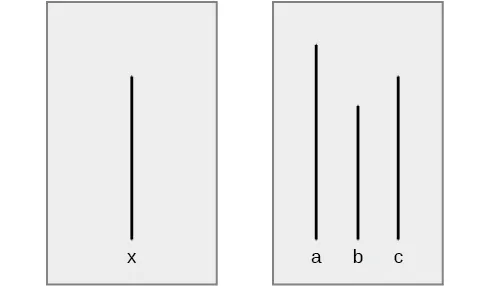
Line-judgment display used in Asch’s conformity paradigm: participants match a standard line (x) to one of three comparison lines (a, b, c). This kind of unambiguous perceptual task is ideal for demonstrating how a dissenting peer can reduce conformity by breaking unanimity. Source
This is someone who gives a different response from the majority. The ally does not have to give the correct answer. What matters most is that they break the appearance of unanimity.
When unanimity is broken, the majority loses some of its power. The individual is less likely to think, “I must be wrong because everyone else agrees.” Instead, they can see that another response is possible. This can increase confidence in personal judgment and reduce the fear of standing out.
Research evidence supports this explanation. In classic line-judgment research, conformity fell sharply when one other person disagreed with the majority. The conformity rate dropped from about 32% to around 5.5%. This shows how powerful a single dissenter can be.
Social support reduces conformity for several reasons:
it weakens the group’s united front
it lowers the risk of social rejection
it gives the person someone to identify with
it makes independent responding seem more normal
Support is especially important when the person is unsure whether to trust their own view. An ally reassures them that disagreement is not irrational or unacceptable.
Limits in conformity situations
The effect of support can fade if the ally changes sides or leaves the situation. If the person becomes isolated again, conformity may increase. This suggests that the protective effect depends on support remaining visible and credible.
Social support in obedience
In obedience situations, support often takes the form of a disobedient model. This is another person who refuses to obey the authority figure. Seeing someone else resist can make it much easier to refuse as well.
A disobedient model changes the meaning of the situation. The authority figure no longer seems all-powerful or unquestionable. The individual can see that refusal is possible, and this reduces the pressure to continue.
Evidence from obedience research shows the same pattern as conformity research.
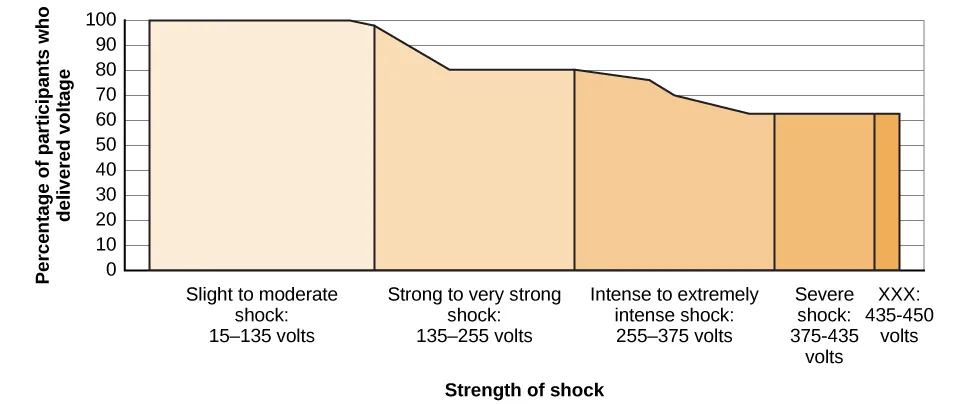
Milgram-style obedience curve showing the percentage of participants who continue administering shocks as voltage increases. The plot highlights how many participants persist to very high levels under authority pressure, providing a visual baseline for why a disobedient model (social support) can produce such a dramatic drop in obedience. Source
When participants were joined by others who refused to carry on, obedience dropped dramatically. In one variation, obedience fell from 65% to 10% when two other participants refused.
This suggests that resistance is far more likely when people are not facing authority alone.
Social support can reduce obedience because it:
gives practical and emotional backing for refusal
shows that disobedience is socially acceptable
makes the authority’s demands seem less legitimate
reduces the individual’s sense of isolation
The presence of resistant others can also strengthen moral confidence. If someone else is prepared to challenge the authority figure, the person may feel more justified in acting on their own doubts.
Why social support works
Social support is effective because social pressure depends heavily on the belief that “everyone else accepts this.” Once that belief is challenged, the person has more freedom to act independently.
Three linked processes are especially important:
confidence: support increases belief in one’s own judgment
reduced fear: support lowers anxiety about rejection or punishment
modeling: support provides an example of how to resist
This means resistance is not just an individual achievement. It is often socially shaped.
When social support may be less effective
Social support does not guarantee resistance in every case. Its impact depends on the quality and strength of the support.
It may be less effective when:
the supporter seems unsure or inconsistent
the supporter has low status and is easy to dismiss
the pressure to obey or conform is very intense
the consequences of resistance seem severe
Private doubt is usually weaker than clear, public opposition. Visible support tends to have the strongest effect because it directly changes the social situation for everyone present.
Implications for understanding resistance
This explanation shows that people often resist because they have social backing, not because they are completely fearless. It helps psychologists explain why the same person may conform in one setting but resist in another.
The key idea is that resistance becomes more likely when another person shows that agreement with the group or authority is not the only option. Social support therefore helps turn private doubt into public resistance.
Practice Questions
Outline what is meant by social support as resistance to social influence. (2 marks)
1 mark for identifying social support as the presence of another person or people who do not go along with social pressure.
1 mark for linking this to resistance, such as making conformity or obedience less likely.
Explain how social support can help a person resist social influence. Refer to conformity and/or obedience in your answer. (6 marks)
Award 1 mark for each relevant point up to 6 marks. Possible content includes:
social support involves the presence of an ally, dissenting peer, or disobedient model
it breaks the feeling that the majority or authority is completely united
it reduces the person’s sense of isolation
it increases confidence in the person’s own judgment
it makes resistance seem more socially acceptable or realistic
in conformity, an ally can reduce pressure to agree with the group
in obedience, a disobedient model can reduce pressure to follow orders
supporting evidence from research can gain credit if clearly linked to explanation
FAQ
Not always. A person may resist more effectively if they believe friends, coworkers, or group members would support them, even if those people are not in the room.
However, visible support is usually stronger. An ally who is clearly present changes the public social situation, whereas imagined or distant support mainly changes private confidence.
The main effect comes from breaking complete agreement, not from proving the correct answer. Once unanimity disappears, the individual no longer feels like the only dissenter.
That said, the ally still needs to seem genuine. If the person looks confused, unserious, or random, their support may carry less weight.
Usually yes. The first supporter has the biggest impact because they remove the feeling of being completely alone.
Extra supporters can still help, but the increase is often smaller. Psychologically, the biggest shift happens when the person moves from “only me” to “not only me.”
Support tends to work better when the other person appears calm, consistent, and sincere rather than dramatic or rebellious for show.
It can also matter whether the supporter seems similar to the individual, knowledgeable about the situation, or willing to accept costs for resisting. These features make the support harder to dismiss.
Schools, workplaces, and groups can make resistance easier by creating structures that show disagreement is allowed.
Examples include:
buddy systems
clear reporting routes
leaders openly inviting challenge
group rules that protect respectful dissent
These steps matter because people are more likely to speak up when they know they will not be isolated.