AQA Syllabus focus:
'Explanations of resistance to social influence, including the role of locus of control.'
Locus of control helps explain why some people stay independent under pressure.
It focuses on whether individuals believe outcomes depend mainly on their own actions or on outside forces beyond their control.
Locus of control and resistance to social influence
Resistance to social influence means showing independence when faced with pressure from other people. A key explanation is locus of control, a concept developed by Rotter.
Locus of control: A personality variable describing whether a person believes outcomes are mainly controlled by their own actions or by external forces.
People differ in where they place control over their lives. This difference affects how likely they are to give in to pressure from a group or an authority figure. In simple terms, those who feel personally in control are usually more able to act independently.
Internal locus of control
Internal locus of control: The belief that what happens in life is largely the result of one’s own decisions, effort, and behavior.
People with an internal locus of control tend to see themselves as responsible for what happens to them. They are more likely to believe that success and failure depend on their own choices rather than luck or fate.
This makes them more likely to resist social influence because they:
feel personally responsible for their actions
rely more on their own judgment
are often more self-confident
are less likely to depend on others for approval or direction
As a result, an internal person is more likely to question pressure from others instead of simply going along with it.
External locus of control
People can also see control as coming from outside themselves.
External locus of control: The belief that what happens in life is mainly caused by luck, fate, chance, or other people.
People with an external locus of control are more likely to think that events are controlled by forces outside their own influence. They may see their behavior as shaped by circumstances, powerful people, or chance.
This can make resistance harder because they:
feel less able to change what is happening
may believe responsibility lies with others rather than themselves
are more likely to accept pressure as something they cannot avoid
An external person may therefore be more likely to conform or obey because they see the source of control as outside the self.
Why locus of control affects resistance
Locus of control affects resistance because social pressure often involves a choice between personal independence and following others. People with an internal locus of control are more likely to believe their own decisions matter, so they are more willing to act on them.
There are several reasons for this link:
Personal responsibility: Internals are more likely to see themselves as accountable for consequences.
Independence: Internals often trust their own beliefs even when others disagree.
Confidence in action: If people believe they can influence outcomes, they are more likely to challenge pressure.
Reduced passivity: Externals may feel that resisting will make little difference, so compliance becomes more likely.
This does not mean that all internals resist and all externals give in. Locus of control increases or decreases the likelihood of resistance rather than determining behavior completely.
Resistance in different social situations
Locus of control can help explain resistance in both group pressure and direct authority pressure.
When facing group pressure, people with an internal locus of control are more likely to stick to their own view if they believe the group is wrong. Their decisions are guided more by personal standards than by the desire to fit in.
When facing direct orders, internals are more likely to think about the consequences of their actions and the fact that they themselves are carrying them out. Because they feel responsible, they are more willing to refuse pressure that conflicts with their beliefs.
Externals, in contrast, may be more likely to view the situation as controlled by the group, the authority figure, or the circumstances. This can reduce the sense that resistance is possible or useful.
Research support and evaluation
Research provides some support for locus of control as an explanation of resistance. Holland repeated part of Milgram’s procedure and measured participants’ locus of control.
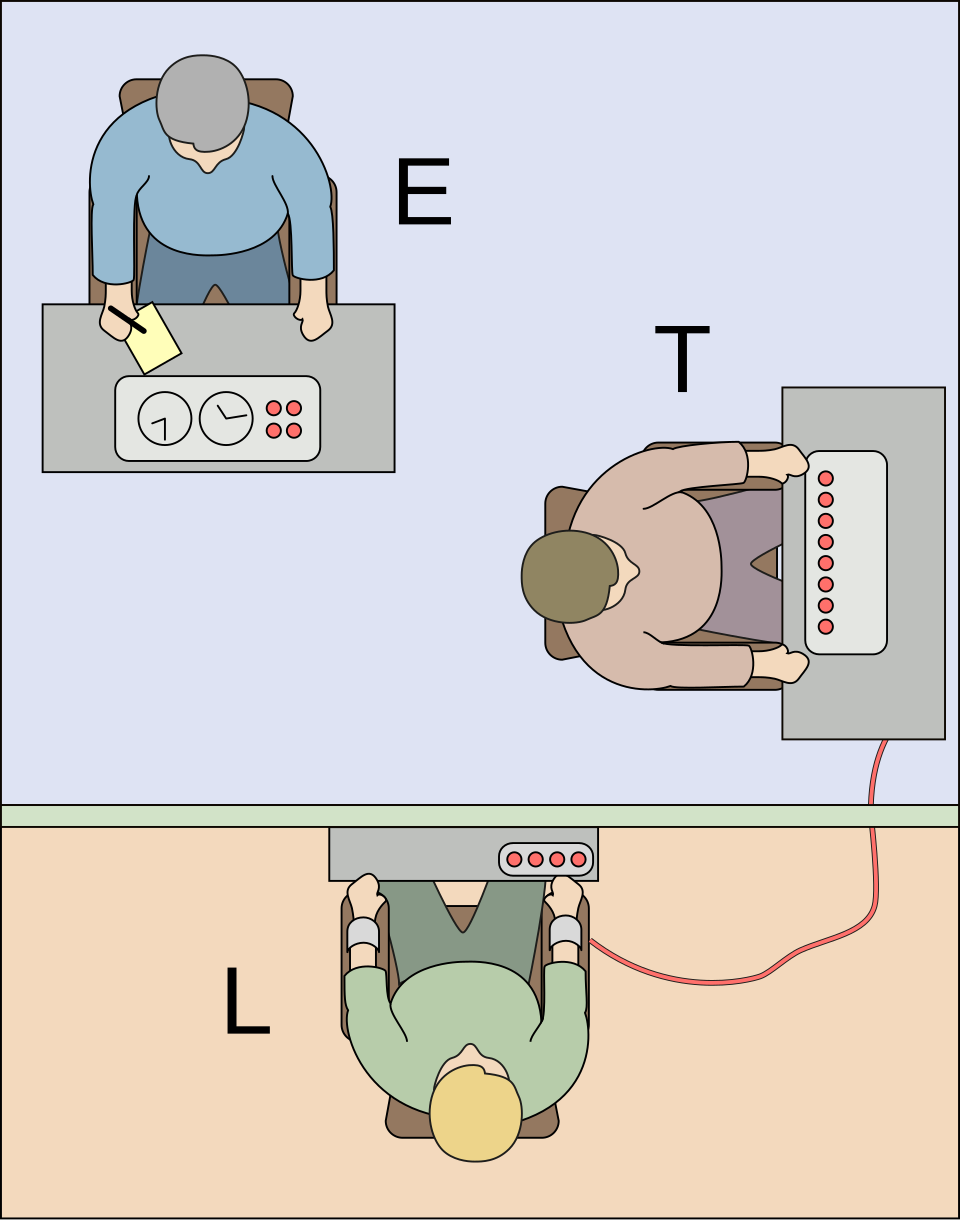
A labeled schematic of the Milgram obedience set-up, identifying the Experimenter (authority figure), the Teacher (participant), and the Learner (confederate/actor). It clarifies how “direct authority pressure” is built into the situation, which is useful when interpreting why internals versus externals might differ in resistance. Source
He found that people with an internal locus of control were more likely to resist the pressure to obey than people with an external locus of control. This supports the idea that internals are more independent.
However, the evidence is not completely consistent. Some research suggests that locus of control is a better explanation for resistance in some situations than in others. This means the relationship may be more complex than the theory first suggests.
A further limitation is that locus of control may be too simple if it is treated as a fixed type. In real life, people may feel in control in one area of life but not in another. For example, someone may feel confident making academic decisions but less confident challenging authority in a formal setting. This means resistance cannot always be predicted from a single personality label.
Another important point is that situational factors still matter. Even someone with a strong internal locus of control can find it difficult to resist powerful social pressure. This suggests that personality is only one part of the explanation.
Even so, locus of control remains useful because it explains why people in the same situation do not all behave in the same way. It highlights the role of individual differences in resistance to social influence.
Practice Questions
Outline what is meant by locus of control as an explanation of resistance to social influence. (2 marks)
1 mark for identifying that locus of control refers to whether people see outcomes as controlled by themselves or by external forces.
1 mark for linking this to resistance, for example that people with an internal locus of control are more likely to resist social influence.
Discuss locus of control as an explanation of resistance to social influence. (6 marks)
AO1 marks for accurate knowledge of locus of control:
Internal locus of control = outcomes seen as mainly due to one’s own actions.
External locus of control = outcomes seen as due to luck, fate, or other people.
Internals are more likely to resist social pressure because they feel personally responsible and more independent.
AO3 marks for evaluation:
Research support such as Holland’s findings that internals were more likely to resist obedience.
The relationship is not always consistent across all situations.
Locus of control may be too simplistic because behavior can vary by context.
Situational factors may still strongly affect resistance.
Credit other relevant discussion of strengths or limitations.
FAQ
Researchers often use self-report questionnaires, especially versions of Rotter’s locus of control scale.
Participants usually choose between paired statements, with one option reflecting a more internal view and the other a more external view.
This allows psychologists to:
compare people on a continuum
look for links between personality and resistance
test whether internals and externals behave differently under pressure
A weakness is that answers may be affected by social desirability, since people may prefer to seem independent.
Yes. Many psychologists see locus of control as a continuum, not two completely separate categories.
A person may feel:
highly internal about school or work
more external in family relationships
more external during stressful or unfamiliar situations
This is one reason why locus of control does not predict resistance perfectly.
It is often more realistic to think of it as a tendency rather than a permanent label.
It can be fairly stable, but it is not completely fixed.
Life experiences can shift it over time. For example:
repeated success may increase internality
repeated failure or lack of choice may increase externality
growing maturity may help people feel more personal control
This matters because resistance to social influence may also change as people’s beliefs about control change.
Culture may shape how people think about control and responsibility.
In more individualist cultures, personal choice and independence are often emphasized, so internal explanations may be more common.
In more collectivist cultures, people may place greater value on social roles, shared responsibility, or respect for authority.
This does not mean one culture is “better” at resisting social influence. It means the meaning of control may differ across cultural settings.
It may be possible to strengthen internal beliefs through experience and training.
Helpful influences can include:
giving people real choices
rewarding effort clearly
building problem-solving skills
encouraging reflection on personal decisions
If someone repeatedly sees that their actions produce outcomes, they may begin to feel more in control.
This could increase confidence and independence, which may make resistance to social pressure more likely in the future.