AQA Syllabus focus:
'The multi-store model of memory, including the sensory register, short-term memory and long-term memory.'
The multi-store model explains memory as a sequence of linked stores. Understanding how information enters, is held, and is retrieved helps clarify the roles of the sensory register, short-term memory, and long-term memory.
The multi-store model of memory
Atkinson and Shiffrin’s multi-store model of memory describes memory as a sequence of separate stores. Information passes from one store to the next in a fixed order, rather than being handled by one single system. The model also emphasizes control processes, which are mental activities that determine whether information is selected, maintained, and transferred.
Control processes are mental operations, such as attention and rehearsal, that influence how information moves through the memory stores.
In this model, material from the environment first enters the sensory register.
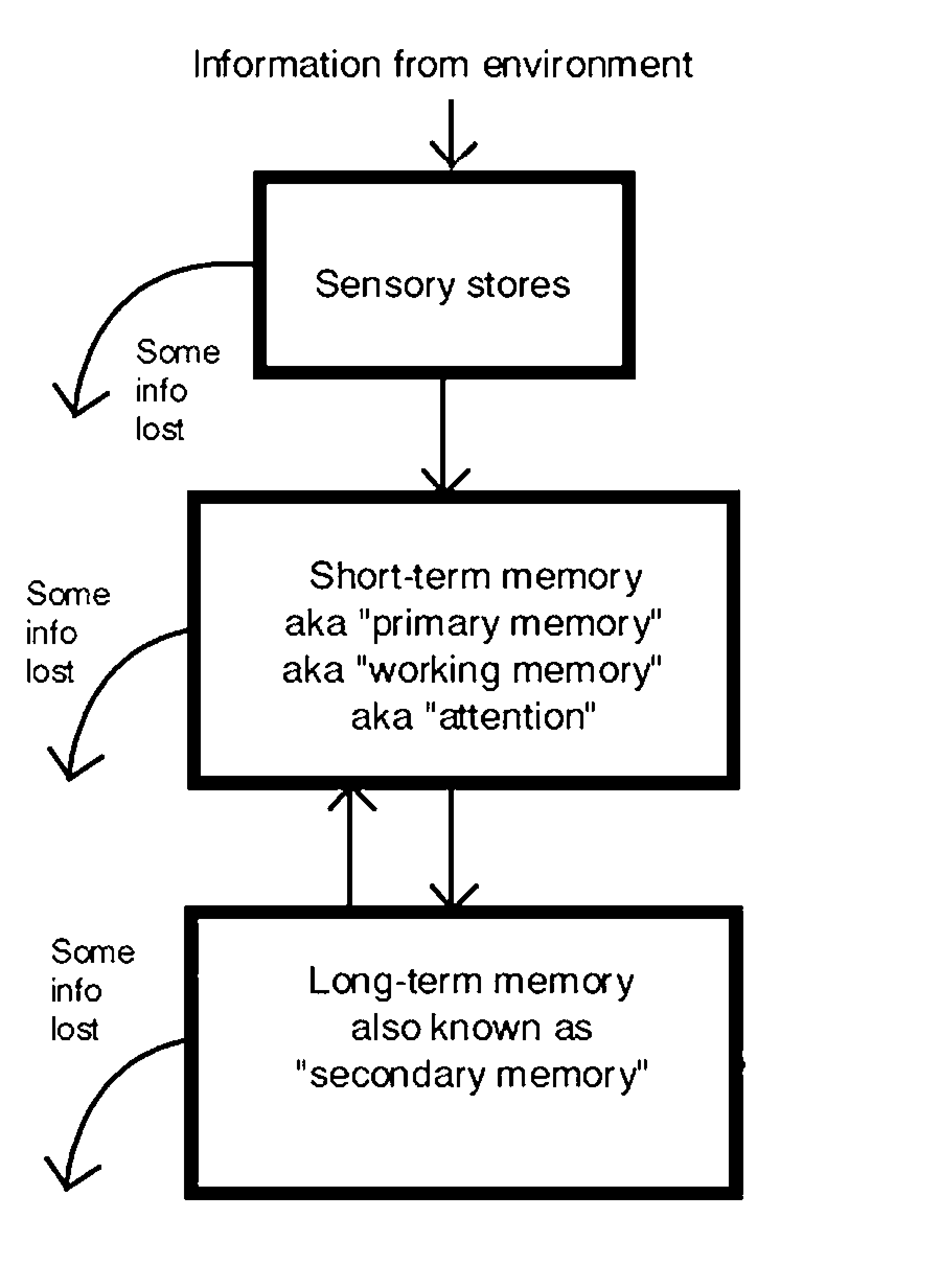
Classic “three-box” diagram of the Atkinson–Shiffrin multi-store model, showing information flowing from the sensory register into short-term memory and then into long-term memory. This visual helps you see the model’s core claim that memory is composed of separate stores rather than one single system. Source
If it is attended to, it passes into short-term memory (STM). Through rehearsal, some information is transferred into long-term memory (LTM). When stored information is needed again, it is brought back into STM.
Sensory register
The sensory register is the first store in the model. It receives information directly from the senses, so it briefly holds a near-exact impression of what has just been seen, heard, touched, or otherwise detected. Because the environment produces a huge amount of input at once, the sensory register is the point where all of that raw information first arrives.
The model assumes that the sensory register includes different registers for different kinds of sensory input. Visual input and auditory input, for example, are not treated as one undifferentiated stream. This helps explain why a person may briefly keep hold of the last thing they heard or the last thing they saw, even before they have consciously thought about it.
Most information in the sensory register is not processed further. Attention is the key factor that determines what happens next. If attention is directed toward a particular piece of input, that material moves into STM. If not, it rapidly fades and is lost from the system.
Short-term memory
Short-term memory is the store for information that is currently in conscious awareness. It is the place where material can be actively held for immediate use, such as when following spoken directions, holding part of a sentence in mind, or remembering a number long enough to use it.
STM is important because it acts as the bridge between incoming sensory information and more lasting storage. In the multi-store model, information usually has to enter STM before it can become a long-term memory. This means that STM is not simply a stopping point. It is the stage at which information can either be lost or prepared for more permanent storage.
A major control process in the model is rehearsal.
Rehearsal is the conscious repetition of information in order to keep it active in short-term memory and support its transfer to long-term memory.
The model mainly focuses on maintenance rehearsal, which means repeating information again and again. Rehearsal keeps the material active in STM, making it less likely to disappear immediately. In the model’s original form, the more often information is rehearsed, the greater the chance that it will pass into LTM.
Long-term memory
Long-term memory is the more enduring store in the model. It contains information that is no longer in immediate awareness but has been retained so that it can be used in the future. This may include knowledge, personal experiences, and learned skills.
LTM is different from STM because information stored there is not constantly in consciousness. Much of what is in long-term memory is inactive most of the time. However, it can still influence behavior when it is brought back into awareness. The model therefore treats LTM as a store that preserves information beyond the immediate present.
Using information from long-term memory depends on retrieval.
Retrieval is the process of bringing stored information from long-term memory back into short-term memory so that it can be consciously used.
When a person answers a question, recalls a fact, or recognizes a familiar event, the model proposes that information has been retrieved from LTM into STM. In other words, information is not useful just because it exists in storage; it has to be brought back into conscious awareness to guide current thinking or behavior.
Flow of information through the stores
The movement of information in the model can be described as a sequence:
Environmental input enters the sensory register.
Attention selects some of that information for further processing.
The selected material passes into STM.
Rehearsal keeps the information active in STM and supports transfer to LTM.
Retrieval brings stored information from LTM back into STM when needed.
Because of this sequence, the model is often described as linear or sequential.
Each store has a distinct role. The sensory register receives raw input, STM holds information in current awareness, and LTM stores information beyond the immediate present.
Why the stores are treated as separate
The model makes a clear distinction between three kinds of memory activity. Sensory information arrives first, conscious processing occurs in STM, and stored knowledge is held in LTM. This means remembering depends on movement between stores, not just on storage in one place.
By separating the stores, the model explains why some information disappears almost immediately, why some can be kept active for a short period, and why some can be retained for later use. This structured description of memory is the core idea students need to know for this topic.
Practice Questions
Name the three memory stores in the multi-store model of memory. (3 marks)
1 mark for sensory register
1 mark for short-term memory or STM
1 mark for long-term memory or LTM
Explain how information moves through the multi-store model of memory. (6 marks)
1 mark for stating that information first enters the sensory register
1 mark for explaining that attention transfers selected information to STM
1 mark for explaining that STM is the current conscious store
1 mark for explaining that rehearsal keeps information active in STM
1 mark for explaining that rehearsal supports transfer to LTM
1 mark for explaining that retrieval brings information from LTM back into STM
FAQ
The term sensory register is often used broadly, but psychologists usually mean several very brief stores linked to different senses.
Iconic memory relates to visual input
Echoic memory relates to auditory input
Haptic memory relates to touch
This helps explain why sights and sounds can linger briefly in different ways.
The original model gives rehearsal a central role, but real-life memory is often less rigid than that.
Information may reach long-term memory more easily when it is:
meaningful
emotionally important
strongly connected to existing knowledge
So rehearsal is important in the model, but it is not always the only route to lasting memory.
Distraction should make learning harder because attention is the gateway from the sensory register to STM.
If competing sights, sounds, or thoughts capture attention, the target information may never enter STM clearly enough to be rehearsed. In that case, failure happens early in the memory system rather than later in long-term storage.
Yes. Neuropsychological cases suggest that different memory stores can be disrupted in different ways.
For example, a person may show fairly normal short-term retention but severe difficulty forming new long-term memories, or show the reverse pattern. Findings like these helped support the idea that memory is not one single, uniform store.
This experience suggests that stored information may be partly available but not fully retrieved into conscious awareness.
A person may remember related details, the first letter, or the general sound of a word without producing the whole answer. Within the logic of the model, that fits the idea that storage and retrieval are not exactly the same process.