
AQA Syllabus focus:
'Features of each store in the multi-store model: coding, capacity and duration.'
Understanding the multi-store model depends on comparing the three memory stores.
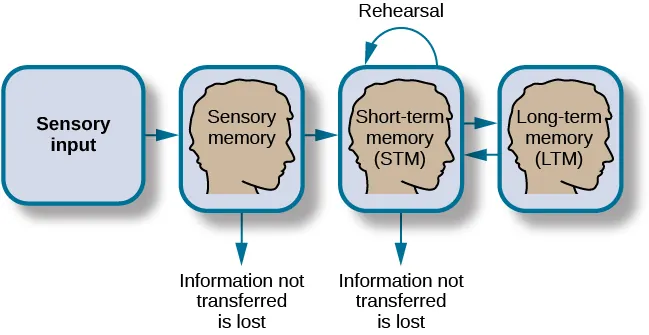
Flow diagram of the Atkinson–Shiffrin multi-store model, showing how sensory input enters sensory memory, can be transferred into STM via attention, and then into LTM, with retrieval back to STM. It also highlights maintenance rehearsal and the idea that information not transferred out of sensory memory or STM is lost. Source
Psychologists study coding, capacity, and duration to show how the sensory register, STM, and LTM differ in important ways.
Coding
The first feature is coding.
Coding is the format in which information is stored in memory, such as visual, acoustic, or semantic form.
In the sensory register, coding is usually modality specific, meaning it depends on the sense that received the information. Visual input is briefly stored as an iconic trace, while auditory input is stored as an echoic trace.
Research on STM suggests that it mainly codes information acoustically. A classic study by Baddeley gave participants lists of words that were either acoustically similar, acoustically dissimilar, semantically similar, or semantically dissimilar. Recall from STM was worse for acoustically similar words, showing that similar sounds are easily confused when information is held briefly.
By contrast, LTM mainly codes information semantically, by meaning. In Baddeley’s study, recall from LTM was poorest for semantically similar words. This indicates that when information is stored for longer periods, meaning becomes especially important.
The overall pattern is:
Sensory register: coding depends on the sense involved
STM: mainly acoustic
LTM: mainly semantic
These are dominant patterns rather than absolute rules. STM can also use visual coding in some tasks, and LTM can sometimes store sounds or images. Even so, the differences support the idea of separate memory stores.
Capacity
The second feature is capacity.
Capacity is the amount of information that can be held in a memory store at one time.
The sensory register has a very large capacity because it briefly takes in a great deal of sensory information. Evidence comes from Sperling’s work on iconic memory. Participants shown a grid of letters could report only a few letters in a whole-report task, but a partial-report procedure showed that more information had been available than could be written down before it faded. This suggests that the visual sensory store can hold a large amount for a very short time.
The capacity of STM is much more limited. Jacobs tested digit span by reading sequences of numbers or letters and asking participants to repeat them in the correct order. He found an average span of about 9.3 digits and 7.3 letters, suggesting that STM can hold a small number of separate items.
A related idea comes from Miller, who argued that the capacity of STM is around seven items, plus or minus two. This is often summarized as 5 to 9 items. Modern research suggests the exact number may be lower in some situations, but for AQA the key point is that STM has a limited capacity.
LTM appears to have a potentially unlimited capacity. Psychologists do not give a fixed number because there is no clear upper limit. People can store large amounts of knowledge, personal experiences, and skills over many years, which contrasts strongly with the small capacity of STM.
Duration
The third feature is duration.
Duration is the length of time information can remain in a memory store before it is lost.
The sensory register has an extremely brief duration. The exact length depends on the type of sensory memory:
Iconic memory lasts for about 0.5 seconds
Echoic memory lasts for around 2 to 3 seconds
The duration of STM is also short, but longer than the sensory register. Peterson and Peterson investigated this by giving participants consonant trigrams such as BKT and preventing rehearsal by asking them to count backward in threes. Recall accuracy dropped rapidly as the delay increased. After about 18 to 30 seconds, very little information remained. This suggests that unrehearsed STM has a brief duration.
The duration of LTM is very long and may last a lifetime. Bahrick and colleagues tested participants on memory for former classmates using high school yearbooks. Even after several decades, participants could still recognize many faces and names with high accuracy. This provides strong evidence that LTM can endure for many years.
Why these findings matter
Differences in coding, capacity, and duration support the claim that memory consists of separate stores rather than one unitary system. Each store shows a distinctive pattern:
the sensory register holds a lot of information for a split second in a sense-based form
STM holds a small amount for a short period and usually relies on sound
LTM stores meaning for very long periods with a much larger capacity
These figures should be treated as typical estimates rather than exact rules. Performance can change depending on the material used, whether the information is meaningful, and how memory is tested. Even so, the overall pattern is one of the clearest ways to distinguish the stores in the multi-store model.
Practice Questions
Identify the most likely code used in STM, the most likely code used in LTM, and the typical capacity of STM. (3 marks)
1 mark for acoustic as the main code in STM.
1 mark for semantic as the main code in LTM.
1 mark for 5 to 9 items or about 7 items, plus or minus 2 as the typical capacity of STM.
Outline what research has shown about the duration of the sensory register, STM, and LTM in the multi-store model of memory. (6 marks)
Award 1 mark for each accurate point, up to 6 marks.
Duration refers to how long information remains in a memory store.
The sensory register has a very brief duration.
Iconic memory lasts about 0.5 seconds or echoic memory lasts about 2 to 3 seconds.
STM lasts about 18 to 30 seconds without rehearsal.
Peterson and Peterson showed rapid loss of consonant trigrams when rehearsal was prevented.
LTM can last many years or possibly a lifetime.
Bahrick found recognition of classmates and names even after several decades.
FAQ
STM often relies on a sound-based trace, so items that sound alike are harder to keep distinct. This is especially true when people must recall items in the correct order.
The effect is strongest in verbal tasks such as immediate serial recall. If a task emphasizes meaning or visual form instead, the acoustic effect may be smaller.
Digits come from a small, highly familiar set and are often rehearsed quickly. This makes them easier to hold accurately in STM.
Letters can sound alike, such as B, C, D, G, P, T, and V. That similarity increases confusion, so letter span is often slightly lower than digit span.
A chunk is a meaningful unit made by grouping separate pieces of information together. For example, several characters can be remembered as one familiar pattern.
Chunking does not necessarily increase the basic storage limit of STM. Instead, it lets each stored unit contain more information, which can make span appear larger.
In science, it is difficult to prove that a capacity has no upper limit at all. Researchers can show that LTM stores enormous amounts, but they cannot test every possible limit.
People also sometimes fail to recall information because of poor retrieval, not because storage is full. For that reason, psychologists usually use cautious wording and say potentially unlimited.
Sound unfolds across time. A slightly longer auditory trace helps the brain combine separate sounds into words, phrases, and meaningful sequences.
Visual scenes can often be sampled very quickly, so the visual trace fades faster. Even so, both iconic and echoic memory are brief compared with STM and LTM.